

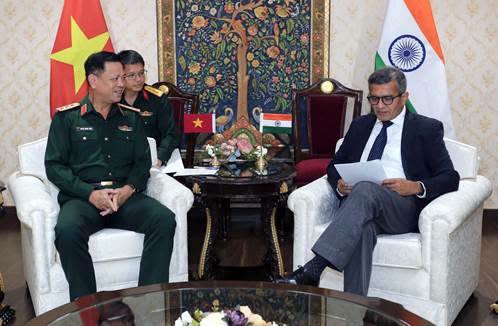
Defence Secretary Rajesh Kumar Singh and Vietnam’s Deputy Minister of National Defence Senior Lieutenant General Nguyen Truong Thang have discussed joint initiatives, technology sharing, defence industrial cooperation and ASEAN-led security mechanisms, building on the strategic direction set by the two countries’ Prime Ministers
Make us preferred source on Google
Key Takeaways
- Defence Secretary Rajesh Kumar Singh met Vietnam’s Deputy Minister of National Defence Senior Lieutenant General Nguyen Truong Thang in New Delhi on September 13, 2026.
- The meeting followed the recent meeting between the Prime Ministers of India and Vietnam on the sidelines of the BRICS Summit.
- Discussions focused on joint initiatives, technology sharing and defence industrial collaboration.
- Both countries reaffirmed their commitment to stronger maritime and defence ties.
- India and Vietnam emphasised the importance of a peaceful, stable and rule-based regional security architecture.
- Both sides highlighted ADMM-Plus and its Experts’ Working Groups as important mechanisms for regional security cooperation.
- The next Defence Policy Dialogue will be hosted by India on the sidelines of Aero India 2027.
- The engagement builds on a broader maritime relationship that includes maritime security dialogue, Maritime Domain Awareness, hydrography, naval cooperation, search and rescue and maritime scientific cooperation. (Press Information Bureau)
New Delhi, India September 14, 2026 (Maritime News): India-Vietnam Defence Engagement Follows BRICS-Level Political Direction Following the recent high-level bilateral meeting between the Prime Ministers of India and Vietnam on the sidelines of the BRICS Summit, Defence Secretary Shri Rajesh Kumar Singh met Vietnam’s Deputy Minister of National Defence Senior Lieutenant General Nguyen Truong Thang in New Delhi on September 13.
The meeting focused on strengthening the bonds of friendship between the two countries, advancing regional security and deepening the bilateral Enhanced Comprehensive Strategic Partnership, according to the Press Information Bureau.
The Defence Secretary-level engagement therefore comes as a follow-up to the political direction being provided at the leadership level.
Also Read: Hormuz Crisis Reshapes Gulf Shipping: What It Means for Indian Trade, Freight and Seafarers
Maritime and Defence Cooperation at the Centre
The two sides discussed accelerating joint initiatives, technology sharing and defence industrial collaboration.
They also reaffirmed their shared commitment to expanding maritime and defence ties to support a peaceful, stable and rule-based regional security architecture.
This latest commitment builds on the broader India-Vietnam strategic framework established earlier in 2026.
During Vietnamese President To Lam’s State Visit to India in May, the two countries elevated their relationship to an Enhanced Comprehensive Strategic Partnership. Their Joint Statement identified the maritime domain as one of the key pillars of bilateral cooperation. (Press Information Bureau)
The May Joint Statement also called for enhanced cooperation in maritime security, maritime safety and search and rescue, alongside hydrography, naval port calls, information sharing, capacity building and defence industrial cooperation. (Press Information Bureau)
Maritime Domain Identified as a Key Pillar
The May 2026 India-Vietnam Joint Statement provides important context for the September defence meeting.
India and Vietnam recognised themselves as maritime countries with a long history of exchanges and specifically identified the maritime domain as a key pillar of cooperation.
The two countries called for enhanced maritime cooperation and agreed on the importance of regularly convening their bilateral Maritime Security Dialogue.
Vietnam also thanked India for inviting it to assign an International Liaison Officer at the Information Fusion Centre–Indian Ocean Region (IFC-IOR) at Gurugram, with the objective of strengthening cooperation in Maritime Domain Awareness. (Press Information Bureau)
India also welcomed Vietnam’s joining of the Indo-Pacific Oceans Initiative (IPOI), with both sides looking to develop greater cooperation under the framework. (Press Information Bureau)
Cooperation Extends Beyond Defence
The maritime relationship is not confined to naval security.
The two countries agreed to enhance cooperation in oceanography, including ocean-observing platforms, data management, ocean prediction and services, capacity building and maritime scientific research. (Press Information Bureau)
This gives the bilateral maritime relationship a wider scope covering security, scientific research, maritime domain awareness and capacity building.
For MaritimeNews, this distinction is important: the September 13 meeting is principally a defence and regional-security engagement, but it sits within a much broader maritime relationship already established between the two countries.
Hydrography and Naval Cooperation Provide an Existing Foundation
India and Vietnam have already developed practical maritime cooperation.
Their May 2026 Joint Statement welcomed the inaugural joint hydrographic survey conducted by the two navies in May 2025 off the coast of Vietnam and agreed to conduct similar exercises regularly in the future. (Press Information Bureau)
The two countries have also identified enhanced naval port calls, information sharing, hydrography, maritime security, maritime safety and search-and-rescue cooperation as areas for continued engagement. (Press Information Bureau)
This means the September meeting is building on an existing institutional and operational foundation rather than creating the maritime relationship from scratch.
ASEAN Defence Ministers’ Meeting Plus Gains Importance
India and Vietnam also emphasised close coordination in multilateral forums to address complex regional security dynamics.
Particular importance was given to the ASEAN Defence Ministers’ Meeting Plus (ADMM-Plus) mechanism.
Both sides reaffirmed their commitment to enhancing practical defence cooperation through ASEAN-led mechanisms and highlighted the role of ADMM-Plus Experts’ Working Groups in maintaining regional stability and building collective security architectures in the Indo-Pacific.
The broader May Joint Statement had also recorded that India and Vietnam would co-chair the ADMM-Plus Experts’ Working Group on Cyber Security for the 2027–2030 cycle. (Press Information Bureau)
Next Defence Policy Dialogue to Be Hosted by India
A specific follow-up from the latest meeting is the scheduled Defence Policy Dialogue, which will be hosted by India on the sidelines of Aero India 2027.
This provides a defined institutional milestone for the next stage of India-Vietnam defence cooperation.
The Defence Policy Dialogue will also provide an opportunity to examine whether the areas discussed at the political and defence-secretary levels are translating into specific initiatives and measurable cooperation.
The relationship already has an established Defence Policy Dialogue mechanism. The 15th India-Vietnam Defence Policy Dialogue was held in Hanoi in November 2025, providing an earlier platform for reviewing bilateral defence cooperation. (Press Information Bureau)
Also Read: India Moves to Build a Global Hub for Ship Ownership, Leasing and Maritime Finance Through GIFT City
From Political Direction to Maritime Implementation
The sequence of engagements now provides a broader picture of how the relationship is developing:
Prime Ministerial engagement → Enhanced Comprehensive Strategic Partnership → maritime and defence cooperation → Defence Secretary-level engagement → Defence Policy Dialogue → implementation.
The May 2026 Joint Statement specifically called for regular meetings in areas including defence, security and the maritime domain, while also looking forward to establishing a Strategic Diplomacy–Defence Dialogue (2+2). (Press Information Bureau)
The September meeting adds another layer to this institutional architecture.
Indo-Pacific Security and Freedom of Navigation
India and Vietnam have already articulated a common position on the wider Indo-Pacific maritime environment.
In their May Joint Statement, the two countries reaffirmed their shared vision for a free, open and rules-based Indo-Pacific and recognised Vietnam as an important pillar of India’s Act East Policy, Vision MAHASAGAR and Indo-Pacific Vision. (Press Information Bureau)
The leaders also reaffirmed the importance of peace, stability, security and freedom of navigation and overflight in the South China Sea, while supporting peaceful resolution of disputes in accordance with international law, particularly the 1982 United Nations Convention on the Law of the Sea (UNCLOS). (Press Information Bureau)
They also called for non-militarisation, self-restraint and avoidance of actions that could escalate disputes affecting regional peace and stability. (Press Information Bureau)
This provides the wider maritime-security context in which the latest defence engagement is taking place.
Also Read: Cochin Shipyard and Drydocks World Sign 50:50 JV to Build India’s Global Ship Repair Ambition
What It Means for the Maritime Community
The India-Vietnam relationship has implications beyond defence establishments.
A stable Indo-Pacific maritime environment affects:
- seafarers;
- merchant shipping;
- ports;
- offshore activities;
- maritime logistics;
- search and rescue;
- hydrographic operations;
- maritime scientific research; and
- regional supply chains.
The May Joint Statement’s emphasis on maritime safety, search and rescue, Maritime Domain Awareness and oceanographic cooperation demonstrates that the relationship is developing across both security and civilian maritime dimensions. (Press Information Bureau)
For maritime stakeholders, the value of these arrangements will ultimately depend on how effectively institutional commitments translate into practical cooperation.
People and the Maritime Last Mile
The strategic objective of a stable maritime region ultimately affects people working and living across the maritime ecosystem.
For seafarers, safer and more predictable waters directly affect their ability to work.
For shipping companies and logistics operators, maritime stability supports predictable vessel operations and supply chains.
For coastal communities, stronger maritime safety, search-and-rescue and information-sharing mechanisms can strengthen the wider safety environment.
The practical benefits therefore extend beyond naval and defence institutions.
What Should Be Tracked Next?
The next Defence Policy Dialogue at Aero India 2027 provides a clear opportunity to track implementation.
MaritimeNews should follow:
- Joint initiatives emerging from the September discussions.
- Progress in technology sharing.
- Concrete outcomes from defence industrial collaboration.
- Progress in the bilateral Maritime Security Dialogue.
- Continued cooperation through IFC-IOR and Maritime Domain Awareness.
- Future hydrographic cooperation.
- Maritime safety and search-and-rescue cooperation.
- Engagement through ADMM-Plus.
- Progress on the proposed 2+2 Strategic Diplomacy–Defence Dialogue.
- Outcomes of the next Defence Policy Dialogue alongside Aero India 2027.
MaritimeNews Insight
India and Vietnam are moving their maritime relationship from strategic intent towards a broader institutional framework covering defence, maritime security, Maritime Domain Awareness, hydrography, maritime safety, search and rescue, oceanography and defence industrial cooperation.
The September 13 meeting is therefore important not because it announced a single new maritime project, but because it reinforces the direction established by the two Prime Ministers and gives defence institutions responsibility for advancing it.
The next test is implementation.
The Defence Policy Dialogue at Aero India 2027 should provide an opportunity to assess what has moved from commitment to concrete cooperation.
For the maritime sector, the measure of success will ultimately be whether stronger India-Vietnam cooperation contributes to safer seas, better maritime awareness, stronger regional coordination and a more stable rules-based Indo-Pacific.
Way Forward
The immediate priority is to maintain the institutional momentum created by the Prime Ministerial and defence-level engagements.
India and Vietnam already have several established channels through which this can happen — the Maritime Security Dialogue, defence policy mechanisms, ADMM-Plus, IFC-IOR cooperation, hydrographic engagement and broader maritime-scientific cooperation.
The next phase should focus on turning these mechanisms into measurable outcomes.
The Defence Policy Dialogue at Aero India 2027 will provide the next important checkpoint.
Frequently Asked Questions (FAQs)
What was the September 13 India-Vietnam meeting about?
Defence Secretary Rajesh Kumar Singh and Vietnam’s Deputy Minister of National Defence Senior Lieutenant General Nguyen Truong Thang discussed joint initiatives, technology sharing, defence industrial cooperation, maritime ties and regional security.
Why is the meeting important for maritime security?
Both countries have identified the maritime domain as a key pillar of their bilateral relationship and have already committed to cooperation in maritime security, safety, search and rescue, Maritime Domain Awareness and hydrography. (Press Information Bureau)
What is ADMM-Plus?
ADMM-Plus is an ASEAN-led defence cooperation framework involving ASEAN member states and partner countries. India and Vietnam emphasised its role in regional security cooperation.
What is IFC-IOR?
The Information Fusion Centre–Indian Ocean Region in Gurugram supports Maritime Domain Awareness cooperation. Vietnam has been invited to assign an International Liaison Officer there. (Press Information Bureau)
When is the next India-Vietnam Defence Policy Dialogue?
The next Defence Policy Dialogue is scheduled to be hosted by India on the sidelines of Aero India 2027.
Have India and Vietnam already conducted joint maritime activities?
Yes. Their May 2026 Joint Statement noted the inaugural joint hydrographic survey by their two navies in May 2025 off the coast of Vietnam and called for similar exercises to be conducted regularly. (Press Information Bureau)
What is the broader Indo-Pacific position of India and Vietnam?
The two countries have reaffirmed their shared vision for a free, open and rules-based Indo-Pacific, including the importance of peace, stability, security and freedom of navigation and overflight in the South China Sea in accordance with international law and UNCLOS. (Press Information Bureau)
Sources & External References
- PIB — Defence Secretary meets Vietnam’s Deputy Minister of National Defence on the sidelines of BRICS Summit — primary source for the September 13, 2026 meeting.
- PIB — Joint Statement on Enhanced Comprehensive Strategic Partnership between India and Vietnam — May 6, 2026 strategic and maritime framework.
- PIB — 15th India-Vietnam Defence Policy Dialogue — previous Defence Policy Dialogue.
- The September 13 PIB release also contains the official photographs from the meeting. (Press Information Bureau)
Make us preferred source on Google
Reporting by MaritimeNews Bureaus, Writing by Harpal S Naol; Editing by Jaspal Singh Naol.


3 thoughts on “India and Vietnam Reaffirm Stronger Maritime and Defence Ties for Regional Security”