
The government wants to double the combined share of coastal shipping and inland waterways in India’s freight movement from 6% to 12% by 2047. But the target raises uncomfortable questions about policy continuity, implementation delays, infrastructure readiness and the absence of measurable interim milestones.
Key Takeaways
- The Union Government wants to increase the combined share of coastal shipping and inland waterways in India’s freight movement from 6% to 12% by 2047.
- The 2047 ambition is part of the Coastal Cargo Promotion Scheme announced in the Union Budget 2026–27.
- In December 2023, the Ministry of Ports, Shipping and Waterways had already identified a potential of 1,300 million tonnes per annum of coastal cargo movement by 2047.
- A July 2026 government reply stated that the proposed Coastal Cargo Promotion Scheme was still at the formation stage.
- The government has introduced measures including concessions on port charges, priority berthing and lower GST on bunker fuel, but their measurable impact needs to be established.
- The central question is no longer whether India has potential for waterway-based freight. It is why the country needs until 2047 to achieve a doubling of its combined freight share, and what milestones will demonstrate progress along the way.
The 2047 Question: Why Another 21 Years?
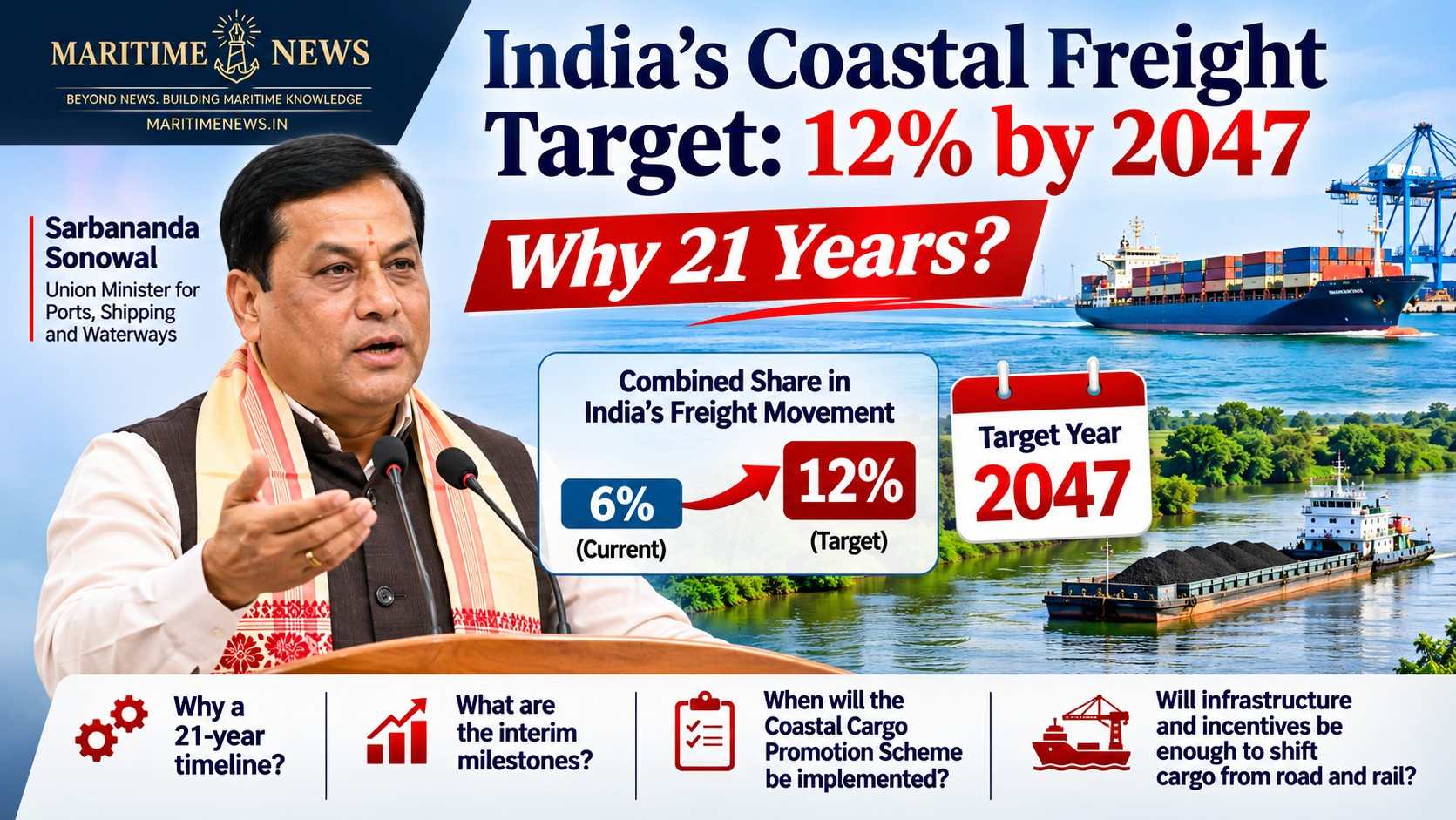
NEW DELHI: The Government of India wants to double the share of coastal shipping and inland waterways in the country’s freight movement from 6% to 12% by 2047. The target, announced under the Coastal Cargo Promotion Scheme in the Union Budget 2026–27, is being presented as part of India’s long-term maritime transformation.
However, the announcement raises a fundamental policy question: why does a country with more than 11,000 kilometres of coastline and an extensive network of rivers need another 21 years to double the share of freight transported through these modes?
Union Minister for Ports, Shipping and Waterways Sarbananda Sonowal reiterated the target at a Consultative Committee meeting in Puri, Odisha, on 3 November 2026. The minister said the government was working to increase the combined share of coastal and inland waterway shipping from 6% to 12% by 2047.
The government has also highlighted the growth in coastal cargo handled at Indian ports, which, according to the minister, increased from 74 million metric tonnes to 177 million metric tonnes over the past 12 years.
That growth is significant. But cargo volume and freight modal share are two different measures. An increase in the volume of coastal cargo does not automatically mean that coastal shipping is gaining a larger share of India’s total freight movement.
The government must therefore explain not only how much cargo is moving through ports and waterways, but also how much freight is actually shifting away from road and rail.
This Is Not a New Ambition: India Has Been Discussing the Potential for Years
The latest announcement should be viewed against the government’s earlier policy commitments.
In December 2023, the Ministry of Ports, Shipping and Waterways stated that India’s coastal shipping sector had the potential to handle 1,300 million tonnes per annum by 2047 under the Maritime Amrit Kaal Vision 2047.
At that time, the ministry reported that coastal cargo handled by Indian ports had increased from approximately 74.97 million tonnes in 2014–15 to 151 million tonnes in 2022–23. It also reported that National Waterways handled 126.15 million tonnes in 2022–23, compared with 6.83 million tonnes in 2013–14.
These figures were presented by the ministry at a consultative committee meeting on coastal shipping.
Source: PIB – Coastal Shipping Policy Consultative Committee Meeting, 22 December 2023.
The figures indicate that both coastal and inland waterway cargo volumes have expanded. However, the 1,300 MTPA coastal cargo potential identified in 2023 and the 12% combined freight-share target announced in 2026 are not identical targets. They use different measures and should not be treated as interchangeable.
The policy question remains: what progress has been made towards the earlier ambition, and how will it contribute to the new modal-share target?
The Scheme Was Announced, But Was It Ready for Implementation?
One of the most important developments in this policy timeline came in July 2026.
In a government reply published on 28 July 2026, the Ministry of Ports, Shipping and Waterways stated that the Coastal Cargo Promotion Scheme had been announced in the Union Budget 2026–27 to increase the combined share of inland waterways and coastal shipping from 6% to 12% by 2047.
The same reply stated that the proposed scheme was at the formation stage.
This raises questions about the implementation timeline. The target had been announced, but the detailed incentive framework was still being formulated several months later.
The government listed several existing measures to promote coastal shipping:
- A 40% concession on vessel- and cargo-related port charges for coastal cargo vessels.
- Priority berthing for coastal vessels to reduce turnaround time.
- Reduction of GST on bunker fuel used by Indian-flag vessels from 18% to 5%.
- Green channel clearance for faster evacuation of coastal cargo at ports.
- Dedicated coastal berths at several major ports.
These measures are relevant, but their existence does not establish their effectiveness.
How many additional cargo owners have shifted to coastal shipping because of these concessions? How much has the reduction in port charges improved the economics of coastal vessels? Has priority berthing reduced turnaround time by a measurable amount?
The ministry needs to publish performance data rather than rely solely on a list of policy interventions.
Source: PIB – Coastal Cargo Promotion Scheme, 28 July 2026.
What Does the Historical Cargo Data Tell Us?
The government’s own historical data offers an important starting point.
In December 2023, the ministry reported coastal cargo volumes of approximately 151 million tonnes in 2022–23. In a parliamentary reply published in December 2024, it reported the following coastal shipping traffic:
| Financial year | Coastal shipping traffic |
|---|---|
| 2021–22 | 133 million tonnes |
| 2022–23 | 151 million tonnes |
| 2023–24 | 162 million tonnes |
The ministry described this as approximately 11% growth over the three-year period.
Source: PIB – Parliament Question: Rise in Coastal Shipping Traffic, 17 December 2024.
These figures establish growth in coastal cargo volumes. They do not, on their own, establish the growth of coastal shipping’s share in total national freight movement.
There is also a need to distinguish coastal shipping from inland waterway transport. Both are included in the 6% to 12% target, but they operate through different infrastructure networks, commercial arrangements and regulatory systems.
Without separate and regularly updated figures for each mode, it will be difficult to assess which segment is progressing and which is holding back the overall target.
Maritime News Archive: The Policy Foundations Were Already Being Discussed
Maritime News has previously reported on several policy and operational developments that are directly relevant to the latest announcement.
1. Coastal Shipping Bill, 2024: The Regulatory Foundation
In October 2024, Maritime News examined the Coastal Shipping Bill, 2024, following its approval by the Union Cabinet. The report discussed the proposed standalone regulatory framework and the need to modernise India’s coastal shipping sector.
Read: Coastal Shipping Bill, 2024: New Era for India’s Maritime Sector.
The subsequent Coastal Shipping Act, 2025 came into force on 15 March 2026, according to a later government reply.
The question now is whether the legislative changes have resulted in a measurable improvement in vessel availability, coastal cargo movement, investment and operating efficiency.
2. Inland Waterways: Investment Cannot Be the Only Measure of Progress
In March 2025, Maritime News examined the National Waterways (Construction of Jetties/Terminals) Regulations, 2025, and raised concerns about the impact of infrastructure expansion on traditional river economies, fishing communities and the environment.
Read: Inland Waterways or a Path to Displacement and Conflict?.
The development of waterways requires more than private investment and new terminals. It also requires environmental safeguards, meaningful community consultation and protection of traditional livelihoods.
3. Digital Approvals and Private Participation
In April 2025, Maritime News reported on the launch of a digital portal for private entities seeking approvals to develop jetties and terminals on National Waterways. The report also covered the first digital NoC for a jetty project on the Mandovi River in Goa.
Read: Digital Portal to Boost Private Investment in National Waterways.
The digital approval mechanism was intended to make terminal development easier. The next measure of success should be the number of projects that have moved from approval to construction and commercial operation.
4. Growth at Non-Major Ports Did Not Always Mean Growth in Coastal Cargo
Maritime News also reported on cargo performance at non-major ports in October 2024.
During April–September 2024, these ports recorded overall cargo growth, but coastal cargo declined by 2.41% compared with the corresponding period of the previous year.
Read: Cargo Handling at Non-Major Ports Sees Significant Growth.
This is an important distinction for the current debate: total port cargo growth and coastal shipping growth are not necessarily the same thing.
The government’s 2047 ambition must be assessed through the actual movement of cargo between transport modes, not just through aggregate port performance.
The Missing Link: Why Would Cargo Owners Shift to Waterways?
The economic case for coastal and inland waterway transport is widely recognised, particularly for bulk commodities and long-distance movement.
However, a cargo owner does not choose a transport mode based on the cost of the vessel journey alone.
The complete logistics calculation includes:
- Movement of cargo from the factory, mine or warehouse to the port or river terminal.
- Loading, unloading and handling costs.
- Availability and frequency of vessels.
- Transit time and schedule reliability.
- Port and terminal charges.
- Storage and cargo aggregation.
- Last-mile road and rail connectivity.
- Delivery from the receiving terminal to the final destination.
A waterway route may offer lower transportation costs over a long distance, but additional handling and last-mile expenses can reduce or eliminate that advantage.
This is why incentives alone may not produce a substantial modal shift.
The government needs to demonstrate that coastal and inland waterway routes are commercially competitive across complete supply chains.
The 21-Year Roadmap: What Should the Government Publish?
If the government is serious about achieving the 12% target by 2047, it should publish a measurable implementation framework.
A target year without interim milestones makes it difficult for Parliament, industry and the public to assess progress.
Maritime News believes the Ministry of Ports, Shipping and Waterways should publish a public performance dashboard containing:
1. Annual modal-share data
The government should publish the combined share of coastal shipping and inland waterways separately, with a transparent methodology and clearly identified baseline.
2. Separate targets for coastal and inland shipping
The two modes should not be combined in a manner that hides the performance of either segment.
3. Annual cargo movement targets
The ministry should specify the cargo volumes expected to move through coastal shipping and inland waterways in each financial year.
4. Infrastructure delivery
The number of operational coastal berths, inland terminals, jetties, multimodal logistics facilities and connected industrial clusters should be published.
5. Scheme implementation
The Coastal Cargo Promotion Scheme should disclose its incentive structure, eligibility conditions, budgetary allocation, beneficiaries and actual cargo shifted.
6. Cost and time competitiveness
The government should publish evidence showing whether the reforms have reduced end-to-end logistics costs and improved delivery reliability.
7. Environmental and social safeguards
The expansion of commercial waterway operations should be accompanied by transparent environmental monitoring and protection of affected communities.
Questions the Ministry Must Answer
The 2047 target creates several questions that deserve clear answers from the Ministry of Ports, Shipping and Waterways:
- What is the methodology used to calculate the present 6% share of coastal shipping and inland waterways?
- What is the separate share of coastal shipping and inland waterway transport?
- Why was 2047 selected as the target year, and what economic or infrastructure assumptions support this timeline?
- What annual or five-year milestones have been established between 2026 and 2047?
- When will the Coastal Cargo Promotion Scheme move from the formation stage to implementation?
- What is the scheme’s proposed financial outlay, and how will its impact be measured?
- How much cargo has shifted from road and rail to waterways as a result of existing government incentives?
- How many sanctioned coastal and inland waterway infrastructure projects are operational, under construction or delayed?
- How will the government protect traditional river users and coastal communities as commercial traffic increases?
- Which authority will be responsible for publishing and independently verifying annual progress?
Reality Check: Growth Is Not the Same as Transformation
India’s coastal cargo volumes and inland waterway traffic have increased over the years. The government has introduced regulatory reforms, financial concessions and infrastructure programmes to promote these modes of transport.
These are important developments and should not be dismissed.
However, the available announcements and historical cargo figures do not, by themselves, establish that India is on track to double the combined freight share by 2047.
The July 2026 government reply that the proposed Coastal Cargo Promotion Scheme was still at the formation stage is particularly relevant. It indicates that the implementation framework remained under development at that point.
The November 2026 announcement reiterates the national ambition, but the public still needs a detailed roadmap showing how the target will be achieved.
The issue is not whether 2047 is an ambitious deadline. It is whether the government has a sufficiently detailed plan to demonstrate progress well before that date.
Frequently Asked Questions
1. What is India’s coastal and inland waterway freight target for 2047?
The government aims to increase the combined share of coastal shipping and inland waterways in India’s freight movement from 6% to 12% by 2047.
2. Which scheme is intended to support this target?
The Coastal Cargo Promotion Scheme, announced in the Union Budget 2026–27, is intended to incentivise a shift of cargo from road and rail to waterways.
3. Has the Coastal Cargo Promotion Scheme been implemented?
A Ministry of Ports, Shipping and Waterways reply dated 28 July 2026 stated that the proposed scheme was at the formation stage. Its subsequent implementation status requires confirmation.
4. How much coastal cargo did Indian ports handle historically?
The ministry reported approximately 162 million tonnes of coastal shipping traffic in 2023–24. The minister subsequently cited an increase from 74 million tonnes to 177 million tonnes over the preceding 12 years at the November 2026 meeting.
5. Why is a 21-year target being questioned?
The concern is not simply the length of the target period. It is the absence of clearly published annual milestones, measurable implementation outcomes and a transparent mechanism for public accountability.
6. What is the difference between coastal shipping and inland waterway transport?
Coastal shipping moves cargo by sea between Indian coastal ports, while inland waterway transport uses rivers, canals and other navigable inland routes. Both are included in the government’s combined 12% target.
India Needs a Roadmap, Not Just a 2047 Destination
India’s maritime geography provides a substantial opportunity to move more freight through coastal shipping and inland waterways. The growth in cargo volumes, regulatory reforms and the government’s renewed focus on modal shift provide a foundation for further development.
But the country’s freight transition cannot be measured by announcements, long-term targets or the number of schemes introduced.
The government identified a coastal cargo potential of 1,300 million tonnes per annum by 2047 in 2023. It announced a 12% combined freight-share target in the 2026 Budget. Yet, as recently as July 2026, the proposed Coastal Cargo Promotion Scheme was still being formulated.
That sequence deserves public scrutiny.
Why should India wait until 2047 to double the share of freight transported through its coastlines and waterways? What prevents a faster transition? And what will the government deliver by 2030, 2035 and 2040 to prove that the 2047 ambition is more than a distant policy promise?
The government must answer these questions with data, funding commitments, infrastructure milestones and annual performance reports.
India does not merely need a destination for its maritime ambitions. It needs a credible route to get there.
Sources and References
- PIB – Sarbananda Sonowal Outlines Plan to Double Coastal & Waterway Freight Share to 12% by 2047, 3 November 2026
- PIB – Coastal Cargo Promotion Scheme, 28 July 2026
- PIB – Coastal Shipping Policy Consultative Committee Meeting, 22 December 2023
- PIB – Parliament Question: Rise in Coastal Shipping Traffic, 17 December 2024
- Maritime News – Coastal Shipping Bill, 2024
- Maritime News – Inland Waterways or a Path to Displacement and Conflict?
- Maritime News – Digital Portal to Boost Private Investment in National Waterways
- Maritime News – Cargo Handling at Non-Major Ports Sees Significant Growth