

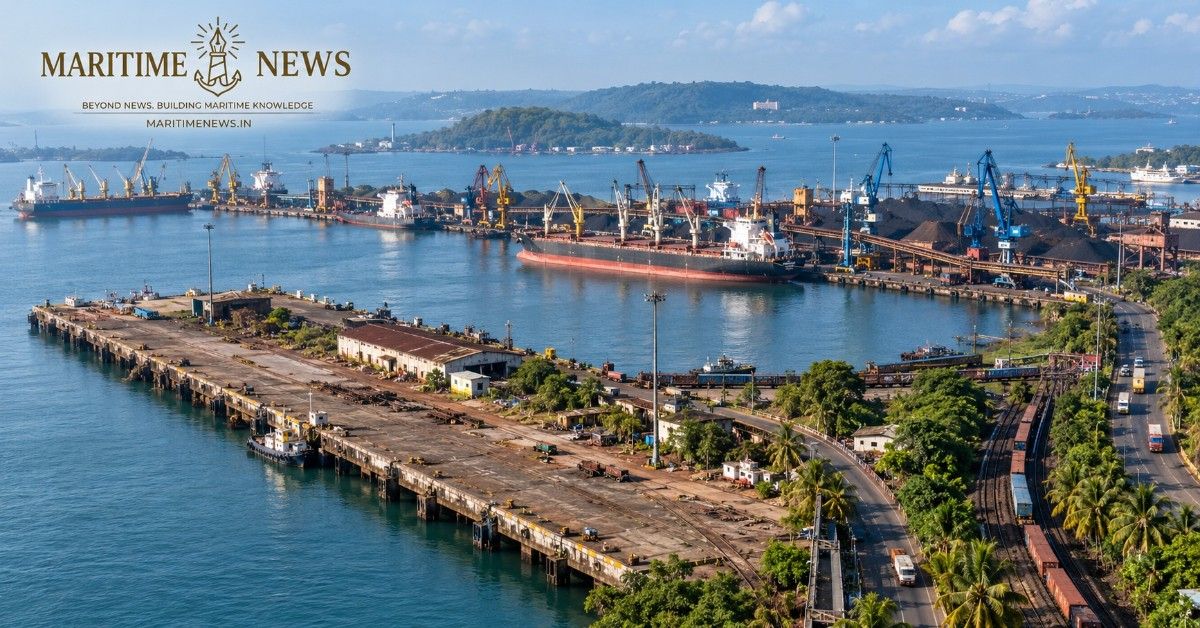
MaritimeNews examines Mormugao Port’s transformation from an iron-ore gateway into a diversified multi-commodity port, tracing its infrastructure plans, PPP transition, Berths 10 and 11, the unresolved Berth 9 redevelopment, local stakeholder concerns and the latest RTI disclosures.
Make us preferred source on Google
Key Takeaways
- A historic port: Mormugao’s development stretches from its early harbour infrastructure to its declaration as a Major Port and its later transformation into a diversified cargo gateway. The Port Authority’s historical account records major development of cargo infrastructure over successive decades. (MPT Goa)
- The 2007 Business Plan: Mormugao commissioned Halcrow, in association with Ernst & Young, to prepare a long-term Business Plan covering a seven-year planning horizon, development strategy, financing and an action plan. (MPT Goa)
- Berth 9 has a long history: The berth was developed as part of the mechanised iron-ore handling system and later became underutilised after the decline and ban on iron-ore mining and ageing of its equipment.
- A 2015 redevelopment proposal: Mormugao subsequently proposed redevelopment of Berths 8, 9 and the barge berths, with three new berths envisaged to provide approximately 18.30 MTPA of capacity at an indicative cost of ₹1,265 crore under a 30-year DBFOT concession.
- Berths 10 and 11 moved to PPP: The two general-cargo berths were handed to Delta Infralogistics/Delta Ports Mormugao Terminal under a 30-year PPP arrangement.
- The Centre’s position is clear: The Union Government says no Major Port has been privatised; ownership of land and core port assets remains with the respective Port Authority/Government of India. (Press Information Bureau)
- Local livelihoods became a major issue: Stevedores, transporters and other port-linked businesses raised concerns after the Berths 10 and 11 transition.
- The courts examined the dispute: The Bombay High Court dismissed the challenge by the Mormugao Stevedores Association to the PPP arrangement, while recording the continuing concerns around stevedoring rights and the port’s regulatory framework. (Casemine)
- Mormugao is performing better, but not without constraints: The Port handled 21.01 million tonnes in FY2025–26, its highest cargo volume in five years, while average turnaround time stood at 66.25 hours. (Press Information Bureau)
- Berth 9 remains unresolved: In February 2026, MPA presented a plan to redevelop Berth 9 as a modern multi-purpose berth. By August, The Times of India reported that the Centre had declined MPA’s request for about ₹1,300 crore, prompting the Port to seek industry proposals. (The Times of India)
- The latest RTI adds a second accountability layer: MPA’s May 2026 RTI reply records five GMIS 2023 MoUs and eight GMIS/India Maritime Week 2025 projects, including completed, operational, commenced and cancelled projects.
- The crucial lesson: An MoU, PPP or project announcement is not the final measure of development. The real test is execution and measurable public outcome.
Also Read: From Flood Recovery to Maritime Connectivity: New Assam Development Push Takes Shape
Mormugao, South Goa, Goa, India, September 5, 2026 (Maritime News) : Mormugao’s evolution has always been linked to changing cargo, technology and investment. According to the Mormugao Port Authority’s historical account, the port was commissioned in 1888 with three berths and a 358-metre breakwater. Infrastructure expanded over the following decades as the port’s role grew. (MPT Goa) The development of Goa’s iron-ore industry fundamentally changed Mormugao’s traffic profile. In 1959, Chowgule & Co. was permitted to establish a mechanical ore-handling plant at Berth 6, while Berth 7 was subsequently developed as an adjunct. (MPT Goa) Mormugao was declared a Major Port in 1964, after which development accelerated through successive government programmes. Berth 8 was constructed as a dedicated mineral-oil berth in 1976. (MPT Goa)
The present PPP transition is therefore another chapter in a much longer process of technological and institutional change. Berths 10 and 11 are multi-purpose general cargo berths at Mormugao Port. According to the Mormugao Port Authority’s official history, Berth 10 was commissioned in 1985 and Berth 11 in 1994. The two berths were subsequently brought under a 30-year PPP arrangement for operation and maintenance. (Ministry of Ports) The concession agreement with Delta Infralogistics (Worldwide) Limited was signed on December 14, 2023.
The Port Authority states that the project covers operation and maintenance of the existing berths, together with approximately 116,000 square metres of backup area and warehouses, with a capital expenditure of ₹139.63 crore. Commercial operations commenced on April 4, 2025. (Ministry of Ports)
Statistics Dashboard
| Indicator | Mormugao Port |
|---|---|
| Location | Goa, West Coast of India |
| Harbour | Protected open-type natural harbour |
| Major Port status | Major Port |
| Number of berths | 11 |
| Mooring dolphins | 6 |
| FY2025–26 cargo handled | 21.01 MMT |
| FY2025–26 cargo growth | 15.91–16% |
| FY2025–26 average turnaround time | 66.25 hours |
| All Major Ports average turnaround | 48.84 hours |
| FY2025–26 operating income | ₹593 crore |
| FY2025–26 operating surplus | ₹285.52 crore |
| Berth 10 & 11 PPP CAPEX | ₹139.63 crore |
| Berth 10 & 11 PPP concession | 30 years |
| Proposed 2015 Berths 8/9/barge redevelopment | 18.30 MTPA |
| Indicative 2015 project cost | ₹1,265 crore |
| Current Berth 9 redevelopment concept | Approx. 355 m quay |
| Berth 9 earlier iron-ore handling | Approx. 10–12 MTPA |
The FY2025–26 cargo, turnaround and financial figures are from government/MPA reporting. The ₹139.63-crore figure relates to the Berths 10 and 11 PPP project, while the 2015 ₹1,265-crore proposal and 18.30-MTPA capacity come from the historical project material. (Press Information Bureau)
Also Read: From Adani Ports CEO to Allcargo MD: The Pranav Choudhary
Why It Matters
Mormugao is not simply another cargo port on India’s western coast. Its history is closely tied to Goa’s industrialisation, iron-ore exports, rail connectivity, mining, coastal shipping, cargo logistics and, increasingly, tourism and diversified maritime activity. Today, however, Mormugao is at an important transition point.
The port has moved away from its historic dependence on iron ore. Private participation has expanded. Berths 10 and 11 are now operated under PPP. Berths 5 and 6 are operated by JSW, while Berth 7 is operated by Adani Mormugao Port Terminal. Berth 9 remains largely unused and is again being considered for redevelopment. (MPT Goa)
The question is therefore no longer simply whether Mormugao should modernise.
The more important question is:
Can Mormugao convert its considerable physical assets, private participation and government investment into sustained cargo growth, faster vessel turnaround, employment and wider economic value for Goa?
That is the question this MaritimeNews report examines.
Understanding the Ecosystem
Mormugao’s port economy is larger than the physical berths.
Cargo owner → shipping line → port authority → terminal operator → stevedore → labour → crane/machinery operator → transporter → railway → warehouse/storage → customs → logistics provider → importer/exporter
Every change in the operating model can therefore affect multiple stakeholders.
This became particularly visible when Berths 10 and 11 moved from the earlier operating structure to the PPP model.
Local stevedores, transporters, contractors and machinery owners argued that the change could reduce opportunities for established local businesses. Reports carried claims of impacts ranging from around 1,200 to 2,000 workers and associated livelihoods, although those figures should be treated as stakeholder claims rather than independently established employment losses. (The Goan)
The counter-question is equally important: if a PPP arrangement increases mechanisation, investment, cargo throughput and revenue, how should those gains be measured against changes in the traditional employment structure?
That is the real stakeholder question.
Also Read: National Shipping Board’s First Sagar Samvad Starts With “IF”
Current Status
Mormugao is presently a multi-commodity port, rather than the predominantly iron-ore port of its earlier era.
According to MPA’s February 2026 presentation to the National Shipping Board, the port is moving toward the landlord model and had achieved approximately 70% implementation of that transition. Most berths are under PPP arrangements, with the Port Authority directly operating only two.
The port currently handles:
- dry bulk;
- break-bulk;
- liquid bulk;
- general cargo;
- containers;
- coal and coke;
- fertilisers;
- iron ore/pellets;
- cruise traffic; and
- other miscellaneous cargo.
The transformation is visible in the berth structure itself.
Mormugao’s 11 Berths: What Each One Does
Berths 1–3
These berths are associated with the port’s passenger/cruise infrastructure. Mormugao is developing an international and domestic cruise terminal, with a marina also envisaged as part of the tourism infrastructure.
Historically, Berths 1–3 were also associated with ship repair. The Port Authority’s historical account records that they were leased to Western India Shipyard Ltd. for a ship-repair facility commissioned in 1995. (MPT Goa)
Berth 4
MPA’s current berth particulars identify Berth 4 for ferries, Ro-Ro and RoPax facilities, with a designed depth of 8 metres, permissible draft of 7 metres and a quay length of 194 metres. (MPT Goa)
Berths 5 and 6
These are operated under PPP arrangements by JSW Port Limited and handle coal, coke and break-bulk cargo, including industrial cargo linked to the hinterland. MPA’s February 2026 presentation states that these berths handle coal and limestone imports and finished steel products.
Berth 7
Berth 7 is operated by Adani Mormugao Port Terminal Pvt Ltd as a dedicated coal terminal.
Adani describes its Mormugao terminal as a fully mechanised coal-handling facility capable of handling Panamax and Capesize vessels. Its disclosed infrastructure includes a 300-metre berth, 14.5-metre available draft, rail-mounted mobile harbour cranes and mechanised evacuation systems. (Adani Ports)
Adani’s operational reporting also records 4.9 MMT throughput against 5 MMT installed capacity for its Mormugao terminal in the reported period. (Adani Ports)
Berth 8
Berth 8 is the port’s liquid-cargo berth, handling petroleum, oil and lubricants and other liquid cargo.
The current MPA berth particulars give a designed depth of 13.10 metres, permissible draft of 13 metres and a listed capacity of 5.20 MTA. (MPT Goa)
Its infrastructure has also been part of the port’s redevelopment planning for many years.
Berth 9
This is the unresolved piece of the Mormugao puzzle.
Berth 9 was developed for mechanised iron-ore handling. The earlier system included specialised equipment, storage, conveyors, ship loaders and barge infrastructure.
According to MPA’s February 2026 presentation, the berth historically handled approximately 10–12 million tonnes of iron ore annually. Following the mining restrictions and ageing of the mechanised infrastructure, the plant was scrapped and the berth became unutilised.
The present proposal is to convert it into a conventional multi-purpose berth, rather than recreating a facility dedicated solely to iron ore.
But there is an important documentation issue.
MPA’s current facility page still describes Berth 9 as “proposed for Dry dock and ship repair yard on PPP basis.” (MPT Goa)
In contrast, MPA’s February 2026 presentation to the National Shipping Board says the current redevelopment is for a multi-purpose cargo berth, and specifically explains that Berth 9 is not intended for ship repair or dry dock; ship-repair possibilities are instead associated with the finger-jetty area.
That evolution itself is significant.
Barge Berths 1–5
The current berth particulars identify five barge berths as non-cargo facilities operated by the Port.
Historically, however, this area was integral to Mormugao’s iron-ore logistics chain. The older port system brought ore from the hinterland by barge to the Mormugao handling system.
MPA told the National Shipping Board that approximately 220 barges had historically supported this activity before mining restrictions caused the traffic to decline.
Berth 10
Berth 10 is a general-cargo/POL berth with a designed depth of 13.10 metres, permissible draft of 12.50 metres and 250-metre quay length.
It is now operated by Delta Mormugao Port Terminal Private Limited (DMPTL) under the PPP arrangement. MPA lists an indicative capacity of 3.20 MTA. (MPT Goa)
Berth 11
Berth 11 is another general-cargo berth, with a 270-metre quay and 12.50-metre permissible draft.
It too is operated by DMPTL under the PPP arrangement, with MPA listing 3.20 MTA capacity. (MPT Goa)
Breakwater Berth
The breakwater berth is used for cruise vessels and is partly leased to the Coast Guard.
Mole Berth
The mole berth is used for Defence and Coast Guard vessels.
Mooring Dolphins
Mormugao also has mooring dolphins and an outer-anchorage/transhipper system, adding another layer to its bulk-cargo handling capability.
Mormugao Port Authority’s berth particulars dated December 8, 2025 provide the clearest current snapshot.
| Facility | Primary Use | Designed Depth | Permissible Draft | Quay Length | Status |
|---|---|---|---|---|---|
| Berths 1–3 | Upcoming International & Domestic Cruise Terminal | 10.50 m | 9.50 m | — | Port-owned / not in operation |
| Berth 4 | Ferry / Ro-Ro / RoPax | 8.00 m | 7.00 m | 194 m | Port-owned |
| Berths 5–6 | Break-bulk / Coal / Coke | 14.10 m | 13.00–14.00 m | 210–240 m | PPP-operated |
| Berth 7 | Coal / Coke | 14.10 m | 14.00 m | 300 m | PPP-operated |
| Berth 8 | POL / Liquid Cargo | 13.10 m | 13.00 m | 50 m | Existing facility |
| Berth 9 | General Cargo | 14.10 m | 14.00 m | 222 m | Proposed dry dock/ship repair PPP |
| Berths 10–11 | General Cargo / POL | 13.10 m | 12.50 m | 250–270 m | PPP-operated by DMPTL |
| Breakwater Berth | Cruise / Coast Guard | 9.50 m | 9.00 m | 450 m | Port/partly leased |
| Mole Berth | Defence / Coast Guard | 9.50 m | 9.00 m | 250 m | Leased to Navy/Coast Guard |
| Barge Berths 1–5 | Non-cargo | 6.00 m | 6.00 m | 120 m | Port-operated |
| Mooring Dolphins / Anchorage | Dry Bulk | 14.10 m | 13.10 m | 340–360 m | Port-operated |
Source: Mormugao Port Authority, Berths Particulars as on 08.12.2025. Mormugao Port Authority — Berths Particulars
Also Read: Can Assam Build a Global Export Economy on One of the World’s Most Dynamic Floodplains?
From Iron Ore to Diversification
Mormugao’s transformation cannot be understood without looking at iron ore.
The Port Authority’s history records the dramatic expansion of iron-ore traffic after the development of Goa’s mining industry. Mechanised handling facilities were introduced, railway infrastructure expanded and Mormugao became a major export gateway.
The Port’s historical account records that the mechanised ore-handling facility developed around Berth 6 was later decommissioned in 1992 because of obsolescence. Berths 10 and 11 were subsequently constructed as multi-purpose general-cargo berths, commissioned in 1985 and 1994 respectively. (MPT Goa)
The result was an infrastructure portfolio that was increasingly capable of handling commodities beyond iron ore.
The Supreme Court’s restrictions on Goa’s iron-ore mining eventually accelerated that transition.
MPA told the National Shipping Board that the port had handled a peak of approximately 50 million tonnes in 2010–11, before the collapse in its traditional iron-ore traffic.
The strategic challenge became clear:
What do you do with infrastructure built around a commodity that can no longer be relied upon as the port’s economic foundation?
The 2007 Business Plan: A Warning From Nearly Two Decades Ago
The March 2007 Business Plan is one of the most important documents in understanding Mormugao today.
The study was commissioned by Mormugao Port Trust and prepared by Halcrow Group Limited and Halcrow Consulting India Ltd., in association with Ernst & Young.
Its stated objectives included establishing a long-term vision, identifying goals for the following seven years, developing a strategy, preparing an action plan and identifying financing sources for proposed investments. The report also envisaged a rolling annual planning process. (MPT Goa)
In other words, Mormugao had already recognised nearly twenty years ago that planning, financing, infrastructure and execution had to be treated as a continuous process.
The report examined the port’s cargo markets, infrastructure, operational constraints and investment requirements.
It identified four factors as important to Mormugao’s share of iron-ore traffic:
- MOHP capacity;
- the differential between MOHP rates and Panjim charges;
- exporters’ investments in transshippers; and
- procedural issues at Mormugao Port Trust.
The Business Plan then modelled different scenarios involving MOHP capacity, tariff competitiveness and procedural improvements.
Also Read: THE COST OF SILENCE
What the 2007 Plan Proposed
The recommendations included major investments in port infrastructure.
Among them were:
- Harbour Mobile Crane at Berth 11 — ₹151 million
- Integration of Berth 8 with Berth 9 for iron-ore handling, including stackyard and wagon-tippling infrastructure — ₹1,071 million
- Replacement of MOHP equipment — ₹1,842 million
- Additional mooring dolphins — ₹220 million
- Development of a new Berth 7 — ₹1,400 million
- New port-craft jetty — ₹25 million
- Vasco Bay development — ₹901 million
The plan also recommended strict productivity norms at Berths 10 and 11 and installation of a harbour mobile crane to improve productivity. (MPT Goa)
This is where the historical record becomes important.
The question is not whether Mormugao lacked plans.
It clearly did not.
The question is how much of the planning pipeline eventually became operational infrastructure.
The 2015 Redevelopment Proposal
By 2015, Mormugao was looking at another major restructuring.
The redevelopment proposal covered:
- Berth 8;
- Berth 9;
- the barge berths; and
- the Mechanical Ore Handling Plant.
The proposed project envisaged three berths with a combined quay length of 950 metres, plus 90 metres for barge-unloader jetties.
The planned capacity was approximately 18.30 MTPA, with an indicative project cost of ₹1,265 crore, to be implemented through DBFOT with a 30-year concession.
The proposal envisaged:
- a new Berth 8 for coal, coke, gypsum, dolomite and limestone;
- a general-cargo/container berth;
- a mineral berth for iron ore, bauxite or other minerals;
- four barge unloaders;
- approximately 70 acres of backup area;
- rail and road connectivity; and
- environmental protection measures.
The historical project proposal therefore already anticipated the need to reuse old infrastructure for a more diversified cargo future.
Also Read: The Sea Doesn’t Forgive Silence
Berth 9: Why Has It Remained Difficult?
The answer appears to involve both infrastructure economics and cargo uncertainty.
The earlier mechanised iron-ore system was designed for a particular cargo ecosystem.
When that cargo declined, the business case changed.
MPA’s current explanation is particularly revealing: an earlier PPP attempt for Berth 9 did not succeed because of high construction costs and commercial viability concerns.
The Port also noted that infrastructure developed without assured cargo can face utilisation problems.
That is the fundamental infrastructure dilemma:
Build first and hope cargo arrives — or secure the cargo model before committing the capital?
Mormugao has experienced both sides of that equation.
Berths 10 and 11: The PPP Experiment
The transition of Berths 10 and 11 provides another important case study.
The Mormugao Port Authority decided in 2022 to outsource operation and maintenance of the two general-cargo berths through a 30-year PPP arrangement. The project received central approval with an estimated project cost of ₹139.63 crore. (Caseon)
The Letter of Award was issued in October 2023 and the concession agreement was signed on December 14, 2023.
Delta Infralogistics subsequently became the private operator through Delta Ports Mormugao Terminal.
Commercial operations commenced on April 4, 2025. (The Goan)
The arrangement was intended to bring additional equipment and mechanisation while generating royalty for the Port.
Is This Privatisation?
This distinction matters.
The term “privatisation” has been widely used in public and political discussion surrounding Berths 10 and 11.
However, in its July 2026 Rajya Sabha response, the Ministry of Ports, Shipping and Waterways explicitly stated that:
- the 12 Major Ports remain under the Government of India;
- no Major Port has been privatised;
- land and core port assets remain with the respective Port Authority/Government of India; and
- specified berths and terminals may be developed and operated through PPP or captive arrangements. (Press Information Bureau)
The Centre therefore describes the model as private participation within a landlord-port framework, rather than sale of the port itself.
For accuracy, MaritimeNews should therefore distinguish between:
transfer of operational responsibility for a berth under PPP
and
privatisation/transfer of ownership of the Major Port.
They are not the same thing.
But Ownership Is Only One Part of the Story
The more important public-interest question concerns who gets to participate in the port economy.
Before the PPP transition, licensed stevedores had operated at Berths 10 and 11.
The Bombay High Court’s May 2025 judgment records that the Mormugao Stevedores Association challenged the PPP arrangement and argued that the transition affected their rights under their existing licences. (Casemine)
The Court ultimately dismissed the petition.
It noted that the licensed stevedores were not completely excluded from port activity and that the Port’s trade circular provided for demarcation between PPP project areas and other port areas. The Court concluded that the petitioners were not deprived of their livelihood rights in the manner alleged and dismissed the petition. (Casemine)
That does not erase the economic concerns raised by local stakeholders.
It establishes something different:
The PPP arrangement survived judicial scrutiny, while the question of how the benefits of a modernised port are distributed remains an economic and policy question.
Also Read: THE PROMISE BEFORE BOARDING
Mormugao’s Performance: The Positive Numbers
There is another side to the story.
Mormugao has recorded significant improvement in FY2025–26.
The Port handled 21.01 million tonnes, its highest cargo volume in five years, with growth of approximately 16%. The government described this as the highest growth rate among India’s Major Ports. (Press Information Bureau)
Average turnaround time improved from 69.68 hours to 66.25 hours.
Average ship berthday output increased from 16,081 MT to 20,289 MT, an increase of approximately 26%. (Press Information Bureau)
The Port also reported:
- ₹593 crore operating income;
- ₹285.52 crore operating surplus;
- stronger dry-bulk performance;
- increased miscellaneous cargo;
- increased fertiliser traffic;
- continued iron-ore/pellet and liquid-cargo growth; and
- higher railway-rake handling.
Several projects were also reported completed, including:
- 3 MWp solar power plant;
- railway-line modifications;
- Berth 8 firefighting system;
- recycled-water pipeline;
- covered shed at Berths 5 and 6;
- Berths 10 and 11 PPP operations; and
- RFID gate automation. (Press Information Bureau)
These are real achievements and should not be overlooked.
The Efficiency Gap
But the numbers also show the remaining challenge.
A later Union Government dataset places Mormugao’s FY2025–26 average turnaround time at 66.25 hours, compared with 48.84 hours for all Major Ports. (Press Information Bureau)
That is a gap of more than 17 hours.
And it is precisely this gap that makes Berth 9, dredging, mechanisation, evacuation infrastructure and hinterland connectivity important.
The question is no longer simply how much cargo Mormugao handles.
It is:
How quickly, efficiently and competitively can it handle that cargo?
Also Read: BOARDING MT CHAPEL
Capital Dredging and the Capesize Question
MPA’s February 2026 presentation identified channel depth as another structural constraint.
The existing channel is approximately 14–15 metres, limiting the ability of fully laden Capesize vessels to enter directly.
The Port has therefore been planning to deepen the approach channel to approximately 19.5 metres.
The objective is to reduce or eliminate lighterage requirements, reduce operational costs and improve competitiveness.
But Mormugao is located at a river mouth, meaning siltation is an ongoing natural challenge.
MPA told the National Shipping Board that approximately 2–2.5 million cubic metres of silt may need to be removed annually through maintenance dredging.
This makes capital dredging only one part of the solution.
A deeper channel requires sustained maintenance.
The Current Berth 9 Turn
This brings us to 2026.
In February, MPA told the National Shipping Board that Berth 9 would be redeveloped into a modern multi-purpose berth with approximately 355 metres of quay length, capable of accommodating larger vessels.
The proposal involved reclamation and structural strengthening, cranes and flexible cargo-handling infrastructure.
The Port also said the berth could retain the ability to support barge-based cargo aggregation if Goa’s iron-ore exports eventually expand again.
The Port’s explanation was also more commercially cautious than some earlier proposals.
The earlier PPP model had not attracted viable bids.
The proposed new approach was therefore to develop the basic infrastructure with government support and subsequently offer the facility for operation and maintenance through private participation.
That model would shift a substantial portion of the initial capital burden away from a private concessionaire.
Also Read: When Documents Begin Speaking
Then Came the Funding Problem
The latest development changes the immediate picture.
On August 17, 2026, The Times of India reported that the Centre had declined MPA’s request for approximately ₹1,300 crore for the redevelopment of Berth 9 and associated capital dredging.
The Port has consequently approached maritime developers, port operators, consortiums and investors for proposals to redevelop, modernise or operate Berth 9 and an adjoining barge berth under a PPP model. (The Times of India)
According to the report, the Port is seeking proposals before deciding whether a technically and commercially feasible solution exists.
This is a significant shift:
Government-funded redevelopment → industry-led feasibility → potential PPP
It also demonstrates how the financing model continues to evolve.
The Turnaround Question
The Berth 9 EOI is not being framed simply as a capacity project.
It is also intended to improve productivity and reduce vessel turnaround time.
The Times of India report cited MPA’s current turnaround time at 66.3 hours, compared with a national Major Port average of 48.8 hours. (The Times of India)
That makes Berth 9 part of a broader operational problem.
A new berth by itself cannot solve the turnaround gap if:
- vessels wait for channel access;
- cargo evacuation is slow;
- railway capacity is constrained;
- road connectivity is inadequate;
- storage is insufficient; or
- cargo availability is uncertain.
Infrastructure has to function as a system.
Also Read: Inside the Engine Room
The RTI Layer: What Happened to the Announcements?
This is where the May 2026 RTI reply obtained from Mormugao Port Authority becomes especially important.
The RTI application sought information on MoUs associated with:
- Global Maritime India Summit 2023;
- Sagarmanthan: The Great Oceans Dialogue 2024; and
- India Maritime Week 2025.
MPA’s response records:
GMIS 2023 — 5 MoUs
Sagarmanthan 2024 — Nil
India Maritime Week 2025 — 8 MoUs
The response also provides project-level information in two annexures.
GMIS 2023: Five Projects, Five Different Outcomes
The Annexure-I table is revealing.
Goa Energy Development Agency
A project involving appointment of GEDА for consultancy services, with a proposed investment of ₹20.49 crore, is listed as operational.
The RTI says a 3 MWp/2.25 MW solar power plant was successfully installed.
NIT Surathkal
The baseline-emission computation project, with a proposed amount of ₹0.39 crore, is listed as work completed.
FLS Engineering Consultant
The augmentation of firefighting at Berth 8 involved a proposed investment of ₹16.6 crore and is listed as operational, with 21 jobs recorded in the employment column.
Sagarmala Development Company
This is the most interesting entry.
A proposed ₹85-crore procurement and commissioning project for a 100/120 MT harbour mobile crane with 10 years of management is recorded as cancelled.
The RTI explains that the work was instead executed through the PPP operator of Berths 10 and 11 — Delta Mormugao Port Terminal Private Limited.
Italguru
The upkeep of the MHC, with a proposed amount of ₹1.7 crore, is recorded as completed.
This is precisely why MaritimeNews should distinguish announcement from outcome.
The ₹85-crore project was not simply “implemented”.
It was cancelled in its original form and the work was executed through another arrangement.
Employment: The RTI Gives Us a Harder Number
The RTI response to the question on employment is particularly important.
For GMIS 2023 projects, MPA stated:
“Projected was NIL”
and provided actual employment associated with completed projects in Annexure-I.
This means the port’s project announcements cannot automatically be translated into claims of large-scale employment generation.
The FLS firefighting project records 21 jobs.
Other projects show no employment figure.
That is a useful baseline for future assessment.
Green Maritime Projects: NIL Implementation
The RTI response also asked specifically about:
- green hydrogen;
- green ammonia; and
- sustainable maritime fuels.
MPA’s response was:
“Present implementation status is NIL.”
That does not mean Mormugao has no green initiatives.
It has commissioned solar capacity, environmental projects and other sustainability measures.
But it does mean that, for the specific category asked in the RTI, MPA reported no present implementation status.
That distinction matters.
India Maritime Week 2025: Eight Projects
Annexure-II records eight projects.
They include:
- a 4 MWp solar power plant;
- a 2 MW solar power plant;
- plantation of 1,000 trees by Adani Mormugao Port Terminal;
- advanced CCTV surveillance;
- electrical-substation modernisation;
- three locomotives for railway operations;
- a 14-ton hydraulic mobile crane; and
- an LNG facility with proposed investment of ₹3,500 crore.
Several are recorded as commenced or operational.
The tree plantation project, for example, records 810 trees planted, with the balance 190 planned for June 2026.
The LNG project is recorded as commenced, with the developer to submit its DPR.
Again, the important journalistic distinction is:
“commenced” is not the same as “completed”, and “MoU signed” is not the same as “investment realised”.
What the RTI Does Not Show
The RTI response also contains an important limitation.
When asked for:
- progress monitoring reports;
- review reports;
- implementation-status reports;
- environmental clearances;
- land allocation;
- financial closure;
- concession agreements; and
- post-event impact/outcome reports,
the response contains several “Not Applicable” entries and does not provide a conventional post-event impact assessment for the summit MoUs.
MPA says monitoring of all MoUs is done through Sagarmanthan Portal by the Ministry.
This does not by itself establish failure.
But it demonstrates why a mature infrastructure story needs to follow projects beyond the announcement stage.
Also Read: Living Below Deck
Mormugao’s Upcoming Project Pipeline
MPA itself currently lists a substantial development agenda, including:
- Conversion of Berths 8, 9, barge berths and MOHP for general cargo;
- redevelopment of Berths 8, 9 and barge berths;
- four-lane NH-17B connectivity;
- capital dredging for Capesize vessels;
- fishing jetty at Vasco Bay;
- pollution-control and mitigation measures;
- railway-yard signalling;
- shifting/re-routing pipelines from Berth 8 to Berth 10;
- paving behind Berths 10 and 11 under ASIDE;
- roads and approaches to paved areas;
- redevelopment of Berths 8 and 9; and
- PPP projects under operation, including captive-user projects.
These are listed by MPA on its own Projects/Development page. (MPT Goa)
The list itself tells the story.
Mormugao’s challenge is not the absence of projects.
It is the conversion of a long project pipeline into completed, productive and economically viable infrastructure.
Economics
Mormugao’s recent performance provides grounds for optimism.
Cargo growth has returned.
Revenue has increased.
Operational efficiency has improved.
Private operators are investing.
The Port is diversifying.
Yet the port remains financially and operationally sensitive to the cargo mix.
Its current revenue reported by the Centre was:
| Financial Year | Revenue |
|---|---|
| 2021–22 | ₹457.66 crore |
| 2022–23 | ₹486.00 crore |
| 2023–24 | ₹585.87 crore |
| 2024–25 | ₹563.16 crore |
| 2025–26* | ₹607.95 crore |
*Provisional/unaudited. (Press Information Bureau)
The financial trajectory suggests recovery and growth, but the larger question is whether the port can generate sustained returns from diversified cargo rather than depending on one commodity cycle.
Also Read: Questions Beyond the Engine Room
Policy Framework
Mormugao’s transformation sits within India’s wider move towards the landlord-port model.
The Union Government’s July 2026 position is that Major Ports remain government-owned while private participation is used for specified terminals and berths through competitive PPP or captive arrangements. (Press Information Bureau)
For Mormugao, that policy has translated into:
Public ownership + private terminal operation + public regulation + private investment + shared logistics ecosystem.
The policy question now is whether the model produces sufficient additional capacity and efficiency to justify the transition.
Governance
Mormugao’s governance challenge has three layers.
1. Port-level execution
MPA must convert plans into functioning infrastructure.
2. Central policy and financing
Major projects such as capital dredging and Berth 9 redevelopment require decisions on funding, viability and strategic priorities.
3. Stakeholder inclusion
Modernisation must also account for the businesses and workers that historically formed the port ecosystem.
The Berths 10 and 11 dispute demonstrates why governance cannot be reduced to a concession agreement.
Stakeholder Analysis
| Stakeholder | Main Interest |
|---|---|
| Mormugao Port Authority | Capacity, revenue, efficiency |
| Ministry of Ports, Shipping & Waterways | National maritime policy and port performance |
| Private terminal operators | Cargo, investment and returns |
| Stevedores | Cargo-handling business |
| Transporters | Cargo evacuation |
| Machinery owners | Equipment deployment |
| Workers | Employment |
| Shipping lines | Turnaround and reliability |
| Cargo owners | Cost and service |
| Railways | Cargo evacuation |
| Goa’s industrial sector | Competitive logistics |
| Fishing community | Fishing infrastructure |
| Tourism sector | Cruise infrastructure |
| Local communities | Jobs, environment and economic benefits |
| Government | Trade, revenue and regional development |
This is why people-centred port reporting cannot stop at the Port Authority gate.
Also Read: Breaking the Silence: From Sign-Off to Disclosure
Challenges
1. Berth 9 remains unresolved
After years of planning, the berth is still awaiting a commercially viable redevelopment model.
2. Cargo uncertainty
Infrastructure designed around iron ore became difficult to justify after the mining restrictions.
3. Channel depth
Capesize access remains constrained by channel depth and the need for continuous dredging.
4. Turnaround time
At 66.25 hours, Mormugao remains slower than the Major Port average of 48.84 hours. (Press Information Bureau)
5. Local economic participation
PPP modernisation has generated concerns among established local businesses.
6. Financing
The latest Berth 9 development shows that large public-capital requirements can collide with commercial viability.
7. Project conversion
The RTI demonstrates that projects can move between operational, completed, commenced and cancelled categories.
8. Green transition
Solar and environmental initiatives are progressing, but the RTI records NIL implementation status for the specific green-hydrogen, green-ammonia and sustainable-maritime-fuel projects queried.
Future Opportunities
Mormugao has several potential growth areas:
Multi-commodity cargo
The port can use Berth 9 to create additional flexible cargo capacity rather than recreating the old single-commodity model.
Container feeder services
MPA has reported that container operations have resumed and that several container vessel calls have been handled, although the port presently functions primarily as a feeder port.
Cruise tourism
The dedicated international and domestic cruise terminal and marina can strengthen Goa’s tourism economy.
Inland water transport
The old barge network demonstrates that waterborne cargo movement is already embedded in Mormugao’s economic history.
Green port infrastructure
Solar generation, recycled water, covered cargo infrastructure and cleaner cargo-handling systems provide a platform for deeper decarbonisation.
Digital port operations
RFID gate automation, indigenous VTMS and modern railway signalling can improve cargo visibility and vessel coordination.
Also Read: Lessons for the Maritime Industry
Global Best Practices
For Mormugao, international port competitiveness should not be measured simply by berth capacity.
Leading ports increasingly focus on:
- vessel turnaround;
- berth productivity;
- cargo dwell time;
- rail evacuation;
- truck turnaround;
- digital visibility;
- environmental performance;
- energy efficiency;
- safety;
- hinterland connectivity; and
- customer reliability.
The Mormugao benchmark should therefore become:
Cargo growth + productivity + lower turnaround + efficient evacuation + environmental performance + stakeholder participation.
Vision 2040
Mormugao’s long-term vision should not be another list of projects.
It should be a measurable transformation.
By 2040, the Port should ideally be able to demonstrate:
Infrastructure
Every strategic berth has a defined cargo purpose and measurable utilisation target.
Efficiency
Turnaround time approaches or beats the Major Port benchmark.
Diversification
No single commodity determines the port’s economic health.
Connectivity
Rail, road and waterway systems operate as an integrated logistics network.
Green transition
Renewable energy, electrification, alternative fuels, recycled water and low-emission cargo handling become measurable operational components.
Employment
Modernisation creates new skilled employment while providing transition pathways for workers affected by changes in operating models.
PPP accountability
Every concession has measurable commitments for investment, capacity, productivity, revenue and service quality.
Public accountability
Every major project moves through:
Announcement → Approval → Funding → Construction → Commissioning → Operation → Outcome
MaritimeNews Insight
Mormugao Port’s story is ultimately not a story about PPP versus government.
It is not even simply a story about privatisation versus public ownership.
The documentary record shows something more complicated.
In March 2007, Mormugao already had a formal Business Plan identifying infrastructure, operational, financial and strategic requirements. (MPT Goa)
By 2015, another major redevelopment proposal sought to restructure Berths 8 and 9 and the barge infrastructure.
In 2023, Berths 10 and 11 entered a 30-year PPP process.
In 2025, commercial operations began under the new arrangement.
In 2026, Mormugao reported its highest five-year cargo volume and several completed infrastructure projects.
At the same time, Berth 9 remains unresolved, with the financing model changing again after the reported rejection of central funding.
And the May 2026 RTI response demonstrates that even within summit-driven investment programmes, outcomes differ: some projects are completed, some operational, some commenced and at least one major project was cancelled and executed through a different route.
That leads to a simple democratic accountability principle:
A project announcement is not an outcome. A concession is not an outcome. Investment is not an outcome. Construction is not an outcome. The outcome is what the port, its users, its workers, its businesses and the wider economy actually receive.
For MaritimeNews, that is the central measure of Mormugao’s next phase.
The responsibility therefore runs through three levels:
People and port stakeholders → political leadership → responsible public administration, with private operators also accountable for the commitments they undertake.
The question for Mormugao is no longer whether another plan can be prepared.
The question is whether the next plan will finally close the gap between planning and performance.
Frequently Asked Questions
1. What is Mormugao Port?
Mormugao Port is a Major Port on Goa’s west coast and a protected natural harbour located near the mouth of the Zuari River.
2. How many berths does Mormugao Port have?
MPA’s current information identifies 11 berths, along with barge berths, a breakwater berth, a mole berth and mooring dolphins. (MPT Goa)
3. What happened to Mormugao’s iron-ore business?
Iron ore historically formed the core of Mormugao’s cargo economy. Mining restrictions and the decline of the mining industry forced the port to diversify.
4. What is Berth 9?
Berth 9 was a mechanised iron-ore handling berth and is currently under redevelopment consideration.
5. Why is Berth 9 important?
It is strategically positioned to provide additional cargo capacity and potentially accommodate larger vessels after redevelopment and channel improvements.
6. Is Berth 9 being developed as a ship-repair berth?
There is an inconsistency in currently available MPA material. Its facility page still mentions dry dock/ship repair, while the February 2026 MPA presentation to the National Shipping Board describes the current proposal as a multi-purpose cargo berth and says Berth 9 is not intended for ship repair/dry dock. (MPT Goa)
7. Why has Berth 9 not been redeveloped earlier?
MPA has stated that earlier PPP attempts faced high construction costs and commercial viability concerns.
8. How much did the 2015 Berth 8/9 redevelopment proposal cost?
The historical proposal put the indicative project cost at approximately ₹1,265 crore and the proposed capacity at around 18.30 MTPA.
9. Are Berths 10 and 11 privatised?
They are operated by a private entity under a 30-year PPP concession. The Union Government says this does not constitute privatisation of the Major Port itself. (Press Information Bureau)
10. Who operates Berths 10 and 11?
Delta Mormugao Port Terminal Private Limited operates them under the PPP arrangement.
11. When did operations begin?
Commercial operations commenced on April 4, 2025. (The Goan)
12. How much is the Berths 10 and 11 PPP project worth?
The approved project cost/capital expenditure is approximately ₹139.63 crore. (Caseon)
13. Why did local stakeholders object?
Stevedores, transporters and other port-linked businesses raised concerns about employment and access to cargo-handling opportunities. (The Goan)
14. Did the Bombay High Court stop the PPP?
No. The Bombay High Court dismissed the Mormugao Stevedores Association’s petition challenging the arrangement. (Casemine)
15. How much cargo did Mormugao handle in FY2025–26?
The Port handled 21.01 million tonnes. (Press Information Bureau)
16. What was Mormugao’s turnaround time?
The FY2025–26 average turnaround time was 66.25 hours. (Press Information Bureau)
17. Why is dredging important?
The existing channel depth limits fully laden Capesize access. MPA has discussed deepening the channel to approximately 19.5 metres while continuing annual maintenance dredging.
18. What is the role of Adani at Mormugao?
Adani Mormugao Port Terminal operates Berth 7 as a mechanised coal terminal. (Adani Ports)
19. What did the May 2026 RTI reveal?
It documented five GMIS 2023 MoUs and eight projects associated with India Maritime Week 2025, along with project-level status information.
20. Did every GMIS 2023 project proceed?
No. The RTI records the ₹85-crore harbour mobile-crane project as cancelled, stating that the work was subsequently executed through the Berth 10 and 11 PPP operator.
21. What did the RTI say about green hydrogen and green ammonia?
For the specific projects queried, MPA reported NIL present implementation status.
22. What is Mormugao’s biggest strategic challenge?
The challenge is to convert its existing assets and new investments into efficient, diversified and commercially sustainable cargo operations.
23. What is the biggest opportunity?
A modernised Berth 9, deeper channel, better rail-road connectivity, diversified cargo, containers, cruise tourism and green-port infrastructure together could strengthen Mormugao’s position on India’s west coast.
24. What should be measured next?
Cargo, turnaround time, berth productivity, investment actually realised, employment, local economic participation, environmental performance and project completion.
25. What is the central MaritimeNews question?
Can Mormugao turn two decades of plans, PPPs and infrastructure announcements into measurable long-term outcomes for the port and its stakeholders?
Glossary
PPP — Public-Private Partnership: An arrangement in which government and a private entity share defined responsibilities for developing or operating infrastructure.
Landlord Port Model: A model in which the Port Authority retains ownership and regulatory responsibility while private entities may operate terminals or facilities.
Berth: A designated place where a vessel docks for loading, unloading or other port activities.
Capesize Vessel: A very large bulk carrier generally requiring deep-water access and specialised port infrastructure.
MOHP: Mechanical Ore Handling Plant, the mechanised system historically used at Mormugao for handling iron ore.
DBFOT: Design-Build-Finance-Operate-Transfer, a concession model in which the private concessionaire undertakes development and operation before transferring the asset back according to the agreement.
MTPA/MMT: Million Tonnes Per Annum / Million Metric Tonnes.
Turnaround Time: The time a vessel spends in port from arrival until departure.
Ship Berthday Output: Cargo handled per ship berthday, used as a measure of berth productivity.
Mooring Dolphin: A fixed structure used to secure vessels, particularly where conventional quay berthing is not used.
Capesize: A large bulk carrier class that requires deep-water port facilities.
Lighterage: Transfer of cargo between vessels or between vessel and shore using smaller vessels when the main vessel cannot access a berth fully laden.
MOH/MHC: Material/Mechanical or Mobile Harbour Crane, depending on the context; cranes used for cargo handling at port facilities.
ASIDE: Assistance to States for Infrastructure Development of Export and Allied Activities, a scheme associated with export-supporting infrastructure.
References
Primary Government and Port Sources
Mormugao Port Authority — History
Mormugao Port Authority: History
Mormugao Port Authority — Projects / Development
Mormugao Port Authority: Projects / Development
Mormugao Port Authority — Berth Facilities
Mormugao Port Authority: Facility Details
Mormugao Port Authority — 2007 Business Plan, Volume I
Mormugao Port Authority Business Plan – Volume I
Mormugao Port Authority — 2007 Business Plan, Volume II
Mormugao Port Authority Business Plan – Volume II
The uploaded copies independently confirm that the Business Plan is dated March 2007, despite the filename containing “2017”.
Mormugao Port Authority — Citizen Charter / Berth 9 redevelopment information
Mormugao Port Authority Citizen Charter
Union Government / PIB
Ministry of Ports, Shipping and Waterways — Ownership of Ports in the Country, July 21, 2026
PIB: Ownership of Ports in the Country
Mormugao Port Authority — FY2025–26 performance, April 11, 2026
PIB: Mormugao Port Authority Records Highest Growth Among Major Ports
Mormugao Port Authority — Stakeholder Awards and FY2025–26 performance, May 22, 2026
PIB: Mormugao Port Authority Honours Stakeholders
National Shipping Board meeting with Mormugao Port Authority, February 27, 2026
The uploaded NSB minutes provide the detailed berth, dredging, Berth 9, PPP, cruise and operational information used in this article.
RTI Evidence
Mormugao Port Authority RTI reply dated May 19, 2026 — GMIS 2023, Sagarmanthan 2024 and India Maritime Week 2025
This is the primary documentary source for the MoU, project-status, investment, employment and green-project findings in this article.
Industry / Operator Sources
Adani Ports — Mormugao Terminal
Adani Ports: Mormugao Terminal
Adani Ports — Mormugao operational performance
Adani Ports: Mormugao Operational Performance
Additional Reporting
The Times of India — Berth 9 redevelopment and Centre funding decision, August 17, 2026
The Times of India: After Centre refuses funding, MPA seeks industry input on Berth 9 redevelopment
Maritime Gateway — Delta Infralogistics and Berths 10 & 11 PPP
Maritime Gateway: Delta Infralogistics to operate two berths at Mormugao Port
The Goan — Local stakeholder concerns over Berths 10 & 11
The Goan: Privatisation of key port berths opposed
Bombay High Court — Mormugao Stevedores Association v. Mormugao Port Authority, May 7, 2025
Bombay High Court judgment record
Verification Note
This article deliberately separates official facts, historical records, stakeholder claims and editorial analysis.
- The March 2007 date of the Business Plan is confirmed by the document itself. (MPT Goa)
- The current berth configuration is based primarily on Mormugao Port Authority information. (MPT Goa)
- The FY2025–26 performance figures are based on PIB/MPA reporting. (Press Information Bureau)
- The government’s position that the Major Port itself has not been privatised is explicitly reported from the July 2026 Rajya Sabha response. (Press Information Bureau)
- Local employment-impact figures are identified as stakeholder claims, not independently verified figures.
- The May 2026 RTI reply is treated as a primary MPA document for the MoU and implementation findings.
- The current Berth 9 description contains a documented inconsistency between MPA’s facility page and its February 2026 NSB presentation. Rather than silently reconcile it, this article identifies the difference. (MPT Goa)
- The August 2026 report of the Centre declining approximately ₹1,300 crore for Berth 9 is attributed to The Times of India; it is not presented as an independently verified Cabinet/Ministry order. (The Times of India)
Source / Reporting Basis
Primary: Mormugao Port Authority, Ministry of Ports, Shipping and Waterways, PIB, MPA Business Plan March 2007, MPA RTI reply dated May 19, 2026, and National Shipping Board minutes dated February 27, 2026.
Secondary/contextual: The Times of India, The Goan, Maritime Gateway, Bombay High Court judgment, and Adani Ports’ official Mormugao terminal information.
Make us preferred source on Google
Reporting by MaritimeNews Bureaus, Writing by Harpal S Naol; Editing by Jaspal Singh Naol.


4 thoughts on “Mormugao Port: From Iron-Ore Gateway to Multi-Commodity Port”