

MARITIME NEWS DOSSIERS
THE COST OF SILENCE
Part VII
Questions Beyond the Engine Room
“The strength of a safety culture is measured not only by how problems are repaired, but by how concerns are received.”
Make us preferred source on Google
Editor’s Note
This Part examines broader operational questions arising from the documentary material reviewed by Maritime News. It considers how the reporting marine engineer’s attributed observations relate to shipboard and shore-side authority, safety-management reporting, pollution prevention, hot-work control, corrective action and organizational learning.
The matters discussed do not form one technical allegation and should not be treated as proof of a common cause. Each concern requires separate assessment against the equipment, operation, vessel status, applicable procedure, regulatory framework and evidence relevant to it. Statements concerning practices onboard MT Chapel or other vessels remain attributed to the reporting marine engineer unless independently supported by documentary material.
Maritime News has not been provided, for the purpose of this Part, with every permit, risk assessment, equipment record, statutory certificate, log entry, internal audit or management-review record that would be required to determine compliance. This publication is not a flag-State investigation, port State control inspection, class survey, terminal review or judicial determination.
Beyond Machinery
By this stage of the Dossier, readers have encountered maintenance observations, internal correspondence and documented concerns relating to crew welfare. Each issue has its own technical context. Taken together, they also invite questions about the systems through which operational information moves between ship and shore.
How was a concern classified? Who had authority to assess it? What evidence was considered? Were interim controls required? What decision was made, what resources were provided, and how was effective close-out verified?
These questions extend beyond one component of machinery. They concern governance: the defined responsibilities, procedures, communications, records and review mechanisms intended to support safe operation and pollution prevention.
The International Safety Management Code provides the principal high-level framework. It addresses ship-shore lines of authority, plans for key operations, reporting and analysis of non-conformities and hazardous situations, maintenance, documentation, corrective action, internal audit and management review. The existence of that framework does not answer what occurred in a particular case, but it identifies the process against which a complete record can be examined.
Environmental Responsibility
Modern shipping operates within a detailed environmental framework. MARPOL, flag-State implementation, port and coastal-State requirements, approved shipboard procedures and equipment-specific instructions may all be relevant. The applicable rule depends on the pollutant, the system, the vessel, the location and the operation being performed.
In his written responses to Maritime News, the reporting marine engineer expressed concerns regarding operational practices associated with pollution-prevention equipment and sewage management. The description supplied for this Part does not identify every system or operating event with sufficient detail for an independent compliance assessment.
A concern involving oily bilge-water treatment would ordinarily require examination under MARPOL Annex I and the vessel’s approved arrangements. Relevant material might include the equipment identity and condition, alarm and test records, maintenance history, valve line-up, tank soundings, Oil Record Book entries, defect reports and any associated correspondence.
A sewage concern requires a different assessment under MARPOL Annex IV and the applicable flag-State provisions. The review would need to establish the vessel’s applicability, the approved sewage treatment, comminuting or holding arrangement, the system’s operational condition, the vessel’s position and status, any discharge undertaken, and the records or certificates relevant to that event.
The reporting marine engineer also identified other vessels which, according to his account, presented similar concerns. Maritime News has not independently verified those broader assertions. Similarity perceived by one observer may justify a structured fleet review, but it does not establish a common practice, policy or deficiency without comparable vessel-specific evidence.
Hot Work and Operational Discipline
The reporting marine engineer informed Maritime News that, according to his understanding, a restriction relating to hot work during cargo operations had been communicated by cargo-related interests. He further stated that hot work continued in the engine-room workshop during his period of service.
Both the source of the restriction and the location of the work are technically important. The expression “cargo interests” may refer to a cargo owner, charterer, terminal or another party, each with a different contractual or operational role. A restriction may be absolute, conditional or limited to identified spaces or stages of cargo handling. Its significance depends on the original communication, its recipient, scope and relationship to the vessel’s Safety Management System and local requirements.
IMO principles define hot work broadly to include welding, cutting, naked flame, heating and spark-generating tools. They also recognize that a workshop may be designated as a space where hot work can be performed when conditions are deemed safe, with first consideration given to using that space. Hot work in a designated workshop is therefore not technically equivalent to hot work undertaken elsewhere onboard or near cargo systems.
The fact that work reportedly occurred in an engine-room workshop during cargo operations does not, by itself, determine whether the activity was prohibited, authorized or safely controlled. A complete assessment would identify the work performed, the workshop’s formal designation, its relationship to hazardous areas, the cargo and vessel condition, the applicable terminal or port requirements, and the procedures then in force.
It would also examine any permit-to-work requirement, risk assessment, responsible supervision, area preparation and isolation, atmosphere testing where relevant, ventilation, protection or removal of combustibles, fire-fighting readiness, fire watches in adjacent spaces and post-work monitoring. Without that record, Maritime News is not in a position to determine compliance or responsibility.
Reporting Systems
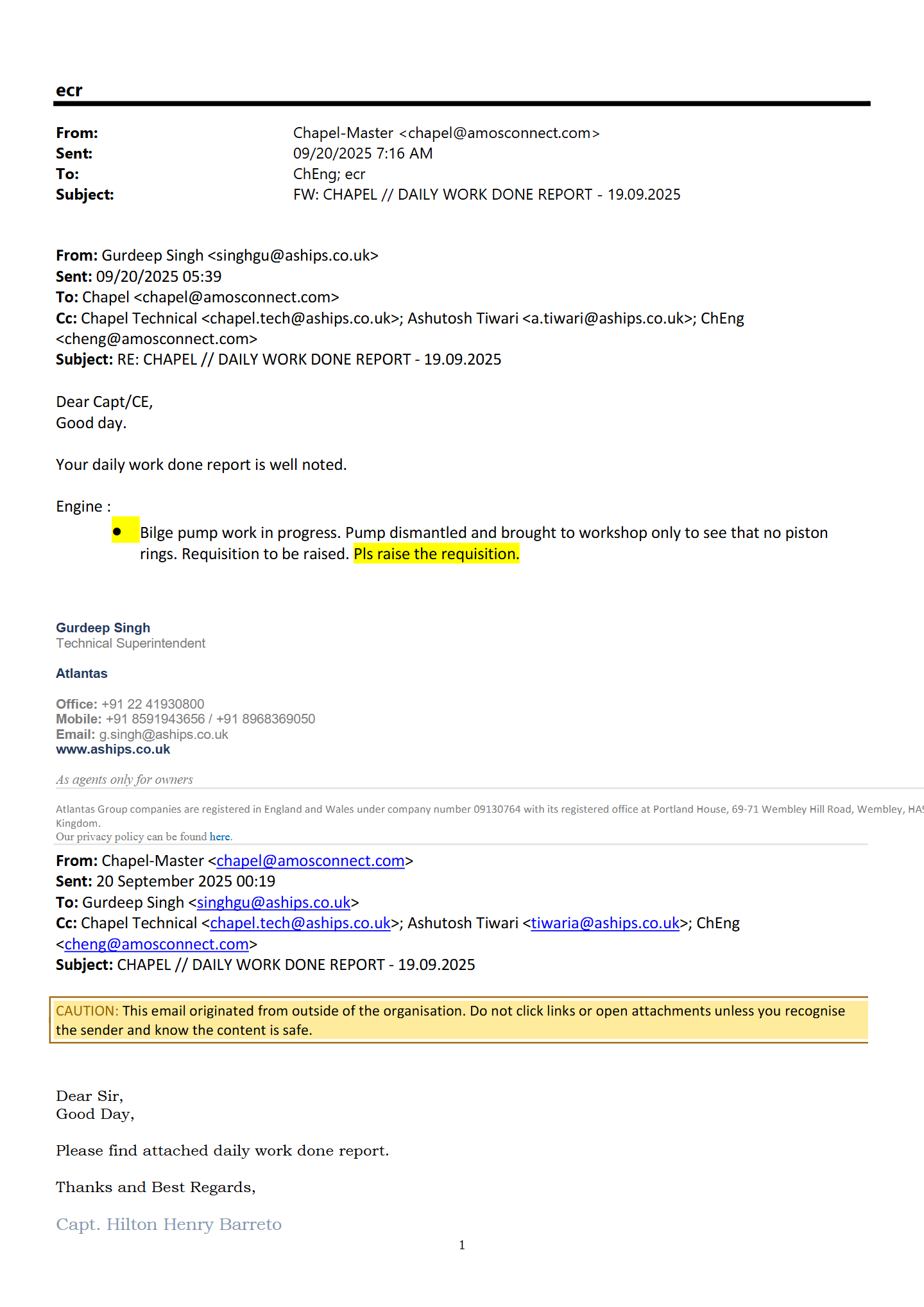
One recurring theme throughout the documentary material is the process by which concerns were communicated and answered. The reporting marine engineer’s account indicates that maintenance, welfare and operational matters were raised internally during his service.
Not every communication follows the same route. A maintenance requisition, defect report, near-miss or hazardous-occurrence report, Safety Management System non-conformity, welfare request and formal onboard complaint may involve different thresholds, recipients and records. A fair review must identify which route was used rather than treating every message as the same type of report.
Within the ISM framework, the Company defines authority and communication between ship and shore. The master retains overriding authority in matters of safety and pollution prevention. The designated person ashore provides a link with company management and monitors safety and pollution-prevention aspects, while technical and operational managers may handle the detailed assessment and resources required for concerns.
For welfare matters governed by the Maritime Labor Convention, a formal onboard complaint procedure may provide a separate route with defined safeguards. The existence of that route should not be confused with routine operational reporting, and this Part does not determine whether any communication entered a formal complaint process.
The quality of a reporting culture is therefore measured by more than the ability to send a message. It is reflected in whether the appropriate route is understood, whether the concern is acknowledged and assessed by competent persons, whether action or a reasoned decision follows, and whether the person raising the issue receives meaningful feedback.
Organizational Learning
Every maritime organization develops through experience. Some lessons follow casualties, audits or inspections. Others begin with routine observations made by personnel who recognize a change in condition or a weakness in a control before a reportable event occurs.
The material reviewed in this Dossier shows how one reporting marine engineer sought to preserve aspects of his operational experience through documents, photographs and written explanations. That preservation is evidence that concerns were important to him. It is not, by itself, evidence that the organization accepted or rejected them, or that a wider failure occurred.
Organizational learning becomes visible when information changes a decision, risk control, maintenance plan, procedure, resource allocation, training requirement or verification practice. It also requires corrective action to be checked for effectiveness and, where patterns are suspected, a structured review of comparable evidence rather than reliance on anecdotal similarity.
Responsibility is distributed but not undefined. The onboard team, master, shore technical management, designated person and senior company management have different functions. The documentary question is whether those functions connected effectively in the matter being examined.
Questions Raised by This Dossier
Without attempting to answer them definitively, the material reviewed by Maritime News invites several professional questions.
- How was each reported concern classified, and which procedure applied?
- Were the responsible onboard and shore-side decision-makers clearly identified?
- What evidence, risk assessment and operational constraints informed the response?
- Where an environmental concern was raised, was the exact system and applicable MARPOL requirement established?
- Where hot work was reported, was the space designated, was any restriction applicable, and were the required controls documented?
- Did corrective action include verification of effective close-out and measures intended to prevent recurrence?
- Were repeated or comparable observations reviewed as a possible trend rather than as isolated events?
- Did the reporting person receive a clear and technically reasoned response?
These questions are not directed solely at one vessel or one company. They are relevant wherever operational information must pass from observation to decision without losing its technical meaning.
Reflection
Throughout this Dossier, Maritime News has sought to separate visible or documentary material, attributed account and editorial analysis. That distinction becomes especially important when the subject moves from equipment condition to pollution prevention, hot-work authorization and organizational conduct.
Professional reporting does not require every concern to be accepted as correct. It requires the concern to be classified fairly, examined by competent persons and answered through a process that can be understood and reviewed.
Regulations, certificates and written procedures provide the framework. Operational discipline is demonstrated in how that framework is applied: who decides, what evidence is considered, what control is imposed, what record is created and how the result is verified.
The reporting marine engineer’s account represents one documented operational perspective. Its value does not depend on treating every assertion as a finding. Its value lies in asking whether the available record is complete enough to understand how concerns moved through the system and whether any lesson was converted into action.
Difficult questions do not weaken a safety culture when they are asked accurately, answered transparently and assessed in proportion to the evidence. That is how professional scrutiny contributes to safer operations.
End of Part VII
“Professional questions are not a sign of weakness. They are often the beginning of a stronger safety culture.”
Continue Reading
← Return to The Cost of Silence – Maritime News Dossier 001
Next Part
Part VIII – Breaking the Silence
“The decision to preserve documents is one thing. The decision to share them is another.”
Make us preferred source on Google
Reporting Basis: Official maritime regulatory frameworks, documentary material reviewed by Maritime News, attributed statements from the reporting marine engineer, internal correspondence and supporting photographic material where referenced.
Verification Note:
This Part is an editorial examination of questions arising from the documentary material reviewed by Maritime News. It does not establish a technical allegation, regulatory violation, common cause or organizational failure as proven.
The article itself states that Maritime News was not provided with every permit, risk assessment, equipment record, statutory certificate, log entry, internal audit or management-review record required to determine compliance. It also expressly states that the publication is not a flag-State investigation, Port State Control inspection, class survey, terminal review or judicial determination.
Where statements concerning MT Chapel or other vessels originate from the reporting marine engineer, they should remain clearly attributed unless independently supported by documentary evidence.
Reporting by MaritimeNews Bureaus, Writing and Editing by Jaspal Singh Naol Technical review and revisions by Priyatham Sanjeeva Reddy Ramidi


One thought on “Questions Beyond the Engine Room”