


MARITIME NEWS DOSSIERS
THE COST OF SILENCE
Part VIII
Breaking the Silenc
“Many operational records begin within a private professional setting. Some later become part of a wider safety conversation.”
Make us preferred source on Google
Editor’s Note
This Part examines why the reporting marine engineer chose to provide documentary material to Maritime News after completing his contract onboard MT Chapel. It is based on his written responses, the communication chronology and the documents made available during preparation of this Dossier.
His stated intention is relevant to understanding why he approached the publication. It does not verify the underlying events, establish the authenticity or completeness of every item, determine that internal remedies were exhausted, or decide whether any disclosure was legally protected or professionally required.
Internal operational reporting, an ISM non-conformity report, an onboard Maritime Labor Convention complaint, an onshore complaint to an authorized officer, a report to a flag or port State authority and disclosure to a media organization are different processes. Maritime News is acting as a publisher, not as a statutory investigator, competent authority, class surveyor or adjudicator.
Where this Part discusses documents, the descriptions refer to material provided to Maritime News. Publication requires separate editorial assessment of provenance, integrity, context, privacy, corroboration, public interest and the opportunity for materially affected parties to respond.
The End of a Contract
Every seafarer’s contract eventually reaches its final handover. Duties are transferred, personal belongings are packed, and the gangway is crossed for the last time in that period of service.
According to the chronology reviewed by Maritime News, the reporting marine engineer signed off MT Chapel in November 2025. The sequence described in this Part is based on the records available to the editorial team, including dated communications and the source’s written responses. It should not be read as verification of any event for which no original record has been examined.
By the end of his contract, the reporting marine engineer had retained photographs, communications and written material relating to matters that, in his professional judgment, deserved further attention. Some records appear contemporaneous with his service; other explanations were prepared later to describe their context.
That distinction matters. A contemporaneous email may establish that a concern was communicated on a particular date. It does not necessarily prove that the concern was technically correct. A later explanation may assist interpretation, but it remains a recollection unless supported by other evidence.
The material would later form the documentary basis from which Maritime News began its editorial review.
From Internal Reporting to External Disclosure
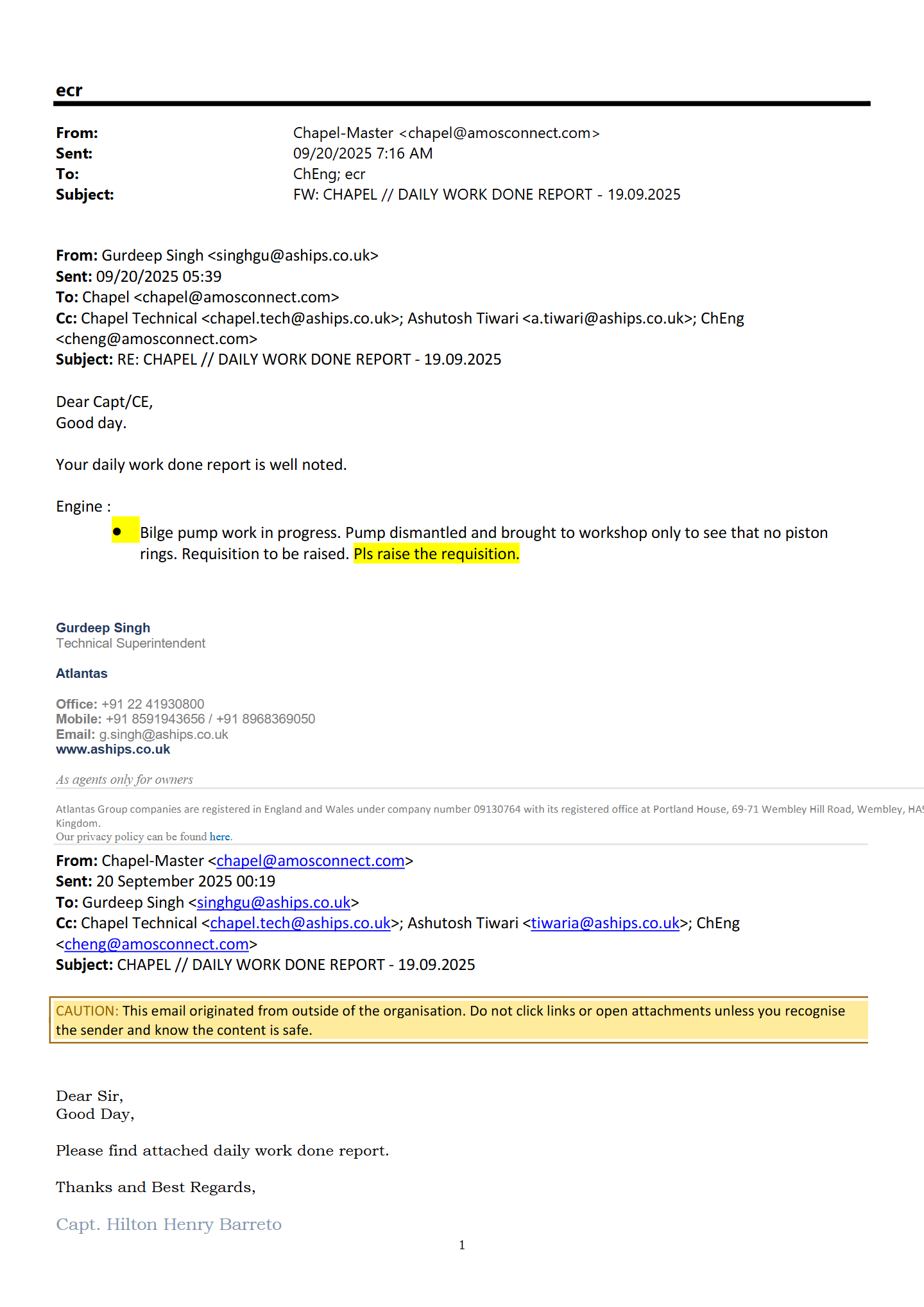
The reporting marine engineer’s account indicates that maintenance and welfare matters were communicated internally while he remained onboard. The documents reviewed by Maritime News support the existence of a number of such communications.
Not every communication has the same procedural meaning. A requisition, defect report, technical email, hazardous-occurrence report, Safety Management System non-conformity, welfare request and formal onboard complaint may have different recipients, thresholds and required responses. A fair chronology must identify the route used rather than treating all correspondence as one reporting process.
The Maritime Labor Convention requires onboard procedures for fair, effective and expeditious handling of complaints alleging breaches of its requirements. It also protects the right to complain directly to the master and appropriate external authorities and requires safeguards against victimization for filing a complaint. An onshore complaint may also be made to an authorized officer in a port, with confidentiality safeguards.
Those formal protections are relevant to seafarer reporting, but they do not make a media organization a competent authority or convert every public disclosure into an MLC complaint. The legal and contractual position of material supplied to a publisher depends on the applicable jurisdiction, employment terms, confidentiality obligations, personal data and the nature of the documents.
The available chronology indicates that the reporting marine engineer approached Maritime News after his contract had ended. This sequence provides context. It does not, by itself, establish that the internal response was inadequate, that every formal route had been used, or that public disclosure was the only remaining option.
Why Maritime News?
During the editorial review, Maritime News asked the reporting marine engineer why he had decided to provide the material.
His written response was:
“My primary intention is no other seafarers should suffer in the company.”
The quotation is reproduced as supplied. It is presented solely as the reporting marine engineer’s stated reason for approaching Maritime News.
The statement does not establish that other seafarers experienced similar conditions, that the company caused harm, or that the source’s interpretation of every event was correct. Motive, credibility, authenticity and substantive accuracy are separate editorial questions.
Maritime News accepted responsibility for a different decision: whether the material presented a legitimate public-interest subject that could be examined fairly, technically and with appropriate protection for affected individuals. That decision required more than accepting the source’s intention. It required independent scrutiny of the documents and of the limits of what they could prove.
Professional Responsibility Beyond Sign-Off
Sign-off ends the marine engineer’s onboard role and the watchkeeping responsibilities attached to that service. It does not erase the professional knowledge acquired during the contract.
Experience at sea may later contribute to mentoring, training, safety meetings, technical discussion, formal complaints, cooperation with competent authorities or industry learning. The appropriate route depends on the nature and urgency of the concern, the evidence available and the procedures and law that apply.
Public disclosure is not an automatic extension of marine engineering duty. Nor is silence always evidence of indifference. Professional judgment may require immediate escalation in one situation, patient verification in another, and protection of confidential or personal information throughout.
This Dossier examines one source’s decision to provide material after sign-off. It does not determine that every seafarer in similar circumstances should make the same decision.
The Weight of Documentation
The reporting marine engineer did not provide a single photograph or one isolated recollection. He provided a collection of emails, photographs, written explanations and chronological responses accumulated or prepared over time.
A collection can provide valuable context, but its evidentiary weight does not arise from volume alone. Each item must be assessed for provenance, date, authorship, continuity, completeness and relationship to the event it is said to document.
For the editorial review, original files should be preserved separately from working copies. Email headers, attachment relationships and available metadata should be retained. Screenshots, exports, cropped photographs, redacted copies and publication extracts should be identified as such. Any enhancement or conversion should be documented so that it is not mistaken for an original.
The verification language must also remain precise. A message may confirm that a concern was raised. A photograph may show a visible condition at the moment captured. Neither necessarily establishes duration, cause, technical consequence, management knowledge or the absence of later corrective action.
Editorial assessment therefore considers both what the documents support and what they do not answer. It also requires protection of crew identities, personal information, private welfare details and security-sensitive content that is not necessary to the public-interest purpose.
Where a proposed passage carries a materially adverse implication, fairness requires a meaningful opportunity for affected parties to respond. A response may add records, correct dates, dispute interpretation or identify action not visible in the source material. A refusal or failure to respond is not, by itself, proof of the allegation.
Beyond One Vessel
Throughout preparation of this Dossier, Maritime News has treated MT Chapel as the subject of a documented case study rather than as a basis for defining an entire organization or the maritime industry.
One source’s operational experience may raise questions of wider relevance without establishing that the same conditions existed on other vessels. General lessons must therefore be separated from vessel-specific evidence and from any broader assertion that remains unverified.
The public-interest value of the Dossier lies in the professional questions it permits readers to examine: how concerns are recorded, how reporting routes operate, how documents are evaluated, how welfare and maintenance issues are answered, and how organizations convert experience into corrective action and learning.
That approach does not require the reader to accept every allegation. It requires the publication to distinguish visible fact, documentary record, attributed account, response and editorial analysis with consistency.
Reflection
Breaking silence is often described as a single decisive moment. In professional practice, the transition from private concern to public discussion should be a process.
It may begin with observation and contemporaneous recording. It may continue through internal reporting, assessment, follow-up and, where appropriate, a formal complaint or report to a competent authority. If material later reaches a publisher, a new set of responsibilities begins.
Those responsibilities include preserving originals, testing authenticity and context, protecting confidential and personal information, seeking corroboration, inviting a meaningful response, correcting errors and avoiding conclusions that exceed the evidence.
The reporting marine engineer supplied documents with one stated intention. Maritime News is independently responsible for deciding what can be verified, what should remain attributed, what should not be published and what public-interest purpose each disclosure serves.
Professional integrity is not demonstrated by disclosure alone. It is demonstrated by accuracy, proportionality, fairness and care at every stage between the original observation and the final published account.
End of Part VIII
“Professional integrity is measured not only by the concerns we raise, but by the accuracy, fairness and care with which we present them.”
Continue Reading
← Return to The Cost of Silence – Maritime News Dossier 001
Next Part
Part IX – Lessons for the Maritime Industry
“The value of every documented experience lies not only in what it says about the past, but in what it can teach about the future.”
Make us preferred source on Google
Reporting Basis: Written responses from the reporting marine engineer, communication chronology and documentary material made available to Maritime News during preparation of Dossier 001.
Verification Note: This Part examines why the reporting marine engineer provided documentary material to Maritime News after completing his contract onboard MT Chapel. His stated intention is presented as his own account and does not, by itself, verify the underlying events or establish the authenticity, completeness or legal status of every document supplied.
The article makes an important distinction between internal operational reporting, ISM non-conformity reporting, Maritime Labour Convention complaints, complaints to competent authorities and disclosure to a media organization. These are separate processes, and Maritime News is acting as a publisher rather than as a statutory investigator, competent authority, class surveyor or adjudicator.
The article also establishes that documentary volume does not automatically establish evidentiary weight. Provenance, date, authorship, continuity, completeness, context and corroboration remain relevant to editorial assessment.
Where a document establishes only that a concern was communicated, it should not be represented as automatically proving the technical correctness of that concern. Similarly, a photograph may show a condition at the time it was captured without establishing its duration, cause, consequence, management knowledge or subsequent corrective action.
Reporting by MaritimeNews Bureaus, Writing and Editing by Jaspal Singh Naol Technical review and revisions by Priyatham Sanjeeva Reddy Ramidi



2 thoughts on “Breaking the Silence: From Sign-Off to Disclosure”