

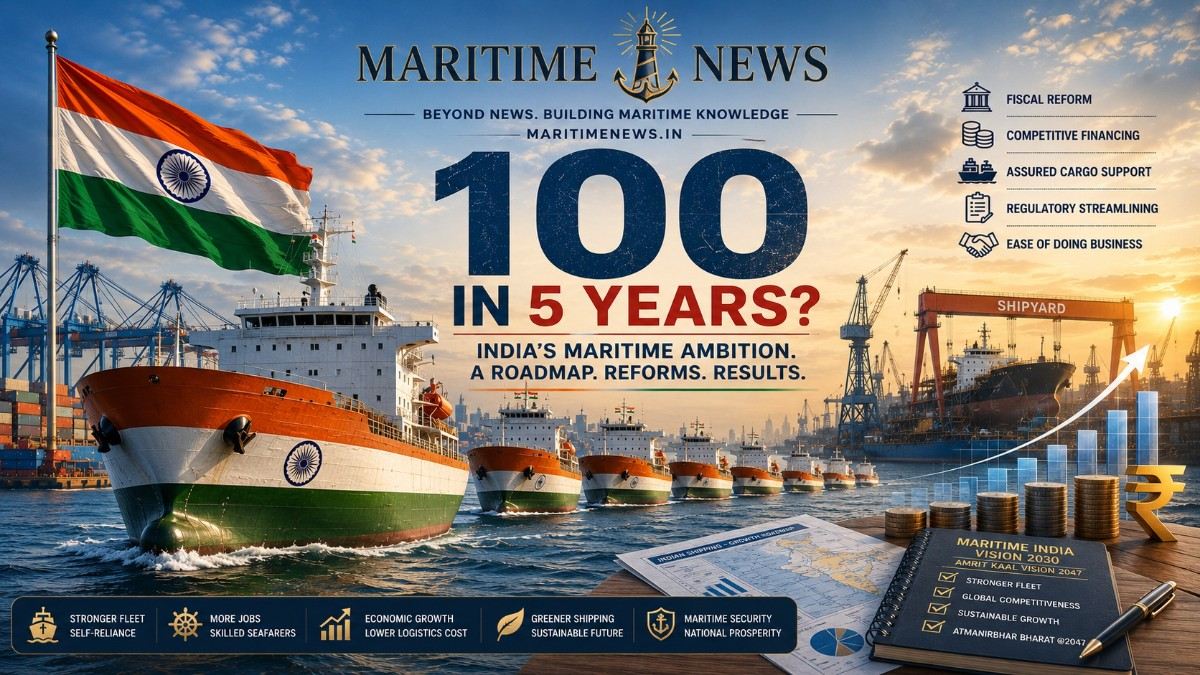
Does India’s 100-Ship Plan Match Its Much Larger Maritime Ambition?
National Shipping Board proposes five-pillar roadmap to make Indian shipping competitive, but the 100-ship proposition must be reconciled with India’s ₹69,725-crore shipbuilding package, ₹25,000-crore Maritime Development Fund, 62-vessel FY2026–27 plan, 400-plus vessel acquisition programme and 4.5-million-GT shipbuilding capacity target.
Make us preferred source on Google
Key Takeaways
- The National Shipping Board held its first Sagar Samvad on August 25, 2026, bringing government, shipowners, financiers, maritime experts and young cadets together.
- The NSB’s five-pillar roadmap covers fiscal reform, assured cargo support, competitive financing, regulatory streamlining and ease of doing business.
- The government says the proposed measures could help India add 100 vessels within five years if adopted; the statement does not establish the 100 vessels as an unconditional sanctioned target.
- Industry representatives said Indian-flagged ships remain 16–20% costlier than foreign-flagged ships.
- Union Minister of State Shantanu Thakur said India pays close to $75 billion annually in freight to foreign shipping lines for cargo including crude oil, gas, coal and urea.
- The 100-ship proposition needs to be read alongside India’s ₹69,725-crore maritime and shipbuilding package, including ₹24,736 crore for SBFAS, ₹25,000 crore for MDF and ₹19,989 crore for the Shipbuilding Development Scheme.
- India is simultaneously pursuing a 62-vessel FY2026–27 programme, a 400-plus vessel acquisition plan, and a target of 4.5 million GT of annual shipbuilding capacity.
- The central policy question is how these programmes connect, what their annual milestones are, and how their achievements will be audited.
Also Read: THE COST OF SILENCE
New Delhi, India, August 31, 2026 (Maritime News) : The National Shipping Board’s first ‘Sagar Samvad’ has put India’s dependence on foreign shipping at the centre of the national maritime policy conversation, with the government saying that proposed reforms could help India add 100 vessels to its merchant fleet within five years — if the measures are adopted.
That last qualification may be the most important part of the announcement.
The first Sagar Samvad, held in Delhi on August 25, brought together policymakers, shipowners, financiers, maritime industry representatives and young cadets to discuss the roadmap towards Maritime India Vision 2030 and Maritime Amrit Kaal Vision 2047. Union Minister for Ports, Shipping & Waterways Sarbananda Sonowal chaired the programme and launched the National Shipping Board’s first official website, while NSB Chairperson Sameer Kumar Khare submitted the Board’s 2025–26 annual report and subcommittee reports containing policy advice to the government.
The discussion produced a five-pillar roadmap covering fiscal reform, assured cargo support, competitive financing, regulatory streamlining and ease of doing business.
But the 100-ship proposition comes at a time when India has already announced a much larger maritime financing and shipbuilding architecture.
The government has approved a ₹69,725-crore package for shipbuilding and maritime-sector development; established a ₹25,000-crore Maritime Development Fund; approved ₹24,736 crore for the Shipbuilding Financial Assistance Scheme; set a target of expanding annual Indian shipbuilding capacity to 4.5 million Gross Tonnage (GT) through the ₹19,989-crore Shipbuilding Development Scheme; prepared a 400-plus vessel fleet acquisition plan; and separately announced a 62-vessel, ₹51,383-crore programme for FY2026–27, targeting an additional 2.85 million GT of capacity.
The question, therefore, is no longer simply whether India needs more ships.
It is whether these multiple programmes are being converted into one measurable national fleet strategy.
Also Read: The Sea Doesn’t Forgive Silence
Sagar Samvad Brings the National Shipping Board Into the Fleet Debate
The inaugural Sagar Samvad was themed “Charting the Roadmap Towards Maritime India Vision 2030 and Maritime Amrit Kaal Vision 2047.”
The event was held at the Civil Services Officers Institute on Vinay Marg in New Delhi and brought together senior government officials, shipowners, financiers and young cadets from maritime training institutes.
Sonowal said the National Shipping Board is a statutory advisory institution intended to bring policymakers, industry, technocrats and other stakeholders into the shipping-policy process.
The Board, reconstituted in May 2025, used the first Sagar Samvad to present its work through its 2025–26 annual report and subcommittee reports, while also launching its official website.
The event therefore represented more than a conventional industry conference.
It was an attempt to place India’s shipping competitiveness problem within the formal policy-advisory process of the National Shipping Board.
The $75-Billion Problem
The economic case for expanding Indian tonnage was clearly stated during the programme.
Union Minister of State for Ports, Shipping & Waterways Shantanu Thakur said India pays close to $75 billion every year in freight to foreign shipping lines to transport cargo as strategically important as crude oil, gas, coal and urea.
The implication is significant.
India has invested heavily in ports, terminals and maritime infrastructure, but a substantial part of the value generated by transporting India’s international trade continues to accrue to foreign shipping companies.
The government’s objective is therefore not merely to build ports.
It is to build Indian shipping capacity capable of carrying Indian trade.
Also Read: THE PROMISE BEFORE BOARDING
Indian Ships Are Still More Expensive
The Sagar Samvad discussion also identified the competitiveness problem from the shipowner’s perspective.
Industry representatives said operating under the Indian flag remains 16–20% more expensive than operating under a foreign flag.
The panel attributed the gap to factors including taxation on ship imports and maintenance services, tax deducted from seafarers’ wages, taxation on freight and higher domestic capital costs — expenses that foreign competitors may not face to the same extent.
The panel therefore argued that the problem is not simply that Indian shipowners do not own enough ships.
The problem is that the economic environment in which Indian shipowners operate can make Indian-flagged shipping less competitive.
Five Pillars Proposed by the NSB
The Sagar Samvad panel proposed five areas for intervention.
Fiscal Reform
The first pillar seeks to address the fiscal disadvantages that make Indian shipping more expensive.
Assured Cargo Support
The second recognises that vessel investment requires visibility of cargo and revenue over long periods.
Competitive Financing
Ships are capital-intensive assets, making the cost and availability of finance central to fleet expansion.
Regulatory Streamlining
The fourth pillar seeks to reduce regulatory barriers and costs affecting shipping operations.
Ease of Doing Business
The fifth pillar is intended to improve the overall operating environment for Indian maritime businesses.
Sonowal welcomed the five-pillar roadmap and said the measures together represent an architecture for India to own a larger share of its trade rather than watching that trade move on foreign vessels.
Also Read: BOARDING MT CHAPEL
But “100 Ships” Needs a Baseline
This is where the Sagar Samvad announcement raises more questions than it answers.
The PIB release says the measures could help India add 100 ships within five years if adopted.
But it does not provide a detailed baseline for the 100 vessels.
It does not specify in the announcement:
- whether the 100 refers to Indian-owned vessels, Indian-flagged vessels, or both;
- the aggregate GT represented by the 100 ships;
- the vessel categories;
- how many vessels are expected to be built in India;
- how many are intended for strategic cargo;
- or how the 100-vessel figure is connected with existing acquisition programmes.
That distinction matters.
A vessel count alone does not adequately measure shipping capacity.
A 5,000-GT vessel and a 150,000-GT vessel both count as one ship.
For national shipping policy, therefore, number of vessels and Gross Tonnage must be measured together.
India Is Already Building a Much Larger Shipbuilding Architecture
The 100-ship proposition also cannot be viewed in isolation from the government’s September 2025 decision to approve a ₹69,725-crore comprehensive package to revitalise India’s shipbuilding and maritime ecosystem.
The package has three major financial components relevant to this discussion.
The Shipbuilding Financial Assistance Scheme (SBFAS) has an outlay of ₹24,736 crore to address the cost disadvantages faced by Indian shipyards compared with global shipyards.
The Maritime Development Fund (MDF) has a corpus of ₹25,000 crore for long-term financing of the shipbuilding and maritime sector.
And the Shipbuilding Development Scheme (SbDS) has an outlay of ₹19,989 crore to expand domestic shipbuilding capacity.
The government’s wider package is therefore aimed not merely at acquiring ships but at building the industrial ecosystem required to manufacture and finance them.
Also Read: When Documents Begin Speaking
The ₹25,000-Crore Maritime Development Fund
The MDF is particularly relevant to the NSB’s call for competitive financing.
The ₹25,000-crore fund consists of:
- ₹20,000 crore Maritime Investment Fund (MIF); and
- ₹5,000 crore Interest Incentivisation Fund (IIF).
The government has a 49% participation in the Maritime Investment Fund, while the fund is intended to provide long-term financing support to the shipbuilding and maritime sector.
The guidelines for the MDF were issued on 20 February 2026, and SBI Ventures Limited was appointed as the Fund Manager for the Maritime Investment Fund on 26 May 2026.
This creates an important policy question.
If competitive financing is one of the NSB’s five pillars, how much of the newly established financing architecture has actually translated into financing for vessels and maritime projects?
The existence of a fund is not the same as its utilisation.
The relevant chain is:
Corpus → Applications → Approvals → Commitments → Disbursement → Vessels/Projects → Outcomes.
The Sagar Samvad announcement does not provide that complete chain.
India’s Shipbuilding Target Is 4.5 Million GT
The government’s ₹19,989-crore Shipbuilding Development Scheme aims to increase India’s annual shipbuilding capacity to 4.5 million Gross Tonnage.
The programme includes greenfield shipbuilding clusters and expansion of existing shipyards.
This is important because it shows that India’s maritime strategy is already moving beyond simple vessel counts.
The government is measuring industrial capacity in millions of GT.
The 100-ship proposition should therefore eventually be expressed in the same language.
Otherwise, India may know how many ships it wants but not how much actual commercial tonnage those ships represent.
Also Read: Inside the Engine Room
The 400-Plus Vessel Acquisition Plan
The government has also prepared a fleet acquisition plan for more than 400 vessels as part of its demand-aggregation strategy.
The stated objective is to provide long-term order visibility to Indian shipyards.
This is an important link between shipping and shipbuilding.
Shipyards need orders.
Shipowners need commercially viable vessels.
Cargo owners need competitive transportation.
Financiers need bankable projects.
The government is attempting to connect those four requirements.
But the Sagar Samvad release does not explain how the 100-vessel five-year proposition relates to the 400-plus vessel acquisition plan.
They should not be assumed to be cumulative.
They may represent different programmes, time horizons, vessel categories or ownership structures.
The government needs to explain the relationship.
The 62-Vessel Programme Is Another Piece of the Puzzle
In April 2026, the government announced a plan for 62 vessels in FY2026–27, with an investment of ₹51,383 crore.
The programme targets an additional 2.85 million GT of capacity.
The vessels identified include container vessels, LPG carriers, crude oil carriers, green tugs, dredging vessels and tankers.
The government also reviewed a proposal involving the Shipping Corporation of India and oil PSUs for the acquisition of 59 vessels.
This is precisely why the 100-ship figure needs greater explanation.
If India is already pursuing a 62-vessel programme in one financial year, what exactly does the NSB’s 100-vessel five-year proposition represent?
Is it:
- an additional 100 vessels?
- a private-sector target?
- a net fleet-addition target?
- a target for Indian-flagged vessels?
- a target for Indian-owned vessels?
- or a subset of the government’s broader fleet-acquisition strategy?
The Sagar Samvad release does not answer these questions.
Also Read: Living Below Deck
India Has Also Given Large Vessels Infrastructure Status
As part of the broader shipbuilding strategy, the government notified infrastructure status for Indian-flagged commercial vessels of 10,000 GT and above in September 2025.
For vessels constructed in India, infrastructure status was extended to vessels of 1,500 GT and above.
This is another important policy intervention because infrastructure classification can improve access to financing and change the investment environment.
Again, however, the success of the policy will ultimately depend on whether it produces measurable fleet growth.
The Real Question: Are India’s Schemes Being Used?
The Sagar Samvad discussion creates a legitimate policy question without providing enough information to answer it.
India now has:
₹25,000 crore of MDF financing architecture.
₹24,736 crore of shipbuilding financial assistance.
₹19,989 crore for shipbuilding development.
A ₹69,725-crore overall package.
A 400-plus vessel acquisition plan.
A 62-vessel FY2026–27 plan worth ₹51,383 crore.
A target of 2.85 million GT of additional capacity in FY2026–27.
And a 4.5-million-GT annual shipbuilding-capacity ambition.
The question is therefore not simply:
Does India have money for maritime development?
The better question is:
How quickly is that money becoming actual ships, shipyard capacity and competitive Indian tonnage?
This distinction is essential.
A policy can be financially large but commercially underutilised.
Conversely, a smaller programme can produce significant outcomes if it is efficiently deployed.
Also Read: Questions Beyond the Engine Room
Is the 100-Ship Number Conservative?
It would be premature to say that the NSB is underestimating India’s potential.
The PIB wording makes the 100-ship number conditional.
It is a potential outcome if the proposed measures are adopted.
It may therefore be a deliberately conservative five-year estimate based on the current competitiveness gap.
But there is another possibility.
The 100 ships may represent only one component of a much larger transformation already underway through shipbuilding support, demand aggregation and public-sector fleet acquisition.
That is why the NSB should define the number more precisely.
The government has set much larger industrial objectives for shipbuilding.
The maritime sector therefore needs a corresponding fleet objective expressed in:
vessels + GT + ownership + flag + cargo carried + value retained.
The Missing Annual Roadmap
The biggest weakness in the present announcement is not necessarily the 100-ship number.
It is the absence of a publicly stated implementation trajectory.
If 100 ships is adopted as a five-year target, the country should know:
Year 1: What is the target?
Year 2: What is the target?
Year 3: What is the target?
Year 4: What is the target?
Year 5: What is the final target?
And each year should disclose:
- vessels ordered;
- vessels financed;
- vessels under construction;
- vessels delivered;
- GT added;
- ownership;
- flag;
- Indian-built share;
- cargo carried;
- financing sanctioned;
- financing disbursed;
- foreign freight expenditure displaced.
A five-year target without annual milestones risks becoming a number that is remembered only at the end of the programme.
Also Read: Breaking the Silence: From Sign-Off to Disclosure
Maritime Strategy Cannot Be Only a 2047 Vision
India’s maritime policy increasingly uses long-term horizons.
The Maritime Amrit Kaal Vision 2047 targets India among the top 10 in ship ownership and shipbuilding by 2030 and the top five by 2047.
That long-term ambition is necessary.
But a 2047 vision cannot be implemented only through a 2047 deadline.
A national maritime strategy needs multiple checkpoints:
Annual — implementation
Three years — programme review
Five years — strategic milestone
Ten years — structural transformation
2047 — national outcome
And the annual performance against those targets should be publicly audited.
The National Shipping Board’s Opportunity
This is where the National Shipping Board can play a particularly important role.
The NSB is not simply another implementing agency.
It is the statutory advisory body that brings industry and government perspectives into shipping policy.
Its first Sagar Samvad has already brought the relevant stakeholders together.
The next step could be to turn the dialogue into a measurable national shipping roadmap.
The NSB could publish or recommend a common baseline covering:
Indian-owned fleet
Indian-flagged fleet
Gross Tonnage
Vessel categories
Age profile
Indian-built tonnage
Cargo carried by Indian vessels
Foreign freight expenditure
Financing availability
Financing utilisation
Shipbuilding orders
Shipyard capacity
Seafarer requirements
Such a baseline would make the 100-ship proposition measurable.
Also Read: Lessons for the Maritime Industry
Why the “IF” Matters
The most important word in the Sagar Samvad announcement may therefore be “if.”
The government has not said that 100 ships will automatically be added.
It has said that the proposed measures could help achieve that outcome if adopted.
That means the real policy work begins after Sagar Samvad.
The five pillars must move from recommendations into policy.
Policy must move into schemes.
Schemes must move into applications.
Applications must become approvals.
Approvals must become financing.
Financing must become vessel orders.
Orders must become ships.
And ships must become commercially competitive Indian tonnage.
Only then will the $75-billion foreign freight problem begin to change.
What India Should Measure
For MaritimeNews, the real measure of success should not be the number of announcements.
It should be the movement of capital through the maritime ecosystem.
₹1 allocated is an announcement.
₹1 sanctioned is a financial decision.
₹1 disbursed is deployment.
A vessel ordered is industrial demand.
A vessel delivered is capacity.
A vessel operated competitively by an Indian owner is shipping capability.
Cargo carried by that vessel is economic utilisation.
And freight retained by Indian shipping is the ultimate national outcome.
That is the chain that India’s maritime policy should track.
Conclusion: Sagar Samvad Starts With “IF”; Implementation Must End With “Achievement”
The first Sagar Samvad has done something important.
It has brought India’s shipping competitiveness problem into a national policy dialogue and put a potential 100-ship, five-year outcome on the table.
It has also identified five areas that the industry believes require intervention: fiscal reform, assured cargo support, competitive financing, regulatory streamlining and ease of doing business.
But India is no longer operating without a maritime policy architecture.
The country has already committed ₹69,725 crore to strengthen shipbuilding and maritime capacity.
It has established a ₹25,000-crore Maritime Development Fund.
It has allocated ₹24,736 crore under SBFAS.
It has a ₹19,989-crore Shipbuilding Development Scheme targeting 4.5 million GT of annual shipbuilding capacity.
It has prepared a 400-plus vessel acquisition plan.
It has announced 62 vessels worth ₹51,383 crore for FY2026–27, targeting 2.85 million GT.
And it has set long-term ambitions of placing India among the world’s leading ship-owning and shipbuilding nations.
The challenge now is to connect these programmes.
The 100 ships need a baseline.
They need a GT target.
They need an annual trajectory.
They need financing milestones.
They need cargo targets.
They need ownership and flagging targets.
They need a three-year review.
They need a five-year audit.
They need a ten-year structural milestone.
And they need to sit within the larger 2047 maritime vision.
Because India’s maritime future cannot be measured by how many schemes are announced.
It has to be measured by how many competitive Indian vessels actually enter service, how much cargo they carry, how much Indian tonnage grows, how much shipbuilding capacity is utilised and how much of India’s enormous freight bill remains within the Indian maritime economy.
The first Sagar Samvad has started with “IF.”
The next Sagar Samvad should be able to answer:
What happened?
What was achieved?
What was missed?
Why?
And what will change next year?
That is how a maritime vision becomes a national strategy.
And that is how a strategy becomes measurable national capability.
Frequently Asked Questions (FAQs)
What is Sagar Samvad?
Sagar Samvad is the National Shipping Board’s dialogue platform for bringing policymakers, maritime industry stakeholders, experts, financiers and other participants together to discuss India’s shipping and maritime policy priorities. Its inaugural edition was held in New Delhi on August 25, 2026.
What did the National Shipping Board propose at the first Sagar Samvad?
The NSB panel proposed a five-pillar roadmap covering fiscal reform, assured cargo support, competitive financing, regulatory streamlining and ease of doing business.
Will India definitely add 100 ships in five years?
Not yet. The PIB statement says the proposed measures could help India add 100 vessels within five years if they are adopted. Therefore, the 100-ship figure should currently be understood as a potential outcome of the proposed reforms rather than an unconditional delivery commitment.
Why does India want more Indian ships?
India relies significantly on foreign shipping lines to transport its international trade. At Sagar Samvad, Union Minister of State Shantanu Thakur said India pays close to $75 billion annually in freight to foreign shipping lines for cargo including crude oil, gas, coal and urea.
Why are Indian-flagged ships considered more expensive?
Industry representatives at Sagar Samvad said Indian-flagged shipping is 16–20% more expensive than foreign-flagged alternatives. They attributed the gap to factors including taxation, domestic capital costs and other fiscal and regulatory burdens.
How much money has India committed to shipbuilding and maritime development?
The government approved a comprehensive ₹69,725-crore package. Its major components include ₹24,736 crore for SBFAS, ₹25,000 crore for the Maritime Development Fund and ₹19,989 crore for the Shipbuilding Development Scheme.
What is the Maritime Development Fund?
The MDF has a corpus of ₹25,000 crore. It comprises a ₹20,000-crore Maritime Investment Fund and a ₹5,000-crore Interest Incentivisation Fund. The government has 49% participation in the Maritime Investment Fund.
What is India’s shipbuilding-capacity target?
The Shipbuilding Development Scheme has an outlay of ₹19,989 crore and aims to expand India’s annual shipbuilding capacity to 4.5 million Gross Tonnage through greenfield clusters and expansion of existing shipyards.
What is the 400-plus vessel acquisition plan?
The government has prepared a fleet acquisition plan for more than 400 vessels as part of demand aggregation. It is intended to provide long-term order visibility to Indian shipyards.
What is the 62-vessel programme?
In April 2026, the government announced plans for 62 vessels during FY2026–27, involving ₹51,383 crore and targeting an additional 2.85 million GT of capacity. The identified vessel categories include container vessels, LPG carriers, crude oil carriers, green tugs, dredging vessels and tankers.
Are the 100 ships, 62 ships and 400-plus vessels the same programme?
The available Sagar Samvad announcement does not establish that they are the same. They should not be added together or treated as cumulative without clarification. They may represent different programmes, time horizons, vessel categories or ownership structures.
What should India do next?
India should establish a common baseline and publish annual targets for vessels, GT, ownership, flag, shipbuilding, financing, cargo carried and freight retained. The five-year target should be accompanied by annual milestones, a three-year review, a five-year assessment, a ten-year milestone and an annual public achievement audit.
What is the larger objective under Maritime Amrit Kaal Vision 2047?
The government has stated an ambition to place India among the top 10 in ship ownership and shipbuilding by 2030 and the top five by 2047.
Make us preferred source on Google
Source / Reporting Basis
Additional government-policy basis:
Government of India/PIB material concerning the ₹69,725-crore shipbuilding and maritime package, ₹25,000-crore Maritime Development Fund, ₹24,736-crore Shipbuilding Financial Assistance Scheme, ₹19,989-crore Shipbuilding Development Scheme, 4.5-million-GT annual shipbuilding-capacity target, 400-plus vessel acquisition plan and 62-vessel FY2026–27 programme.
Reporting approach:
The article distinguishes between the PIB’s conditional “could help add 100 vessels within five years, if adopted” formulation and an actual government delivery commitment. The wider policy figures are used for context and comparison, not added together as a single fleet target.
Reporting by: MaritimeNews Bureaus, Writing & Editing by: Jaspal Singh Naol, Editor-in-Chief
3 thoughts on “National Shipping Board’s First Sagar Samvad Starts With “IF””