

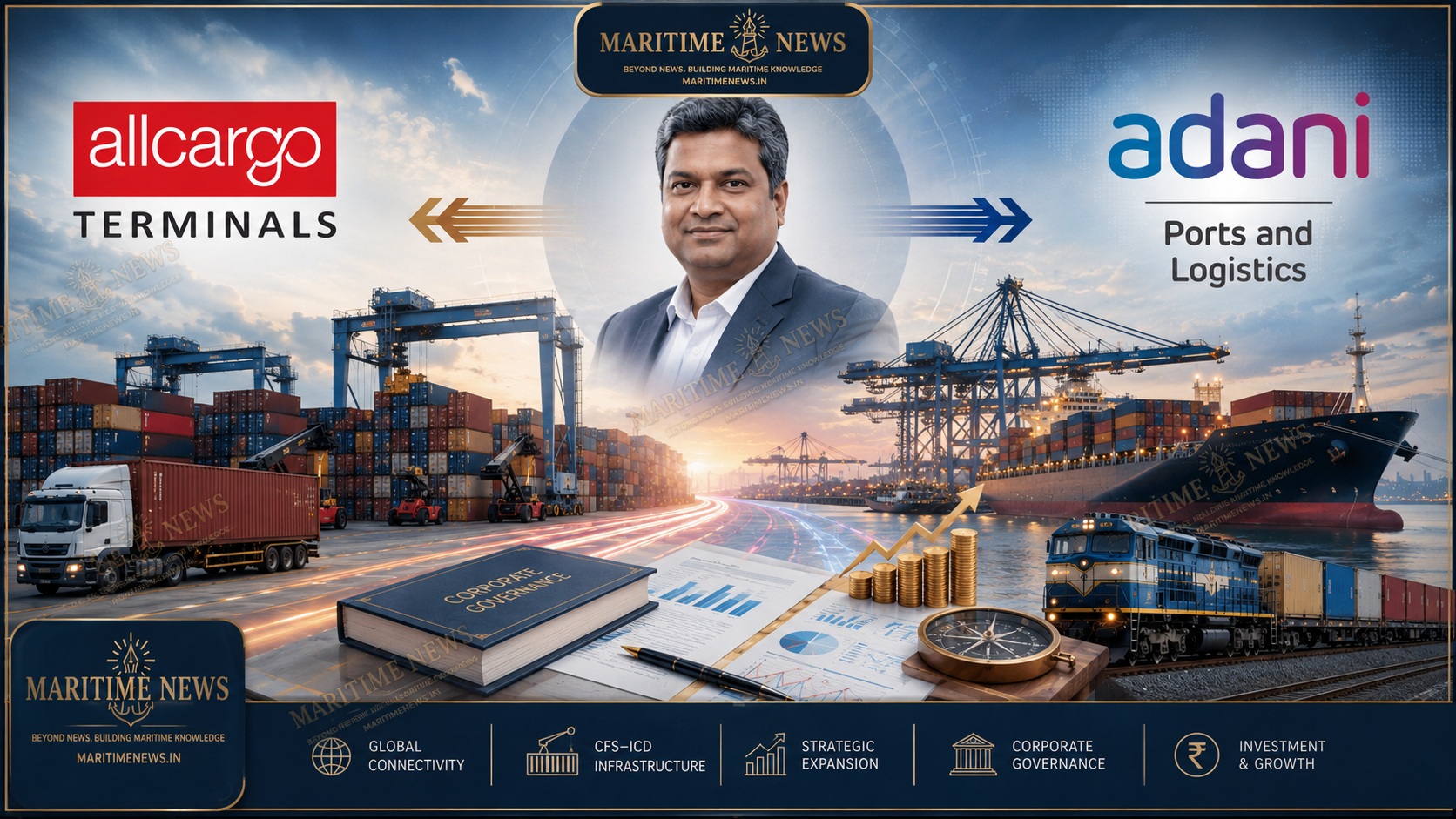
The Choudhary–Bansal–Ramiah Transition Raises Bigger Questions
As Niraj Bansal replaces Choudhary at APSEZ and Suresh Kumar Ramiah completes his tenure at Allcargo, the leadership change comes amid a wider expansion and corporate restructuring of India’s port-linked logistics chain
Make us preferred source on Google
Key Takeaways
- APSEZ announced Pranav Choudhary’s departure on May 11, 2026, with his CEO–Ports tenure ending May 31.
- Niraj Bansal took over as CEO–Ports on June 1.
- APSEZ stated that Choudhary was leaving to pursue career opportunities outside the Adani Group.
- The public disclosure does not establish that Choudhary was demoted, removed or forced to resign.
- Choudhary had previously held senior positions covering Hazira and Dahej ports, the container business and the Ports vertical.
- Allcargo disclosed Suresh Kumar Ramiah’s superannuation on August 11, with his tenure ending August 31.
- On the same August 11 Board meeting, Allcargo approved Choudhary as Additional Director and Managing Director effective September 1 for three years, subject to shareholder approval.
- The Board also approved the reconstitution of key Board committees effective September 1.
- Choudhary is to join the Audit Committee, Stakeholders Relationship Committee and CSR Committee as part of the new committee structure.
- ATL had already approved the acquisition of a 25% stake in Allcargo Group Services Private Limited (AGSPL) on May 21, with the Shareholders Agreement executed July 1 and the acquisition subsequently disclosed in July.
- AGSPL is a shared corporate-services platform, not another CFS, ICD or port acquisition.
- ATL operates CFS–ICD infrastructure at major locations including JNPT, Mundra, Chennai and Kolkata, along with an ICD at Dadri.
- Allcargo has outlined expansion plans targeting 1 million laden TEUs, with capacity expected to rise beyond 1.25–1.3 million TEUs.
- The company has indicated approximately ₹400 crore of expenditure for its broader expansion plan, to be phased through FY2030.
- Expansion initiatives include JNPT, Mundra, Chennai and Farukhnagar.
- Q1 FY27 consolidated revenue from operations stood at ₹214.41 crore, while consolidated profit after tax stood at ₹6.37 crore.
- Allcargo’s August 11 filing also disclosed an income-tax assessment demand of ₹49.35 crore, against which the company has appealed the balance amount, as well as a separate GST dispute.
- The story therefore involves leadership transition, corporate restructuring, capital deployment and expansion, rather than merely a change of Managing Director.
Also Read: National Shipping Board’s First Sagar Samvad Starts With “IF”
Mumbai, Maharashtra, India August 31, 2026 (Maritime News) : The appointment of Pranav Choudhary as Managing Director of Allcargo Terminals Limited (ATL) is more than a routine executive transition.
It completes one leadership change while opening another.
On May 11, 2026, Adani Ports and Special Economic Zone (APSEZ) announced that Choudhary would cease to be CEO–Ports with effect from May 31. Niraj Bansal was appointed to take over from June 1. APSEZ stated that Choudhary was leaving to pursue career opportunities outside the Adani Group.
On the Allcargo side, the company disclosed on August 11 that its Managing Director Suresh Kumar Ramiah would cease to hold office at the close of business on August 31 following superannuation in accordance with the company’s retirement policy.
But August 11 contained a second, and potentially more significant, decision.
The Allcargo Board approved Choudhary’s appointment as Additional Director and Managing Director effective September 1, 2026, for a three-year term, subject to shareholder approval.
The Board also approved the reconstitution of key committees effective September 1.
In other words, Allcargo had selected Choudhary 20 days before Ramiah’s tenure ended.
The appointment also came after ATL had already begun changes to its corporate structure and while the company was preparing for a substantial expansion of its CFS–ICD network.
The chronology therefore raises questions beyond the appointment itself.
Why did Choudhary leave APSEZ? Why was Bansal selected to replace him? Why did Allcargo choose a former APSEZ CEO–Ports to lead its next phase? Can Choudhary’s experience help Allcargo capture more cargo and customers? Can his infrastructure and policy-facing experience create new opportunities? And, if Allcargo becomes substantially larger, could its platform eventually become strategically attractive to a larger integrated port-and-logistics group?
The available disclosures do not answer all of these questions.
That is precisely why the transition deserves attention.
Part I — May 11: Choudhary Leaves APSEZ
The first event occurred at APSEZ.
On May 11, 2026, APSEZ announced a leadership transition in its Ports business.
Pranav Choudhary was to cease as CEO–Ports on May 31, while Niraj Bansal would assume the position from June 1.
APSEZ stated that Choudhary was leaving to pursue career opportunities outside the Adani Group.
That is the official explanation.
But it does not explain the circumstances surrounding the change.
There is no public evidence in the announcement establishing that Choudhary was demoted.
There is no evidence establishing that he was removed.
There is no evidence establishing that he was forced to resign.
Those possibilities should therefore remain questions, not conclusions.
The question for readers is straightforward:
What happened inside APSEZ before Choudhary’s departure?
The public disclosure does not provide the answer.
Also Read: THE COST OF SILENCE
Part II — Bansal Takes Over
On June 1, Niraj Bansal assumed the CEO–Ports position.
His background is markedly different from Choudhary’s.
APSEZ’s disclosure states that Bansal served for more than 27 years in the Government of India as an Indian Revenue Service officer before taking voluntary retirement as Commissioner of Income Tax.
He subsequently served as:
- Deputy Chairman of JNPT; and
- Chairman-in-charge of JNPT between 2014 and 2019.
He later joined the Adani Group and held senior positions in its ports and infrastructure businesses.
His career therefore combines:
Government
→ Port administration
→ JNPT
→ Private-sector ports
→ Infrastructure development
The change does not prove that APSEZ was deliberately seeking a different leadership profile.
But it raises a reasonable question:
Was APSEZ looking for a different combination of government, port-administration and infrastructure experience for the next phase of its Ports business?
That remains unanswered.
Part III — What Choudhary Was Leaving Behind
Choudhary’s experience at APSEZ was broad.
He had served as:
- Senior Vice President & CEO — Hazira & Dahej Port
- Joint President & Head — Container Business
- CEO — Ports
Allcargo’s own appointment disclosure describes his experience as covering strategic leadership, business transformation, infrastructure development, project finance and stakeholder management.
The company also highlights his earlier leadership of APSEZ’s container terminal portfolio.
This is important because the business Choudhary is now taking over is itself deeply connected to containers and port gateways.
Also Read: The Sea Doesn’t Forgive Silence
Part IV — August 11: Allcargo’s Succession Was Already Decided
The second half of the story begins on August 11.
Allcargo Terminals disclosed that Suresh Kumar Ramiah would cease as Managing Director and Key Managerial Personnel at the close of business on August 31, consequent to superannuation under the applicable retirement policy.
Ramiah’s own letter also recorded the cessation of his other responsibilities, including:
- Director;
- Audit Committee member;
- Stakeholders Relationship Committee member;
- CSR Committee member;
- Chairperson of the Executive Committee; and
- Member and Nodal Officer of Those Charged With Governance.
But the August 11 Board meeting did not merely acknowledge the outgoing MD.
It approved Pranav Choudhary as Additional Director and Managing Director, effective September 1, for three years, subject to shareholder approval.
The Board also approved the reconstitution of key committees effective September 1.
This creates an important transition:
Ramiah exits
↓
Choudhary enters
But Choudhary does not merely enter the MD’s office.
Under the approved committee structure, he also becomes a member of the Audit Committee, Stakeholders Relationship Committee and CSR Committee.
The leadership transition therefore has a governance dimension as well.
Part V — The July Corporate Development
The leadership transition also occurred against the background of another corporate change.
On May 21, 2026, Allcargo’s Board approved the acquisition of a 25% stake in Allcargo Group Services Private Limited (AGSPL).
The Shareholders Agreement was executed on July 1, and the acquisition of the two shares representing the 25% stake was subsequently disclosed in July.
AGSPL is part of the promoter-group shared-services structure.
The arrangement provides ATL access to corporate and shared centre-of-excellence services covering areas such as:
- Finance;
- Human Resources;
- Legal;
- Information Technology;
- Procurement;
- Marketing and Communications; and
- Administration.
This is not an acquisition of another CFS, ICD or port operator.
That distinction is important.
But the transaction nevertheless represents a change in ATL’s corporate architecture.
And it predates Choudhary’s appointment.
There is no public evidence establishing that the AGSPL transaction was undertaken because of Choudhary or specifically for his arrival.
It should therefore remain a separate but contemporaneous corporate development.
Also Read: THE PROMISE BEFORE BOARDING
Part VI — Why Allcargo?
To understand the appointment, the company itself needs to be examined.
Allcargo Terminals emerged as an independent listed entity following its demerger from Allcargo Logistics.
Its CFS–ICD network covers major maritime gateways including:
JNPT
Mundra
Chennai
Kolkata
along with an ICD at Dadri.
The company also operates its myCFS digital platform.
Its stated ambitions extend beyond maintaining existing CFS facilities.
ATL has been pursuing additional capacity, terminal opportunities, multimodal logistics and inland connectivity.
That makes Choudhary’s background relevant.
He is moving from the leadership of a major ports business into an independently listed company whose business is closely connected with the same port-to-container logistics chain.
Part VII — The Expansion Programme
Allcargo is not entering a period of strategic inactivity.
The company has outlined an expansion programme targeting approximately 1 million laden TEUs.
Management commentary has also indicated a capacity trajectory from approximately 8.3 lakh TEUs to more than 1.25–1.3 million TEUs.
The company has indicated that approximately ₹400 crore would be required for its broader expansion plan, with expenditure phased through FY2030.
Funding is expected to involve a combination of internal cash generation, existing reserves, debt and equity.
This is important for understanding Choudhary’s mandate.
He is not simply taking over an existing network.
He is taking charge of a company attempting to scale its physical infrastructure and cargo volumes.
Also Read: BOARDING MT CHAPEL
Part VIII — Where the Capital Is Going
The expansion programme involves several locations.
JNPT
ATL is pursuing additional capacity through the expansion of its Speedy JNPT facility.
Mundra
The company is pursuing additional CFS capacity.
Chennai
ATL is working toward a new facility closer to the Kattupalli cluster.
Farukhnagar
The company is developing a rail-linked inland logistics proposition, including a Private Freight Terminal and ICD.
The geographical spread matters.
The company is simultaneously dealing with:
western gateways
- southern gateways
- eastern gateways
- inland rail-linked logistics.
That is a substantially broader execution agenda than simply operating individual CFS facilities.
Part IX — The Financial Context
The leadership change also needs to be placed against ATL’s financial position.
For Q1 FY27, the company’s consolidated filing reported:
Revenue from operations: ₹214.41 crore
Total income: ₹216.49 crore
Profit before tax: ₹13.57 crore
Profit after tax: ₹6.37 crore
The figures show that Choudhary is entering a business with an operating base and continuing revenue generation.
But the financial picture also contains matters that investors will need to monitor.
Allcargo disclosed an income-tax assessment demand of ₹49.35 crore relating to the relevant block period. The company has appealed the balance amount before the Commissioner of Income Tax (Appeals).
The company also disclosed a separate GST demand of ₹25.29 crore, together with an equivalent penalty and applicable interest, which it has challenged before the Madras High Court, where an interim stay has been granted.
These matters do not establish that the company is financially distressed.
But they form part of the regulatory and financial environment that the incoming management will have to navigate.
Also Read: When Documents Begin Speaking
Part X — The Port–CFS–ICD Equation
The importance of Choudhary’s move becomes clearer when the container logistics chain is simplified.
Vessel
↓
Port
↓
Container terminal
↓
CFS / ICD
↓
Rail / Road
↓
Cargo owner
APSEZ operates major port infrastructure.
Allcargo operates CFS and ICD infrastructure further along the cargo chain.
The businesses therefore occupy different positions within the same maritime logistics ecosystem.
That can produce:
cooperation
interdependence
and
competition.
A port operator needs efficient cargo evacuation and logistics connectivity.
A CFS/ICD operator needs cargo flows through the gateway.
But CFS/ICD operators also compete for customers and volumes.
Part XI — Does APSEZ Need Allcargo?
There is no evidence that APSEZ is dependent on Allcargo.
But ATL operates at several major gateways where large port operators, including APSEZ, have significant interests.
A strong CFS–ICD network can contribute to:
- cargo evacuation;
- inland distribution;
- container handling;
- storage;
- customs-related processes; and
- connectivity with cargo owners.
That creates a legitimate industry question:
Could a stronger Allcargo strengthen the wider logistics ecosystem around major gateways while simultaneously becoming a stronger commercial competitor?
The answer does not have to be one or the other.
Both dynamics can coexist.
Also Read: Inside the Engine Room
Part XII — Will Choudhary Bring Business With Him?
This is perhaps the most obvious question surrounding the appointment.
Choudhary has spent years working within the port and container industry.
He has relationships and knowledge accumulated across:
- ports;
- shipping;
- containers;
- infrastructure;
- customers;
- government-facing processes; and
- project development.
But customers do not belong to executives.
There is no evidence that Choudhary will transfer business from APSEZ to Allcargo.
The meaningful question is different:
Can his knowledge of the market help Allcargo win new business on its own commercial merits?
The evidence will be visible in cargo volumes, new customers, utilisation and market share.
Part XIII — Can Government-Facing Experience Create New Opportunities?
Choudhary’s profile also includes stakeholder engagement, policy advocacy, infrastructure development and project finance.
These capabilities can be relevant when infrastructure companies pursue:
- government schemes;
- infrastructure incentives;
- financing programmes;
- port-related projects;
- logistics infrastructure;
- multimodal development.
But there is no basis to suggest that Choudhary’s relationships would provide preferential access to public money.
The appropriate question is:
Can his understanding of government-facing infrastructure processes help Allcargo identify and compete for legitimate opportunities for which the company qualifies?
That is a question of capability.
It is not an allegation of influence.
Also Read: Living Below Deck
Part XIV — The Governance Transition
There is another detail worth watching.
Ramiah leaves several governance responsibilities.
Choudhary enters the new structure as a member of key committees, including:
- Audit Committee;
- Stakeholders Relationship Committee; and
- CSR Committee.
This gives the incoming MD visibility across not only operations and strategy but also important governance functions.
It also demonstrates that the August 11 Board decision was broader than simply appointing a replacement Managing Director.
The company was preparing a new leadership and governance structure effective September 1.
Part XV — What Was Allcargo Looking For?
The public appointment disclosure provides clues.
Allcargo’s Chairman, Shashi Kiran Shetty, highlighted Choudhary’s experience across ports and infrastructure and linked his appointment to the company’s plans to accelerate its digital-first growth strategy, expand its national footprint and create value for customers and stakeholders.
Choudhary himself said he would focus on strengthening the company’s customer-centric approach, digital capabilities and value creation.
That gives us the company’s stated expectation.
The market’s task is now to test whether those expectations are delivered.
Also Read: Questions Beyond the Engine Room
Part XVI — Choudhary’s New Test
The move should not automatically be described as either a promotion or a demotion.
At APSEZ, Choudhary led the Ports business within a much larger infrastructure group.
At Allcargo, he becomes the head of an independently listed company.
His responsibility therefore changes from:
major business vertical
to
entire listed enterprise.
The success of that transition will ultimately be determined by performance.
Part XVII — Bansal’s New Test
Bansal faces the corresponding challenge at APSEZ.
His background combines government administration, JNPT experience, port governance and private-sector infrastructure.
His task will be to lead the Ports business through APSEZ’s next stage of expansion.
The two appointments therefore create an unusual comparison.
Choudhary takes his port-sector experience into Allcargo.
Bansal takes his government, JNPT and infrastructure experience into the role previously held by Choudhary.
The outcomes may reveal whether the two companies were seeking different capabilities for their respective next phases.
Also Read: Breaking the Silence: From Sign-Off to Disclosure
Part XVIII — Could Allcargo Become Strategically More Valuable?
There is a larger industry question.
Allcargo’s CFS–ICD network gives it a position across important gateways and inland logistics corridors.
If its expansion succeeds, the company could become a larger and more strategically important part of India’s port-linked logistics infrastructure.
Large integrated infrastructure groups have historically used both organic expansion and acquisitions to build their networks.
That makes Allcargo’s future strategic value worth watching.
But there is no evidence of an existing proposal by APSEZ or the Adani Group to acquire Allcargo Terminals.
Therefore the acquisition question must remain an open hypothesis:
If Allcargo becomes substantially larger through successful execution of its expansion programme, could its network eventually become strategically attractive to an integrated port-and-logistics group?
That is a future possibility.
It is not a current transaction.
Part XIX — The Three-Year Test
The real story begins when Choudhary takes charge on September 1.
His tenure can be measured against concrete indicators.
Cargo
Can ATL reach its 1 million laden TEU ambition?
Capacity
Can the company move beyond 1.25–1.3 million TEUs of capacity?
Capital
Can the approximately ₹400 crore expansion requirement be deployed efficiently through FY2030?
JNPT
Does the expansion generate additional volumes and customers?
Mundra
Does ATL strengthen its competitive position?
Chennai
Does the planned facility near the Kattupalli cluster materialise?
Farukhnagar
Does the rail-linked logistics development meet its milestones?
Market share
Does ATL’s competitive position improve?
Digitalisation
Does myCFS translate into measurable operational benefits?
Government opportunities
Can ATL participate successfully in legitimate infrastructure programmes?
Port relationships
Does the relationship with major port operators become more collaborative, more competitive, or both?
These are the metrics that will eventually answer the questions raised by the appointment.
Also Read: Lessons for the Maritime Industry
Conclusion — The Real Story Begins on September 1
The chronology is now clear.
May 11, 2026: APSEZ announces Pranav Choudhary’s departure.
May 31: Choudhary ceases as CEO–Ports.
June 1: Niraj Bansal takes over.
May 21: Allcargo’s Board approves the 25% AGSPL acquisition.
July 1: The AGSPL Shareholders Agreement is executed.
July: The 25% acquisition is disclosed.
August 10: Ramiah’s cessation letter is dated.
August 11: Allcargo discloses Ramiah’s forthcoming superannuation.
August 11: The Allcargo Board approves Choudhary as Additional Director and Managing Director from September 1 for three years, subject to shareholder approval.
August 11: The Board approves the new committee structure.
August 31: Ramiah completes his tenure.
September 1: Choudhary takes charge.
The significance lies in the sequence.
This is not simply:
“Former Adani Ports executive joins Allcargo.”
It is a combination of:
- APSEZ leadership transition
- Allcargo leadership succession
- governance restructuring
- shared-services restructuring
- CFS–ICD expansion
- major capital deployment.
At APSEZ, the official explanation is that Choudhary left to pursue career opportunities outside the Adani Group.
Whether there were other internal circumstances remains unknown.
Was it simply a career decision?
Was there a change in leadership requirements?
Was APSEZ seeking a different profile?
The public record does not answer those questions.
At Allcargo, however, the sequence is clearer.
Ramiah’s superannuation was disclosed on August 11.
On the same date, the Board approved Choudhary as the incoming Managing Director.
The company had therefore identified its next leader before Ramiah’s tenure ended.
And the appointment comes as ATL prepares to expand its physical and digital logistics platform.
Choudhary brings experience from the port and container side of the industry.
Allcargo brings an established CFS–ICD network.
The combination creates a straightforward test.
Can experience be converted into growth?
Can the company add cargo?
Can it fill new capacity?
Can it execute projects?
Can it attract customers?
Can it deploy capital?
Can it increase market share?
And can it build a larger logistics platform without compromising profitability or governance?
There is also the larger industry question.
A stronger Allcargo could help improve the logistics ecosystem surrounding major gateways.
At the same time, it could become a more formidable competitor within that ecosystem.
Both can happen simultaneously.
The possibility of a future acquisition should remain exactly that — a possibility.
There is no evidence today that the Adani Group is seeking to acquire Allcargo Terminals.
But if ATL successfully executes its expansion strategy, the strategic value of its network could change.
For now, the market should watch the company rather than merely the executive.
The evidence will emerge through:
cargo + capacity + utilisation + capex + customers + market share + projects + corporate transactions.
The Choudhary–Bansal story began in May.
The Ramiah–Choudhary transition was decided in August.
The real test begins on September 1.
Frequently Asked Questions
When did Pranav Choudhary leave APSEZ?
APSEZ announced his departure on May 11, 2026, with his tenure as CEO–Ports ending on May 31.
What reason did APSEZ give for his departure?
APSEZ stated that Choudhary was leaving to pursue career opportunities outside the Adani Group.
Was Choudhary demoted or forced to resign?
The available public disclosure does not establish either claim. The circumstances beyond the official explanation remain unknown.
When did Niraj Bansal take over?
Bansal assumed the CEO–Ports position at APSEZ on June 1, 2026.
When was Ramiah’s departure disclosed?
Allcargo disclosed his forthcoming cessation on August 11, 2026.
Why did Ramiah leave?
His tenure ended following superannuation in accordance with the company’s retirement policy.
When was Choudhary appointed Allcargo MD?
The Allcargo Board approved his appointment on August 11, 2026, effective September 1, for a three-year term, subject to shareholder approval.
Did Allcargo appoint Choudhary only after Ramiah left?
No. The Board approved Choudhary’s appointment on August 11, while Ramiah’s tenure continued until August 31.
What governance changes occurred?
Choudhary enters the new structure as a member of the Audit Committee, Stakeholders Relationship Committee and CSR Committee, while Ramiah’s corresponding responsibilities cease.
What is the AGSPL transaction?
ATL acquired a 25% stake in Allcargo Group Services Private Limited, a promoter-group shared-services entity.
Is AGSPL another logistics company acquired by Allcargo?
No. It is a shared corporate-services arrangement, covering functions such as finance, HR, legal, IT, procurement and administration.
When did the AGSPL process begin?
Allcargo’s Board approved the acquisition on May 21, 2026. The Shareholders Agreement was executed on July 1, followed by disclosure of the acquisition in July.
What is Allcargo’s expansion ambition?
ATL has outlined an ambition to reach approximately 1 million laden TEUs, with capacity expected to rise beyond 1.25–1.3 million TEUs.
How much capital is planned for expansion?
The company has indicated approximately ₹400 crore for the broader expansion plan, to be deployed in phases through FY2030.
Where is ATL expanding?
The company’s expansion agenda includes JNPT, Mundra, Chennai and Farukhnagar, alongside its existing network.
Will Choudhary bring business from APSEZ to Allcargo?
There is no evidence that customers or contracts will automatically move with him. The question is whether his experience helps ATL win business through its own commercial capabilities.
Does APSEZ need Allcargo?
There is no evidence that APSEZ is dependent on Allcargo. However, both companies occupy interconnected positions within India’s port-to-inland logistics chain.
Can Choudhary’s government-facing experience help Allcargo?
Potentially, it could help the company identify and compete for legitimate infrastructure schemes, incentives, financing opportunities and projects. It does not establish preferential government access.
Could the Adani Group eventually acquire Allcargo?
There is currently no evidence of an acquisition proposal. It remains a strategic possibility to watch rather than a current corporate development.
What should the industry watch now?
The key indicators are cargo volumes, capacity utilisation, market share, customer additions, capex deployment, JNPT/Mundra/Chennai/Farukhnagar expansion, digitalisation and future corporate transactions.
Make us preferred source on Google
Source / Reporting Basis
Primary corporate disclosures and company-reported material:
- Adani Ports and Special Economic Zone (APSEZ) — May 11, 2026 corporate disclosure concerning the change in senior management, including Pranav Choudhary’s cessation as CEO–Ports effective May 31 and Niraj Bansal’s appointment effective June 1.
- Allcargo Terminals Limited — August 11, 2026 Board Meeting disclosure — covering:
- Suresh Kumar Ramiah’s cessation following superannuation;
- Pranav Choudhary’s appointment as Additional Director and Managing Director from September 1, 2026;
- three-year term subject to shareholder approval;
- Board committee reconstitution;
- Q1 FY27 financial results;
- ₹30 crore inter-corporate deposit extension.
- Allcargo Terminals Limited — Ramiah’s August 10, 2026 letter — covering his cessation from the MD position and other governance responsibilities effective August 31.
- Allcargo Terminals / Stock Exchange disclosures concerning AGSPL — covering the May 21 Board approval, July 1 Shareholders Agreement and subsequent acquisition of the 25% stake in Allcargo Group Services Private Limited.
- Allcargo Terminals investor/management material — used for the company’s stated CFS–ICD expansion plans, capacity ambitions and approximately ₹400 crore broader expansion requirement phased through FY2030.
- Allcargo Terminals FY2025–26 / FY2026 investor material — used for company-reported business scale, operating footprint and strategic direction.
Reporting approach: Corporate disclosures are treated as the primary factual basis. Company-reported market share, capacity and strategic targets are attributed to Allcargo rather than presented as independently established facts.
Verification Note
Verification status: Verified with qualifications.
The core chronology has been checked against corporate disclosures:
May 11, 2026 — APSEZ announced Choudhary’s departure.
May 31, 2026 — Choudhary ceased as APSEZ CEO–Ports.
June 1, 2026 — Niraj Bansal assumed the CEO–Ports role.
May 21, 2026 — Allcargo Board approved the 25% AGSPL acquisition.
July 1, 2026 — AGSPL Shareholders Agreement executed.
August 11, 2026 — Allcargo Board approved Choudhary as MD effective September 1.
August 31, 2026 — Ramiah’s superannuation takes effect.
September 1, 2026 — Choudhary’s MD appointment becomes effective, subject to shareholder approval.
Important editorial qualification: There is no verified evidence establishing that Choudhary was demoted or forced to resign from APSEZ. APSEZ’s disclosed reason is that he left to pursue career opportunities outside the Adani Group. Any discussion of internal corporate politics is therefore presented as a question for consideration, not an established fact.
Likewise, there is no verified evidence of an Adani/APSEZ proposal to acquire Allcargo Terminals. The potential strategic-acquisition angle is deliberately framed as a future industry question rather than reported as an existing transaction.
The AGSPL transaction is also not an acquisition of a CFS, ICD or port operator; it concerns a 25% stake in a promoter-group shared-services entity.
Reporting by: MaritimeNews Bureaus, Writing & Editing by: Jaspal Singh Naol, Editor-in-Chief

3 thoughts on “From Adani Ports CEO to Allcargo MD: The Pranav Choudhary”