

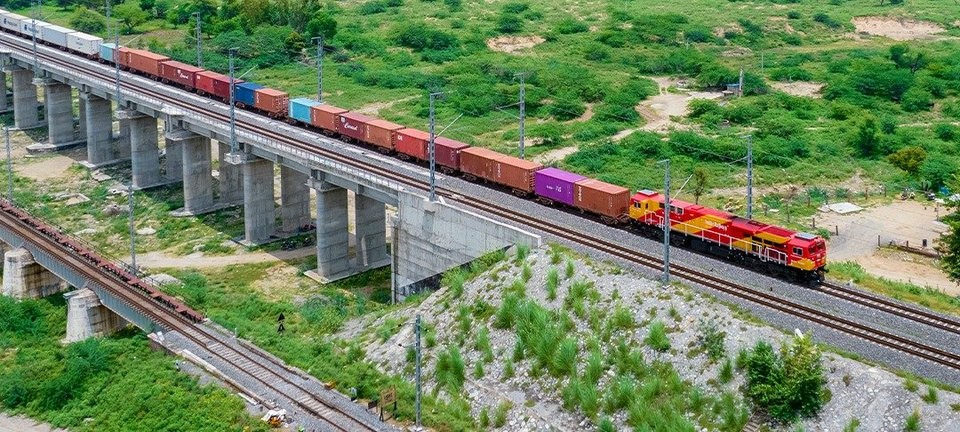
Double-stack freight from JNPT to Vadodara highlights how rail–port connectivity is reshaping cargo movement; PM links faster logistics with manufacturing, agriculture and jobs
Make us preferred source on Google
Key Takeaways
- 2,800 km of Dedicated Freight Corridors have been completed across the Eastern and Western networks.
- More than 430 freight trains can operate daily on the dedicated network, according to the Prime Minister’s account.
- A double-stack container train from JNPT to Vadodara demonstrated the corridor’s ability to move cargo equivalent to more than 250 trucks in a single train movement.
- Freight journeys that previously took considerably longer by road can now be completed much faster on dedicated rail infrastructure.
- The DFC is expected to reduce fuel consumption, logistics costs and freight-related emissions.
- Faster freight connectivity is intended to benefit ports, manufacturers, farmers, exporters, importers and logistics operators.
- Modi linked the infrastructure push with India’s broader manufacturing ambition, describing the country’s emerging industrial ecosystem as moving “from chips to ships.”
Vadodara, Gujarat, India, September 8, 2026 (Maritime News) : Prime Minister Narendra Modi on Tuesday marked the completion of the 2,800-km Eastern and Western Dedicated Freight Corridors (DFCs) at Vadodara, Gujarat, describing the network as a critical logistics backbone for a rapidly developing India.
Speaking at an event where development projects worth more than ₹35,000 crore were inaugurated, dedicated to the nation or taken up for foundation, Modi highlighted the growing integration between freight rail infrastructure, ports, manufacturing centres, agricultural markets and regional economies. (Press Information Bureau)
The completion of the DFC network is particularly significant for India’s maritime logistics sector because it creates a faster rail freight interface between major ports and inland production and consumption centres. Press Information Bureau – Prime Minister’s address and project details
From JNPT to Vadodara: the port connection matters
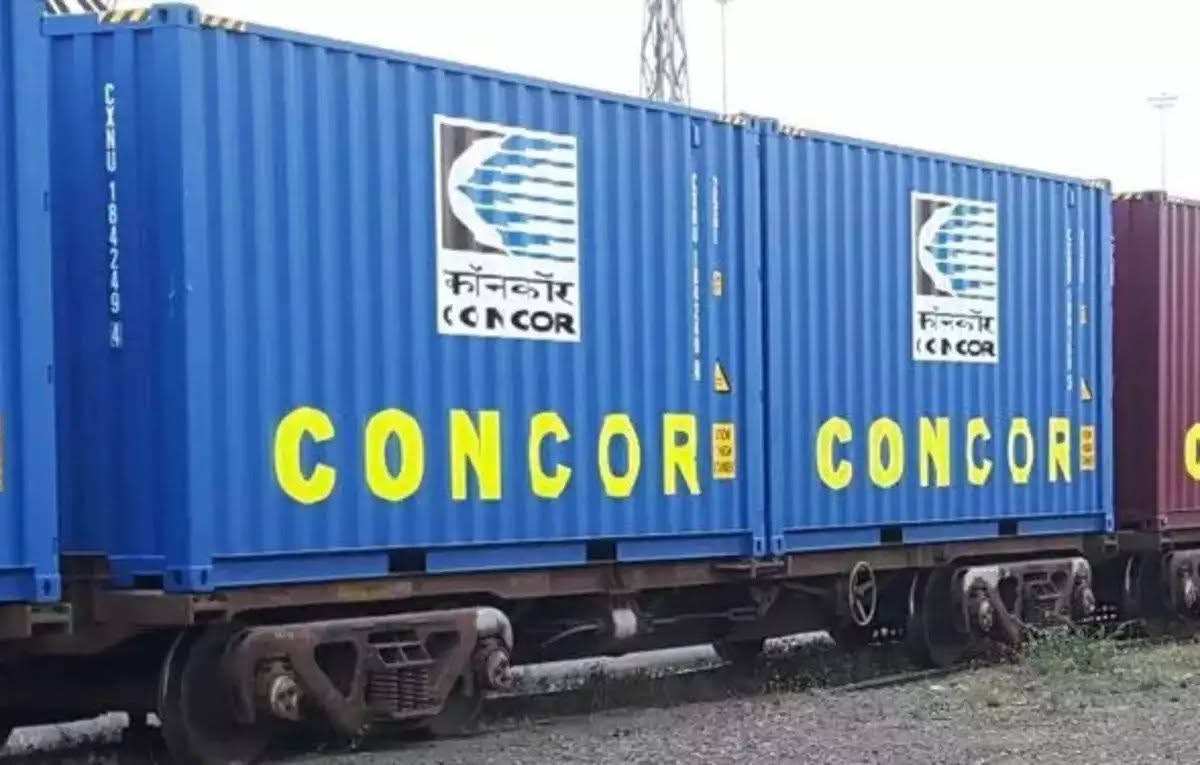
One of the most important examples cited by Modi was the movement of a double-stack container freight train from Jawaharlal Nehru Port (JNPT) to Vadodara.
According to the Prime Minister, one such train carried cargo equivalent to more than 250 trucks, demonstrating the potential of rail to move large volumes between India’s gateway ports and inland markets.
This is more than a railway achievement for the maritime sector.
For ports, the value of a deep-water berth or a modern container terminal ultimately depends on what happens after cargo leaves the port. Faster evacuation by rail can determine how efficiently a port handles growing volumes, how quickly containers move inland and how much road congestion is generated around the gateway.
The DFC therefore strengthens the port–rail–industrial corridor connection, rather than functioning merely as a standalone railway project.
Also Read: Mormugao Port: From Iron-Ore Gateway to Multi-Commodity Port
430 freight trains a day: what changes for cargo movement?
Modi said the separation of passenger and freight traffic has allowed freight trains to operate with greater efficiency, with more than 430 cargo trains running daily on the dedicated network.
The government says the infrastructure is reducing transit times and enabling cargo to travel at higher speeds than on conventional mixed-use railway routes. The Prime Minister cited the example of journeys that earlier took around 30 hours by truck being reduced to approximately 10–12 hours through the new logistics network.
For shippers, the significance lies not only in speed but also in predictability.
A more predictable freight network can help manufacturers plan inventory, exporters schedule cargo, ports manage evacuation and logistics companies optimise equipment and manpower.
Farmers also become part of the logistics chain
The Prime Minister also connected the DFC with agricultural supply chains.
Perishable commodities such as flowers, fruits and vegetables can reach larger markets more quickly when transport infrastructure is faster and more reliable.
For farmers, the last-mile benefit is therefore not simply a question of railway speed. It is about whether agricultural produce can move from production areas to markets before its commercial value deteriorates.
This places freight infrastructure within a much larger supply-chain ecosystem involving farmers, aggregators, warehouses, transport operators, mandis, exporters and consumers.
Also Read: From Flood Recovery to Maritime Connectivity: New Assam Development Push Takes Shape
DFC and the changing geography of Indian manufacturing
The Prime Minister also used the Vadodara event to underline the government’s manufacturing ambitions.
He pointed to India’s expanding production of railway coaches, wagons and locomotives, domestic solar-module manufacturing and the development of advanced industrial capabilities, including aircraft manufacturing.
His broader message was that manufacturing growth requires infrastructure capable of moving raw materials, components and finished products efficiently.
That is where the DFC becomes strategically important.
A manufacturing economy cannot depend only on production capacity. It also needs reliable freight corridors connecting factories with ports and markets.
“From chips to ships”
Modi described India’s emerging manufacturing trajectory as moving “from chips to ships”, linking the country’s industrial ambitions across electronics, energy, transport equipment and maritime manufacturing.
For the maritime sector, that broader manufacturing push has implications beyond cargo volumes.
Greater domestic manufacturing can generate additional demand for:
- port infrastructure;
- coastal and inland logistics;
- containerised freight;
- shipbuilding and ship repair;
- industrial corridors;
- warehousing and distribution;
- rail-linked cargo terminals; and
- import and export connectivity.
The effectiveness of this ecosystem will ultimately depend on how well its individual components work together.
Also Read: From Adani Ports CEO to Allcargo MD: The Pranav Choudhary
Infrastructure investment and employment
The Prime Minister also linked large-scale investment in railways, ports, roads, airports and pipelines with employment generation.
The argument is particularly relevant to port-led development. When a port expands capacity, the economic impact can extend beyond the waterfront into trucking, warehousing, manufacturing, logistics services, repair facilities, industrial parks and local businesses.
For communities located around major transport gateways, therefore, the real measure of infrastructure development is not only cargo handled but also the economic activity and employment created around that cargo.
The next challenge: moving from capacity to integration
The completion of the DFC is a major infrastructure milestone, but its full economic value will depend on integration with the rest of the logistics system.
The critical question for ports and cargo owners is increasingly whether rail capacity, port capacity, road connectivity, terminals, warehouses and last-mile evacuation are developing at the same pace.
A high-capacity port connected to a constrained inland network can still face bottlenecks. Similarly, a high-speed freight corridor delivers maximum value only when cargo can enter and leave the network efficiently.
The next phase, therefore, is likely to be less about creating isolated infrastructure assets and more about ensuring that the entire freight chain functions as one system.
Also Read: National Shipping Board’s First Sagar Samvad Starts With “IF”
MaritimeNews Insight
The completion of the 2,800-km Dedicated Freight Corridor changes the way India’s port connectivity should be viewed.
For years, port development has often been measured through berths, drafts, cranes and cargo-handling capacity. Those remain fundamental. But the competitiveness of a port increasingly depends on what happens beyond the port boundary.
The JNPT–Vadodara example cited by the Prime Minister illustrates this clearly: a port is only as efficient as the logistics network that carries its cargo onward.
For India’s maritime ambitions, the next frontier should therefore be the integration of ports + DFCs + industrial corridors + coastal shipping + road networks + logistics parks + last-mile connectivity.
That integration will determine whether India’s growing port capacity translates into lower logistics costs, faster exports, stronger domestic supply chains and greater competitiveness for Indian industry.
What it means for last-mile stakeholders
For ports: Better rail evacuation can support higher cargo throughput without placing the entire burden on roads.
For exporters and importers: Faster and more predictable inland movement can improve cargo planning and inventory management.
For logistics companies: Dedicated freight infrastructure creates opportunities for more efficient rail-linked multimodal services.
For farmers: Faster access to distant markets can reduce losses for perishable commodities.
For manufacturers: Reliable freight connectivity strengthens access to both domestic markets and export gateways.
For truck operators: The growth of rail freight does not eliminate road transport. Instead, it can change the role of trucking towards first- and last-mile movement.
For local communities: The real test will be whether infrastructure investment produces sustained employment, business opportunities and improved connectivity beyond major industrial centres.
Also Read: Can Assam Build a Global Export Economy on One of the World’s Most Dynamic Floodplains?
Frequently Asked Questions (FAQs)
What is the Dedicated Freight Corridor?
The Dedicated Freight Corridor is a railway network designed specifically for freight movement, separating cargo trains from passenger traffic on dedicated routes.
How long is the DFC network?
The Eastern and Western Dedicated Freight Corridors together cover approximately 2,800 km, according to the Prime Minister’s address.
Why is the DFC important for ports?
It provides faster and more dedicated rail connectivity between ports and inland production and consumption centres, potentially improving cargo evacuation and reducing logistics bottlenecks.
What was the JNPT–Vadodara example?
Prime Minister Modi cited a double-stack container train travelling from JNPT to Vadodara, saying its cargo was equivalent to more than 250 trucks.
Who benefits from the DFC?
The benefits extend across the logistics chain, including ports, exporters, importers, manufacturers, farmers, freight operators, logistics companies and consumers.
Does faster rail freight eliminate the need for trucks?
No. Road transport remains important, particularly for first- and last-mile movement between factories, warehouses, farms, logistics terminals and ports.
What is the larger significance for India’s maritime sector?
The DFC strengthens the connection between India’s ports and inland economic centres, supporting the country’s wider ambition to reduce logistics costs and become more competitive in global trade.
Source
This report is based primarily on the Prime Minister’s Office/Press Information Bureau release dated 8 September 2026, including the Prime Minister’s remarks on the completion of the DFC, freight operations, the JNPT–Vadodara double-stack train and the wider infrastructure and manufacturing programme. (Press Information Bureau) Official PIB release
Make us preferred source on Google
Reporting by MaritimeNews Bureaus, Writing by Harpal S Naol; Editing by Jaspal Singh Naol.
2 thoughts on “PM Modi marks completion of 2,800-km Dedicated Freight Corridor as Vadodara becomes a new logistics milestone”