
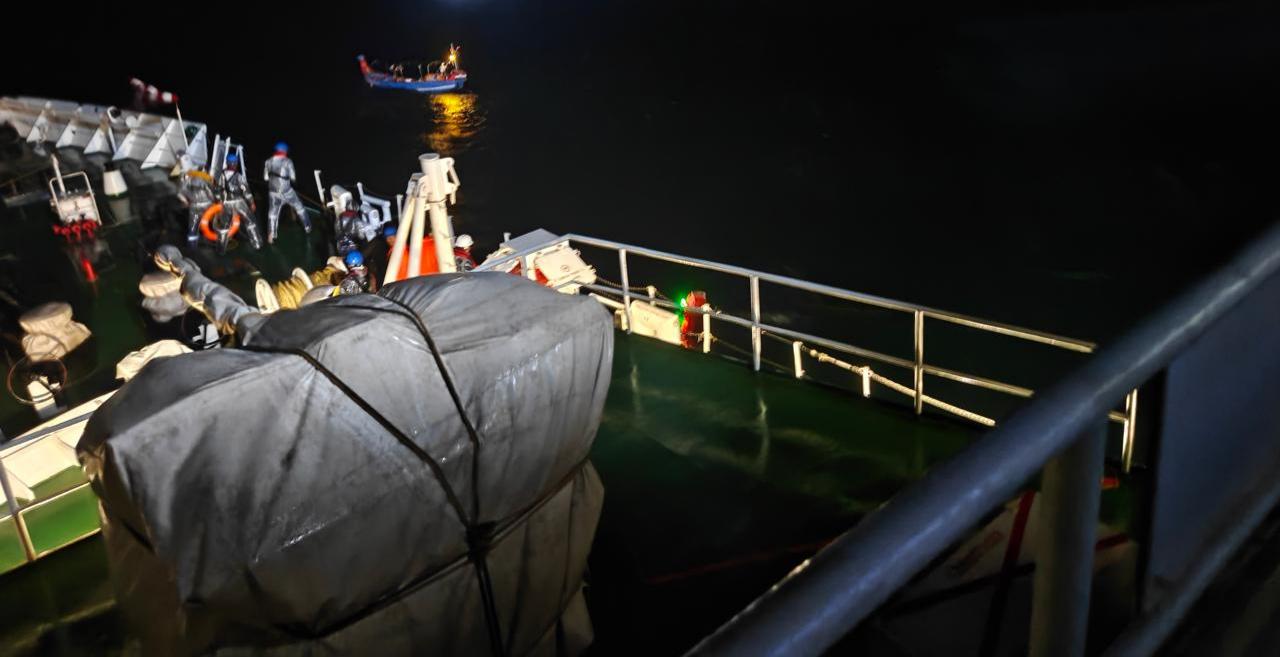
ICG Ship Sachet safely rescued six fishermen from a distressed fishing vessel battling severe flooding and hull damage in rough weather, highlighting the importance of rapid response, modern rescue technology and India’s evolving maritime safety architecture.
Make us preferred source on Google
Key Takeaways
- Indian Coast Guard rescued six fishermen from IFB Manju Matha.
- Distress call was received approximately 33 nautical miles off Suratkal.
- Vessel reported severe flooding and hull damage due to rough weather.
- Rescue was carried out despite poor visibility, rough seas and strong winds.
- Remote-operated rescue equipment was deployed to safely recover all crew members.
- The operation highlights India’s strengthening maritime Search and Rescue capability.
Mangaluru, Karnataka, India, June 30 (Maritime News) – The Indian Coast Guard (ICG) successfully rescued six fishermen from the distressed Indian Fishing Boat (IFB) Manju Matha during a challenging Search and Rescue (SAR) operation conducted approximately 33 nautical miles off the Suratkal coast near Mangaluru on 29 June 2026.
Responding to a VHF distress call reporting severe flooding and hull damage caused by rough sea conditions, ICG Ship Sachet immediately diverted from its assigned mission and reached the distressed fishing vessel despite strong winds, rough seas and poor visibility.
Using remote-operated lifebuoys specifically designed for adverse weather operations, the Coast Guard safely recovered all six crew members before proceeding towards New Mangalore for their safe disembarkation.
While the immediate outcome was the successful rescue of six lives, the operation also demonstrates the growing capability of India’s maritime Search and Rescue framework, where technology, professional training and rapid operational response increasingly work together to protect lives at sea.
When Minutes Decide Survival
Life at sea can change within moments.
A routine fishing voyage can rapidly become a life-threatening emergency when severe weather combines with flooding, structural damage and deteriorating visibility.
Such conditions leave little room for delayed decisions.
In this case, the Indian Coast Guard received a VHF distress call from IFB Manju Matha at approximately 1600 hours, reporting that the vessel had sustained hull damage and was taking on water while operating offshore.
With six fishermen facing immediate danger, every passing minute increased operational risk.
Recognising the urgency, ICG Ship Sachet altered course and proceeded towards the reported location to commence rescue operations.
Operating in Adverse Sea Conditions
Search and Rescue operations become significantly more complex during the southwest monsoon.
Strong winds, high waves, reduced visibility and rapidly changing sea conditions limit manoeuvrability while increasing risks for both survivors and rescuers.
The Coast Guard nevertheless conducted the rescue under precisely these circumstances.
Rather than relying solely upon conventional recovery methods, the crew deployed remote-operated lifebuoys designed for use during adverse weather conditions, allowing rescuers to reach survivors while reducing additional operational risks.
The successful recovery of all six fishermen illustrates how modern rescue technologies increasingly complement the skill and experience of SAR personnel.
More Than a Rescue Mission
Although the operation involved a single fishing vessel, its significance extends beyond the immediate incident.
Search and Rescue capability forms one of the most important public safety services within the maritime sector.
Every fishing vessel, merchant ship, offshore installation and coastal operator depends upon confidence that assistance will be available when emergencies occur beyond immediate reach.
The effectiveness demonstrated during this operation reinforces confidence in India’s maritime emergency response system.
For coastal communities whose livelihoods depend upon the sea, that confidence carries enormous practical importance.
Technology Supporting Maritime Safety
One of the most noteworthy aspects of the rescue was the operational use of remote-operated rescue equipment.
Modern SAR operations increasingly combine traditional seamanship with advanced technologies capable of improving response effectiveness during hazardous weather.
Across the world, maritime rescue organisations are expanding the use of:
- Remote rescue devices.
- Satellite communications.
- Digital distress alert systems.
- Thermal imaging.
- Unmanned aerial systems.
- Improved weather forecasting.
- Advanced navigation technologies.
The successful deployment of remote-operated lifebuoys during this operation reflects the gradual integration of such technologies into India’s maritime safety framework.
Strengthening Confidence at Sea
For fishermen, confidence in maritime safety is not measured by the absence of emergencies.
It is measured by the certainty that professional assistance will arrive when emergencies occur.
The rapid response demonstrated by ICG Ship Sachet reinforces that confidence.
It also highlights the continuing importance of maintaining well-equipped rescue assets, trained personnel and effective communication systems capable of responding under demanding operational conditions.
As maritime activity continues expanding along India’s coastline, the role of the Indian Coast Guard in protecting life at sea will become increasingly significant.
Search and Rescue Is the Foundation of Maritime Confidence
The successful rescue of six fishermen off the coast of Mangaluru represents more than an operational success for the Indian Coast Guard.
It demonstrates the importance of maintaining a robust Maritime Search and Rescue (SAR) system capable of responding rapidly to emergencies under some of the most demanding conditions at sea.
For the maritime industry, Search and Rescue is not merely an emergency service.
It is an essential component of maritime governance that enables fishermen, merchant ships, offshore installations and coastal operators to conduct their activities with confidence that professional assistance is available when lives are at risk.
As India’s maritime economy continues to expand, the effectiveness of its SAR network becomes increasingly important to both safety and economic resilience.
Every Distress Call Tests the System
Unlike routine maritime operations, Search and Rescue missions unfold in uncertain and rapidly changing environments.
The rescue of IFB Manju Matha illustrates this reality.
Within a short period, the Coast Guard had to:
- Receive and verify a distress message.
- Assess the urgency of the situation.
- Divert operational assets.
- Navigate through rough seas and poor visibility.
- Locate the distressed vessel.
- Execute a rescue without placing additional lives at unnecessary risk.
Each stage required coordination, training and operational discipline.
The successful outcome therefore reflects not only the actions of one vessel but the effectiveness of the wider SAR framework supporting such missions.
Technology Is Changing Maritime Rescue
One of the most significant aspects of the operation was the deployment of remote-operated lifebuoys designed for use during adverse weather conditions.
Although this may appear to be a small operational detail, it reflects a broader trend within modern maritime safety.
Search and Rescue organisations around the world are increasingly integrating advanced technologies to improve response capability.
These include:
- Digital distress alert systems.
- Satellite-based communication.
- Automatic Identification System (AIS) data.
- Thermal imaging equipment.
- Unmanned aerial systems.
- Advanced weather forecasting.
- Remote rescue devices.
Technology does not replace professional seamanship.
Instead, it enables rescue teams to operate more safely and effectively in situations where traditional methods alone may expose both survivors and rescuers to greater danger.
Weather Is Becoming a Growing Operational Challenge
The rescue also highlights the operational realities of India’s southwest monsoon.
Strong winds, rough seas, heavy rainfall and reduced visibility remain recurring hazards for coastal communities engaged in fishing.
As maritime activity increases and weather patterns become more unpredictable, emergency response agencies are likely to encounter more complex rescue scenarios.
This reinforces the importance of:
- Continuous crew training.
- Investment in specialised rescue equipment.
- Real-time weather intelligence.
- Reliable communication systems.
- Public awareness among fishing communities.
Preparedness must evolve alongside changing environmental conditions.
Fishermen’s Safety Begins Before an Emergency
While successful rescues save lives, the most effective maritime safety strategy is preventing emergencies wherever possible.
The incident also highlights the importance of strengthening preventive measures such as:
- Timely dissemination of weather advisories.
- Regular hull inspections and vessel maintenance.
- Availability of life jackets and lifesaving appliances.
- Functional VHF communication equipment.
- Emergency Position Indicating Radio Beacons (EPIRBs), where applicable.
- Safety awareness and emergency response training for fishing crews.
Search and Rescue capability and preventive safety measures should therefore be viewed as complementary elements of the same maritime safety system.
MaritimeNews Insight
The most significant achievement of this operation was not simply rescuing six fishermen.
It was demonstrating that India’s maritime emergency response system functioned effectively under adverse operational conditions.
Confidence at sea depends upon more than ships and ports.
It depends upon confidence that distress alerts will be received, response assets will be deployed without delay and trained personnel will reach those in danger when conditions are at their worst.
Every successful rescue strengthens that confidence across the wider maritime community.
Every Successful Rescue Is Also a Test of National Preparedness
The rescue of six fishermen by the Indian Coast Guard off the coast of Mangaluru ended with every crew member brought safely ashore.
For the families involved, the operation meant six lives saved.
For the maritime community, however, the mission represents something much broader.
Every Search and Rescue (SAR) operation serves as a practical test of a nation’s ability to respond when maritime emergencies occur unexpectedly, often under extreme operational conditions.
The effectiveness of that response influences not only safety outcomes but also public confidence in the institutions responsible for protecting life at sea.
India’s Maritime Domain Is Expanding
India’s maritime landscape is becoming increasingly complex.
Alongside traditional fishing activity, the country is witnessing growth in:
- Commercial shipping.
- Coastal shipping services.
- Offshore energy exploration.
- Port-led industrial development.
- Cruise tourism.
- Marine infrastructure projects.
- Blue Economy initiatives.
As maritime activity expands, so too does the diversity of emergencies that may require rapid response.
Future SAR operations may involve not only fishing vessels but also merchant ships, offshore platforms, passenger vessels, recreational craft and support vessels operating across India’s vast maritime domain.
This evolving environment requires continuous strengthening of emergency response capabilities.
Building the Next Generation of Maritime Search and Rescue
Modern SAR is increasingly shaped by technology.
The successful use of remote-operated lifebuoys during the Mangaluru rescue demonstrates how innovation is becoming an integral part of maritime emergency response.
Looking ahead, future investments may increasingly focus on:
- Artificial Intelligence-assisted distress analysis.
- Unmanned aerial vehicles for rapid search operations.
- Satellite-based vessel tracking.
- Enhanced digital distress communication systems.
- Real-time weather and oceanographic intelligence.
- Autonomous rescue equipment.
- Integrated maritime command-and-control platforms.
Technology cannot replace the judgement, experience and courage of rescue personnel.
However, it can significantly improve response speed, situational awareness and operational safety.
The challenge for maritime administrations will be integrating these technologies while maintaining high standards of professional training.
Prevention Remains the Strongest Safety Measure
While effective rescue operations save lives, reducing the number of emergencies remains an equally important objective.
For the fishing sector, this requires continued emphasis on:
- Weather awareness before sailing.
- Regular inspection of fishing vessels.
- Hull maintenance and seaworthiness.
- Reliable communication equipment.
- Availability of approved lifesaving appliances.
- Emergency preparedness training for fishing crews.
- Timely dissemination of marine weather advisories.
A resilient maritime safety system combines prevention, preparedness and response rather than relying solely on rescue capability after incidents occur.
Strengthening Confidence Across the Maritime Economy
Search and Rescue capability has implications extending far beyond emergency response.
Reliable SAR services strengthen confidence among:
- Fishing communities.
- Merchant shipping operators.
- Offshore industries.
- Port authorities.
- Marine insurers.
- Coastal tourism operators.
- International maritime stakeholders.
Confidence that effective assistance is available during emergencies supports economic activity by reducing perceived operational risk.
In this way, maritime safety contributes not only to protecting lives but also to supporting sustainable growth across the wider Blue Economy.
MaritimeNews Insight
The rescue off Mangaluru illustrates an important reality.
The strength of a maritime nation is measured not only by the size of its ports or the number of ships flying its flag.
It is also measured by how effectively it protects people when conditions deteriorate.
Professional crews, reliable communication systems, specialised rescue equipment and rapid operational decision-making together form the invisible infrastructure that underpins confidence in maritime activity.
Each successful rescue reinforces that foundation.
Governance Reflection
The Indian Coast Guard continues to play a central role in India’s maritime safety architecture.
As coastal activity expands, maintaining this capability will require sustained investment in:
- Modern rescue assets.
- Advanced surveillance systems.
- Training and skill development.
- Inter-agency coordination.
- Community outreach programmes for fishermen.
- Technology-driven maritime domain awareness.
Equally important will be continued collaboration between the Coast Guard, fishing communities, State authorities, weather agencies and maritime regulators to strengthen preventive safety measures alongside emergency response.
MaritimeNews Editorial Verdict
The rescue of six fishermen from IFB Manju Matha should not be viewed solely as a successful humanitarian operation.
It reflects the growing maturity of India’s maritime Search and Rescue ecosystem.
The operation demonstrated how professional training, rapid operational response and modern rescue technology can work together to save lives under severe weather conditions.
As India’s maritime economy continues to expand under the Blue Economy vision, Search and Rescue will become increasingly important as a strategic public service supporting fisheries, shipping, offshore operations and coastal development.
The greatest measure of a nation’s maritime capability is not how it responds on calm days, but how effectively it protects lives when the sea is at its most unforgiving.
India’s response off the coast of Mangaluru provides a timely reminder that investments in maritime safety are investments in national resilience.
MaritimeNews Editorial Note
This editorial is based on the Indian Coast Guard’s official information regarding the Search and Rescue operation conducted off the coast of Mangaluru on 29 June 2026. The analysis reflects MaritimeNews’ independent assessment of the wider implications for maritime safety, Search and Rescue capability, fisheries protection and India’s evolving Blue Economy. The editorial aims to encourage informed discussion on strengthening maritime preparedness, technology adoption and institutional resilience in safeguarding life at sea.
Make us preferred source on Google
Source: PIB Delhi
Reporting Basis: Official Government Release and MaritimeNews Analysis
Reporting by MaritimeNews Bureaus, Writing by Harpal S Naol; Editing by Jaspal Singh Naol.