Port cuts carbon emissions by 45%, advances green hydrogen, launches PortGPT and expands education and research partnerships
Make us preferred source on Google
MaritimeNews Summary
V.O. Chidambaranar Port Authority (VOC Port) is rapidly emerging as one of India’s most future-ready ports, combining decarbonisation, renewable energy, green hydrogen, artificial intelligence, education and research into a single development strategy. According to the port’s first Sustainability Report, renewable energy now offsets nearly 94% of its energy-consumption equivalent, while net carbon emissions have fallen by approximately 45%.
The announcement was accompanied by a series of initiatives including the launch of the PortGPT mobile application, recognition as a Scope-2 Emission Free Port, the commencement of academic activities at Kendriya Vidyalaya, and a strategic partnership with Gati Shakti Vishwavidyalaya.
Taken together, these developments suggest that VOC Port is positioning itself not merely as a cargo gateway, but as a blueprint for India’s next generation of sustainable, technology-enabled and knowledge-driven ports.
Key Takeaways
- VOC Port reduced net carbon emissions by approximately 45%.
- Renewable energy now offsets nearly 94% of energy-consumption equivalent.
- Carbon intensity per tonne of cargo has nearly halved over four years.
- VOC Port recognised as a Scope-2 Emission Free Port.
- India’s first green hydrogen pilot project at a major port highlighted.
- PortGPT mobile application launched for AI-enabled operations.
- Kendriya Vidyalaya begins academic activities for 2026-27 session.
- MoU signed with Gati Shakti Vishwavidyalaya.
- IIM Calcutta case study documents VOC Port’s green transformation.
- VOC Port strengthens its position as a national green port benchmark.
How VOC Port Reduced Carbon Emissions by 45%
Thoothukudi, Tamil Nadu, India, June 23 (Maritime News) – Union Minister of Ports, Shipping and Waterways Sarbananda Sonowal described VOC Port as a model for sustainable maritime development, highlighting the findings of the port’s first Sustainability Report.
The report revealed that renewable energy now offsets nearly 94% of the port’s energy-consumption equivalent, while net carbon emissions have been reduced by around 45%.
Equally significant is the reduction in carbon intensity per tonne of cargo, which has nearly halved during the past four years.
Sustainability Progress Snapshot
| Indicator | Progress Achieved |
|---|---|
| Renewable Energy Offset | 94% |
| Net Carbon Emission Reduction | 45% |
| Carbon Intensity per Cargo Tonne | Nearly 50% Reduction |
| Scope-2 Emission Status | Emission Free Recognition |
These figures place VOC Port among the most advanced sustainability performers within India’s major port ecosystem.
Beyond Decarbonisation: Building a Future-Ready Port
Many ports around the world are focused primarily on cargo handling, capacity expansion and logistics efficiency.
VOC Port appears to be pursuing a broader strategy.
The developments announced at Tuticorin indicate that the port is simultaneously investing in:
- Sustainability
- Renewable energy
- Green hydrogen
- Artificial intelligence
- Education
- Research and innovation
- Community infrastructure
This integrated approach reflects a growing understanding that future port competitiveness will depend on more than cargo volumes alone.
Ports are increasingly being evaluated on environmental performance, digital capabilities, workforce development and innovation ecosystems.
Why Green Hydrogen Matters
One of the most strategically significant aspects of VOC Port’s transformation is its focus on green hydrogen.
The IIM Calcutta case study released during the event documents VOC Port’s transition from a conventional cargo hub toward a green energy and sustainable maritime centre.
The study highlights the port’s pioneering efforts in renewable energy, electrification and green hydrogen development, including India’s first green hydrogen pilot project commissioned at a major port.
Why Ports Are Looking at Green Hydrogen
Global shipping faces mounting pressure to reduce emissions.
As the maritime industry explores alternative fuels, ports are expected to play a critical role in future fuel production, storage and distribution.
Green hydrogen could eventually support:
- Clean energy generation
- Industrial decarbonisation
- Future maritime fuels
- Port electrification initiatives
VOC Port’s early investment positions it among the first Indian ports preparing for this transition.
PortGPT and the Rise of AI-Powered Ports
Another major development announced during the event was the launch of the PortGPT mobile application.
VOC Port has become the first major port in India to extend an enterprise-grade generative artificial intelligence platform through a dedicated mobile application.
While many organisations continue to experiment with AI, VOC Port is attempting to integrate the technology into day-to-day operational and administrative processes.
Potential Applications of PortGPT
- Knowledge management
- Operational decision support
- Process optimisation
- Data accessibility
- Institutional memory management
MaritimeNews Insight
The significance of PortGPT is not the application itself.
The significance lies in the signal it sends: Indian ports are beginning to view artificial intelligence as operational infrastructure rather than merely a technology experiment.
Also Read: CBIC Pushes Unified Customs System as India Targets Faster Cargo Clearance and Lower Logistics Costs
Education and Human Capital Strategy
One of the most overlooked announcements was the commencement of academic activities at Kendriya Vidyalaya, VOC Port.
Initially operating from the Port School campus, the institution will provide CBSE education to children of port employees, Central Government personnel and local communities.
At first glance, a school may appear unrelated to port operations.
However, modern infrastructure development increasingly recognises that social infrastructure is as important as physical infrastructure.
Why This Matters
Quality education supports:
- Workforce stability
- Talent attraction
- Community development
- Long-term social sustainability
For port cities seeking sustainable growth, educational institutions play a critical role in building human capital.
Industry-Academia Collaboration Gains Momentum
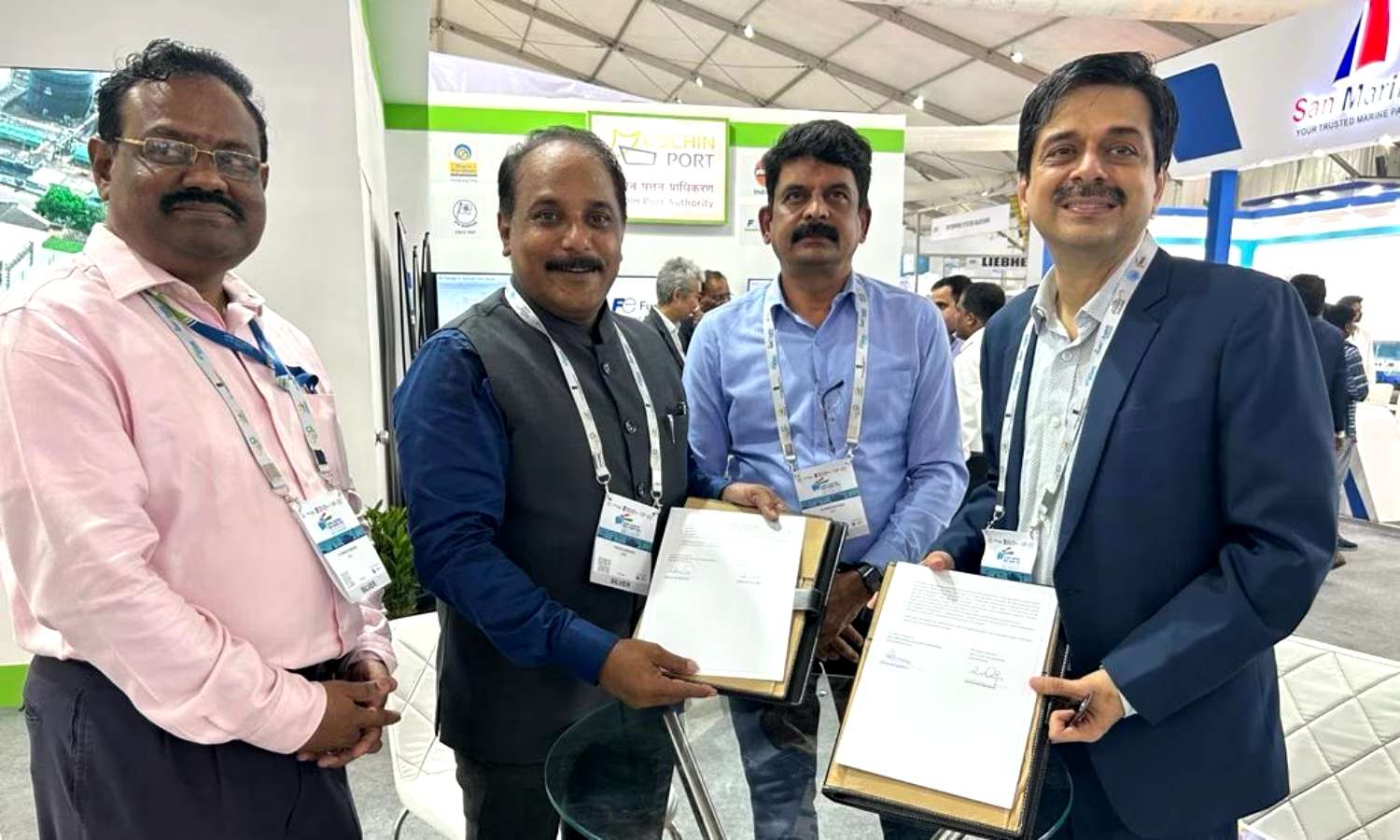
VOC Port also signed a Memorandum of Understanding with Gati Shakti Vishwavidyalaya, Vadodara.
The partnership seeks to promote collaboration in:
- Logistics education
- Research
- Innovation
- Skill development
- Sustainable port operations
The proposed Centre of Excellence in Maritime Logistics and Port Management could create a platform for industry-academia engagement at a time when the maritime sector faces growing demand for specialised talent.
Why Ports Need Universities
Future ports will require professionals skilled in:
- AI and digital systems
- Green energy technologies
- Logistics optimisation
- Port management
- Sustainability compliance
The collaboration reflects a recognition that workforce development must evolve alongside infrastructure development.
Also Read: JNPA’s Industrial Expansion Plan Raises Questions Over Navi Mumbai’s Port Region
What This Means for India’s Green Port Ambitions
India has committed itself to multiple sustainability goals under Maritime India Vision 2030 and Maritime Amrit Kaal Vision 2047.
VOC Port’s progress demonstrates how these policy objectives can be translated into measurable outcomes.
Key Areas of Progress
| Area | Status |
|---|---|
| Renewable Energy | Advanced |
| Carbon Reduction | Significant |
| Green Hydrogen | Early Leadership |
| AI Adoption | Emerging |
| Education Infrastructure | Expanding |
| Research Ecosystem | Strengthening |
The port’s experience could provide valuable lessons for other major ports seeking to accelerate their own sustainability journeys.
Capital Markets and Infrastructure Impact
The developments at VOC Port are unlikely to create immediate stock market movements.
However, they reinforce broader investment themes gaining traction across the maritime sector.
Potential Beneficiary Segments
- Green infrastructure providers
- Renewable energy developers
- Port technology companies
- Maritime digital solution providers
- Green hydrogen ecosystem participants
Investor Watchlist
Stakeholders may monitor:
- Expansion of green hydrogen projects
- AI deployment across ports
- Renewable energy integration
- Sustainability-linked infrastructure investments
MaritimeNews Capital Markets Verdict
VOC Port’s transformation supports the long-term investment narrative surrounding sustainable maritime infrastructure and technology-enabled port operations in India.
Also Read: JNPA’s Floating Waste and Oil Spill Under Scrutiny
Historical Context: How Indian Ports Are Changing
Traditionally, ports were evaluated primarily on:
- Cargo throughput
- Revenue generation
- Vessel traffic
- Infrastructure capacity
Today, the criteria are changing.
Global port competitiveness increasingly depends on:
- Carbon reduction
- Energy transition
- Digitalisation
- Innovation
- Human capital development
VOC Port’s recent initiatives reflect this broader evolution.
The port’s transformation mirrors a global shift from conventional logistics hubs toward integrated economic and sustainability ecosystems.
Alternative Perspectives and Emerging Challenges
While VOC Port’s achievements are significant, challenges remain.
Key Questions
- Can green hydrogen become commercially viable at scale?
- Can AI deployment deliver measurable productivity gains?
- Can emissions reductions continue beyond current levels?
- Can the VOC model be replicated across all major Indian ports?
Environmental advocates may also note that port-level emissions represent only part of the broader maritime decarbonisation challenge, which includes vessel emissions and supply chain activities.
The journey toward net-zero maritime operations remains ongoing.
What Can Be Done Next?
Government
- Accelerate green port policies.
- Support hydrogen infrastructure development.
- Encourage AI adoption across major ports.
Port Authorities
- Replicate successful sustainability initiatives.
- Expand renewable energy integration.
- Invest in workforce development.
Industry
- Participate in pilot projects.
- Adopt low-carbon technologies.
- Strengthen innovation partnerships.
Academic Institutions
- Develop maritime sustainability programmes.
- Expand logistics and AI research collaboration.
Transparency & Evidence Check
Confirmed
- 45% reduction in net carbon emissions.
- 94% renewable energy offset.
- Scope-2 Emission Free Port recognition.
- Launch of PortGPT.
- Kendriya Vidyalaya commencement.
- MoU with Gati Shakti Vishwavidyalaya.
Also Read: Centre Approves ₹797 Crore Green Hydrogen Jetty at Paradip Port
MaritimeNews Analysis
The conclusion that VOC Port is emerging as a future-ready model for Indian ports represents MaritimeNews analysis based on the combination of sustainability, technology, education and innovation initiatives announced.
MaritimeNews Insight
India’s next phase of port competition may not be determined solely by cargo volumes.
It may increasingly be defined by which ports can successfully combine sustainability, energy transition, artificial intelligence, talent development and innovation into a unified growth model.
VOC Port appears to be positioning itself early for that future.
MaritimeNews Critique
VOC Port’s achievements are impressive, but the true test lies ahead.
Pilot projects, sustainability reports and digital initiatives must ultimately translate into measurable operational improvements, economic value creation and replicable frameworks for other ports.
The challenge is no longer proving that transformation is possible.
The challenge is scaling it.
What Happens Next?
Key developments likely to be monitored include:
- Expansion of green hydrogen initiatives.
- Wider adoption of PortGPT capabilities.
- Operational outcomes from AI integration.
- Progress on academic collaboration projects.
- Additional decarbonisation milestones.
These indicators will determine whether VOC Port’s transformation evolves from an isolated success story into a national model.
2047 Outlook
2030 Outlook
VOC Port consolidates its position as one of India’s leading green ports.
2040 Outlook
Green hydrogen and AI become integrated components of routine port operations.
2047 Outlook
Ports evolve into multi-functional ecosystems serving as logistics hubs, energy hubs, innovation centres and talent development platforms.
VOC Port may ultimately be remembered as one of the earliest Indian ports to embrace that transition.
MaritimeNews Verdict
VOC Port’s 45% reduction in carbon emissions is a significant achievement.
Yet the larger story extends beyond emissions.
The port is simultaneously investing in green energy, artificial intelligence, education, research and sustainability.
Taken together, these initiatives suggest that VOC Port is not merely reducing its environmental footprint—it is attempting to redefine what an Indian port can become in the decades ahead.
Make us preferred source on Google
Source: PIB Delhi
Reporting Basis: Official Government Release and MaritimeNews Analysis
Reporting by MaritimeNews Bureaus, Writing by Harpal S Naol; Editing by Jaspal Singh Naol.