
UNCTAD data shows India’s market share rose to 35.4%, helping achieve a Maritime India Vision 2030 target five years ahead of schedule
Make us preferred source on Google
MaritimeNews Summary
India has emerged as the world’s leading ship recycling nation in 2025, achieving one of the most significant targets under Maritime India Vision 2030 nearly five years ahead of schedule.
According to the latest United Nations Conference on Trade and Development (UNCTAD) report, India’s share of global ship recycling increased from 30.1% in 2024 to 35.4% in 2025, while total ship recycling volumes surged from 1.86 million gross tons (GT) to 2.99 million GT.
The achievement is being viewed as more than a ship recycling milestone. It represents one of the clearest examples of how sustained maritime policy reforms, infrastructure modernization and industry collaboration can translate into measurable global leadership.
However, the larger question now facing policymakers and industry stakeholders is whether India can replicate this success across shipbuilding, ship repair, maritime manufacturing and the broader blue economy.
Key Takeaways
- India becomes the world’s largest ship recycling nation in 2025.
- Global market share rises to 35.4% from 30.1% in 2024.
- Ship recycling volumes increase nearly 60% year-on-year.
- Maritime India Vision 2030 target achieved five years early.
- 115 ship recycling facilities have become Hong Kong Convention compliant.
- ₹53.5 crore provided for modernization of recycling yards.
- Alang expansion aims to increase capacity to nearly 9 million LDT.
- More than 16,000 vessels are expected to require recycling globally over the next decade.
- India is seeking inclusion under European Union Ship Recycling Regulations.
- The achievement strengthens India’s broader maritime industrial ambitions.
A Maritime Goal Achieved Ahead of Schedule
Delhi, India, June 23 (Maritime News) – For years, India’s maritime policy agenda has been built around a simple but ambitious objective: transform the country from a maritime participant into a maritime power.
The latest UNCTAD figures suggest one part of that vision has already been achieved.
India’s rise to the top position in global ship recycling fulfills a target outlined under Maritime India Vision 2030, one of the government’s flagship maritime development frameworks.
While many infrastructure and industrial targets require decades to materialize, ship recycling has emerged as one of the earliest sectors to demonstrate measurable progress.
According to the Ministry of Ports, Shipping and Waterways, India’s global market share climbed to 35.4% in 2025, making it the world’s largest ship recycling destination.
India’s Ship Recycling Growth
| Indicator | 2024 | 2025 |
|---|---|---|
| Global Market Share | 30.1% | 35.4% |
| Ship Recycling Volume | 1.86 Million GT | 2.99 Million GT |
| Global Ranking | Top Tier | No.1 |
The figures represent more than statistical growth. They indicate that India is increasingly shaping the future of an industry that is expected to witness substantial expansion as ageing global fleets move toward retirement and replacement.
From Alang’s Past to India’s Maritime Future
The story of India’s ship recycling success cannot be told without discussing Alang.
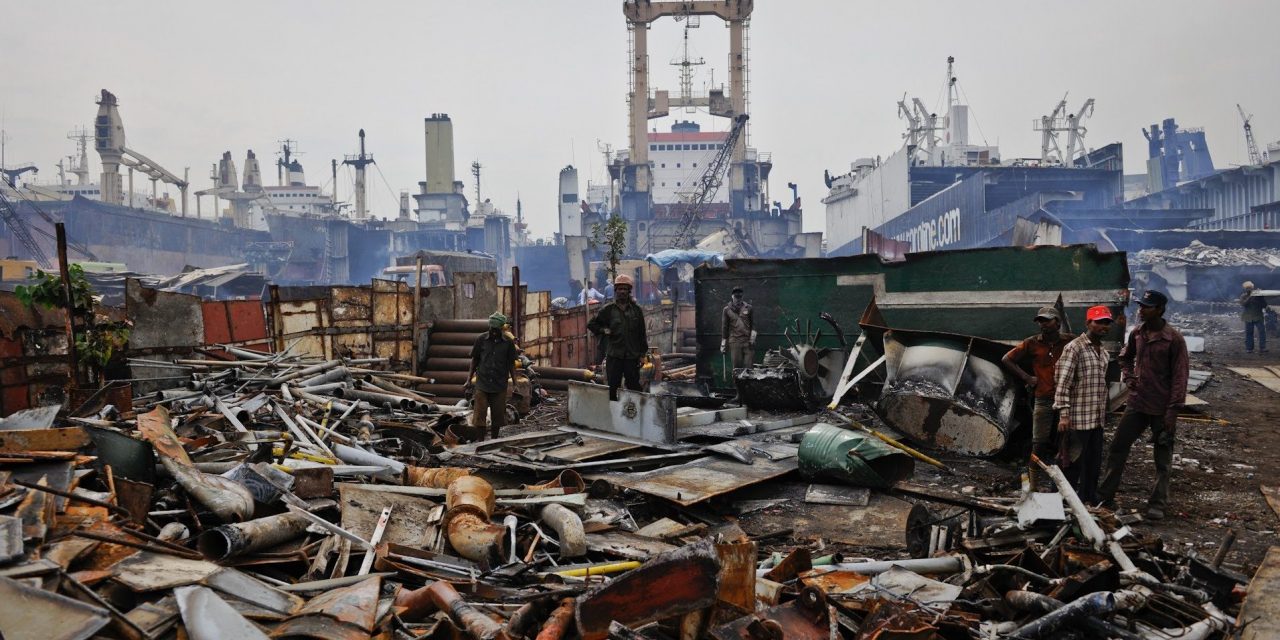
Located on the Gujarat coast, Alang has long been one of the world’s largest ship recycling clusters. For decades, it symbolized India’s dominance in ship dismantling while simultaneously attracting international scrutiny over environmental practices, worker welfare and safety standards.
The industry’s evolution over the past decade reflects a deliberate effort to change that perception.
The enactment of the Recycling of Ships Act, 2019, India’s ratification of the Hong Kong International Convention for the Safe and Environmentally Sound Recycling of Ships, modernization investments and enhanced compliance standards have collectively transformed the industry’s operating environment.
Government support of ₹53.5 crore has helped 115 facilities achieve Hong Kong Convention compliance, strengthening India’s credibility among international shipowners and regulators.
Today, the conversation is increasingly shifting from ship breaking to sustainable ship recycling.
How India Reached the Top
India’s rise has not been accidental.
It has been driven by a combination of policy interventions, regulatory reforms and industry modernization.
Key Government Initiatives
| Initiative | Strategic Objective |
|---|---|
| Recycling of Ships Act, 2019 | HKC Compliance |
| Yard Modernisation Support | Infrastructure Upgrades |
| Ship-Breaking Credit Note Scheme | Promote Shipbuilding |
| Industry Engagement | Improve Competitiveness |
| Alang Expansion Plan | Capacity Growth |
One of the most innovative initiatives has been the Ship-Breaking Credit Note Scheme.
Under the programme, shipowners receive a credit note equivalent to 40% of the scrap value of a recycled vessel. The credit can subsequently be used towards the construction of a new vessel at an Indian shipyard.
The scheme creates a direct link between ship recycling and domestic shipbuilding, helping strengthen multiple segments of the maritime value chain simultaneously.
Also Read: CBIC Pushes Unified Customs System as India Targets Faster Cargo Clearance and Lower Logistics Costs
Global Ship Recycling Competitive Landscape
India’s emergence as the world’s leading ship recycling nation comes amid intense competition from traditional recycling markets across South Asia and beyond.
For decades, Bangladesh, Pakistan, India and Turkey have collectively dominated global ship recycling activity. However, increasing environmental scrutiny, compliance requirements and sustainability expectations are reshaping the competitive landscape.
| Country | Competitive Advantage |
|---|---|
| India | HKC Compliance, Policy Support, Modernisation |
| Bangladesh | Large Capacity |
| Pakistan | Cost Competitiveness |
| Turkey | European Proximity |
Unlike some competing markets, India is increasingly positioning itself as a destination for environmentally responsible and internationally compliant ship recycling rather than purely volume-driven dismantling.
This strategic shift may prove increasingly important as global shipowners face mounting environmental, social and governance (ESG) expectations.
Why This Matters Beyond Ship Recycling
The significance of this achievement extends far beyond dismantling ships.
Modern ship recycling is increasingly viewed as a critical component of the circular economy.
Every vessel reaching the end of its operational life contains valuable steel, machinery, marine equipment and industrial materials that can be recovered and reintroduced into productive economic activity.
As global industries seek greater sustainability and resource efficiency, ship recycling is becoming strategically important not only for maritime nations but also for manufacturing economies.
India’s leadership position therefore supports:
- Industrial resource recovery
- Steel availability
- Circular economy objectives
- Maritime manufacturing ecosystems
- Sustainable development goals
The sector’s growth has implications far beyond coastal recycling yards.
Impact on India’s Maritime Value Chain
Ship recycling does not operate in isolation.
Its growth increasingly influences multiple segments of India’s maritime economy.
Maritime Lifecycle Ecosystem
| Segment | Potential Impact |
|---|---|
| Ship Recycling | Direct Growth |
| Shipbuilding | Scrap-linked incentives |
| Ship Repair | Industrial ecosystem benefits |
| Marine Engineering | Increased demand |
| Steel Processing | Resource recovery |
| Maritime Manufacturing | Secondary growth |
The Ship-Breaking Credit Note Scheme is particularly important because it creates a direct bridge between ship recycling and domestic shipbuilding.
This integrated approach is rarely seen in global maritime markets and may emerge as one of India’s key competitive advantages.
The Geography of the Opportunity
Gujarat Emerges as the Biggest Winner
The most immediate beneficiary is Gujarat, which hosts Alang and a significant portion of India’s ship recycling ecosystem.
The state’s maritime economy stands to gain through:
- Increased industrial activity
- Higher employment generation
- Expanded support services
- Greater investment attraction
Western India’s Industrial Ecosystem
Ship recycling creates opportunities for steel processors, engineering firms, logistics providers, equipment refurbishers and manufacturing units across western India.
National Maritime Benefits
At a national level, leadership in ship recycling strengthens India’s position across the broader maritime value chain and supports ambitions to become a leading maritime economy.
Also Read: JNPA’s Industrial Expansion Plan Raises Questions Over Navi Mumbai’s Port Region
Employment and Industrial Impact
The ship recycling industry’s significance extends beyond maritime operations.
Every recycled vessel generates activity across:
- Steel processing
- Transportation
- Equipment refurbishment
- Industrial services
- Engineering support
The modernization of Indian recycling facilities has also created demand for higher-skilled labour, environmental management professionals and compliance specialists.
As capacity expands, employment generation is expected to extend well beyond coastal recycling yards.
Maritime India Vision 2030 Delivers an Early Win
Many flagship government visions are judged years after they are announced.
In this case, one of Maritime India Vision 2030’s key targets has already been achieved.
The accomplishment provides evidence that focused policy interventions can produce measurable outcomes when supported by industry participation and regulatory consistency.
More importantly, it offers a blueprint for other maritime sectors.
Industry observers will now ask whether similar approaches can accelerate growth in:
- Shipbuilding
- Ship repair
- Maritime manufacturing
- Offshore engineering
- Marine equipment production
The answer to that question may define India’s maritime trajectory over the next two decades.
Also Read: CIDCO’s Mega Logistics Park Vision Faces Infrastructure Reality Check
Why EU Recognition Could Change the Industry
One of the most important developments still pending for India’s ship recycling sector is inclusion under the European Union Ship Recycling Regulation (EUSRR).
While India has achieved global leadership by volume, access to European-flagged and European-controlled vessels remains an important strategic objective.
Industry experts believe EU recognition could:
- Increase international confidence.
- Improve access to higher-value vessels.
- Enhance India’s environmental credibility.
- Strengthen long-term competitiveness.
The approval process remains ongoing, making EU recognition one of the most important milestones the industry must achieve over the coming years.
MaritimeNews Insight
India may have become No.1 by volume.
EU recognition could determine whether it becomes No.1 by global reputation.
Maritime Stocks and Investment Watchlist
While the ship recycling milestone is not expected to create an immediate stock market event, investors may view it as another indicator of India’s growing maritime industrial ecosystem.
Investor Watchlist
Shipbuilding
- Cochin Shipyard
- Garden Reach Shipbuilders & Engineers (GRSE)
- Mazagon Dock Shipbuilders
Port & Maritime Infrastructure
- Adani Ports and Special Economic Zone
Shipping
- Shipping Corporation of India
What Investors Should Monitor
- Alang expansion progress
- EU recognition developments
- Additional HKC-compliant facilities
- Shipbuilding-recycling integration
- Maritime manufacturing initiatives
MaritimeNews Capital Markets Verdict
The development strengthens the long-term investment narrative surrounding India’s maritime economy, particularly sectors linked to shipbuilding, ship repair, marine engineering and maritime infrastructure.
Also Read: FRA Concerns Over Great Nicobar Transshipment Port Project
Historical Context: How We Got Here
2019
India enacted the Recycling of Ships Act and ratified the Hong Kong Convention.
2020–2024
Modernization programmes accelerated across Alang and other recycling facilities.
2024
India’s global market share reached 30.1%.
2025
Market share increased to 35.4%, making India the world’s leading ship recycling nation.
The timeline demonstrates that policy consistency, regulatory support and industry investment have collectively driven the sector’s rise.
Alternative Perspectives and Emerging Challenges
While the achievement is significant, it is not without challenges.
Environmental groups and sustainability advocates continue to monitor recycling practices closely.
As India seeks inclusion under European Union Ship Recycling Regulations, international scrutiny of environmental compliance, worker welfare and waste management standards is likely to intensify.
The challenge ahead is not merely maintaining volume leadership.
It is maintaining credibility.
In global ship recycling, reputation increasingly matters as much as capacity.
What Can Be Done Next?
Government
- Accelerate Alang expansion.
- Pursue EU recognition.
- Support additional HKC compliance upgrades.
Industry
- Invest in environmental technologies.
- Strengthen workforce training.
- Improve transparency and reporting.
Regulators
- Enhance environmental monitoring.
- Maintain global compliance standards.
- Encourage best practices across facilities.
Investors
- Monitor maritime manufacturing and recycling integration.
- Track policy developments linked to shipbuilding and maritime infrastructure.
Transparency & Evidence Check
Confirmed Facts
- India’s global market share increased to 35.4%.
- Ship recycling volume reached 2.99 million GT.
- India achieved the top global ranking.
- 115 facilities have become HKC compliant.
- Alang expansion plans are under consideration.
Industry Projections
- More than 16,000 vessels may be recycled globally over the next decade, according to BIMCO.
- India could recycle 500–600 vessels annually if capacity expansion continues.
MaritimeNews Analysis
The conclusion that India is building a maritime lifecycle economy represents MaritimeNews editorial analysis based on observed policy direction, industry developments and government initiatives.
MaritimeNews Insight
India’s emergence as the world’s leading ship recycling nation is not simply a success story about recycling ships.
It is evidence that India is gradually building a complete maritime lifecycle economy.
Historically, countries dominated either shipbuilding, shipping, ports or recycling.
India’s strategy increasingly appears to be different.
The country is attempting to build capabilities across every stage of a vessel’s lifecycle—from construction and operation to repair, retrofitting, recycling and resource recovery.
If successful, the long-term significance of this achievement could extend far beyond ship recycling itself.
Also Read: ₹172 Crore Somtane–Chikhli Chord Line to Strengthen JNPA Hinterland Connectivity
MaritimeNews Critique
India’s rise to the top of global ship recycling represents a major maritime achievement, but leadership will increasingly be judged by more than market share.
Environmental performance, worker safety, ecosystem protection and governance standards are likely to become defining factors over the coming decade.
The next phase of growth will require India to demonstrate that commercial expansion and sustainability can advance together.
Achieving leadership was difficult.
Sustaining it may prove even more challenging.
Can India Stay No.1?
Achieving leadership is one challenge.
Retaining it is another.
India’s future leadership will depend on:
- Maintaining environmental compliance.
- Expanding recycling capacity.
- Securing EU recognition.
- Improving worker safety standards.
- Integrating recycling with shipbuilding and maritime manufacturing.
Competition from Bangladesh, Pakistan and other emerging recycling markets is unlikely to diminish.
The next phase of competition may increasingly be decided not by volume alone but by sustainability, technology and international credibility.
Risk Assessment
Key Risks
- Global competition from other recycling markets.
- Delays in Alang expansion.
- Stricter international environmental regulations.
- Capacity constraints during future growth phases.
Opportunity Assessment
Key Opportunities
- EU recognition of Indian recycling facilities.
- Growth in global vessel retirements.
- Expansion of maritime manufacturing.
- Stronger integration with shipbuilding.
- Increased international market share.
2047 Outlook
2030 Outlook
India consolidates leadership while expanding capacity and strengthening compliance standards.
2040 Outlook
Ship recycling becomes integrated with shipbuilding, ship repair and maritime manufacturing ecosystems.
2047 Outlook
India emerges as a fully integrated maritime lifecycle economy participating in every stage of a vessel’s journey—from design and construction to operation, repair, retrofitting, recycling and resource recovery.
This would align closely with Maritime Amrit Kaal Vision 2047 and India’s broader Viksit Bharat ambitions.
MaritimeNews Verdict
India’s emergence as the world’s largest ship recycling nation represents one of the most tangible successes under Maritime India Vision 2030.
The achievement validates years of policy reform, infrastructure modernization and industry collaboration.
Yet the bigger story may not be ship recycling itself.
The bigger story is whether this milestone becomes the foundation for India’s broader ambition of becoming a fully integrated maritime power by 2047.
That journey has only just begun.
Make us preferred source on Google
Source: PIB Delhi, UNCTAD, BIMCO
Reporting Basis: Official Government Release, Industry Data and MaritimeNews Analysis
Reporting by MaritimeNews Bureaus, Writing by Harpal S Naol; Editing by Jaspal Singh Naol.