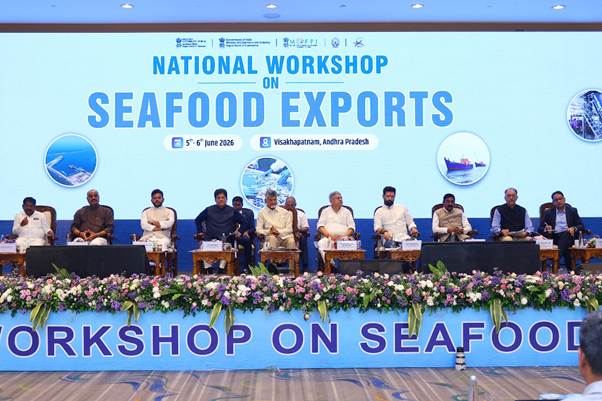
Maritime News: India has set an ambitious target of achieving USD 30 billion in seafood exports within the next five years, building on a decade of strong growth that has seen marine product exports rise by nearly 70 percent in value terms.
The roadmap was discussed during a two-day National Workshop on Seafood Exports held in Visakhapatnam, jointly organised by the Department of Commerce, Department of Fisheries and the Ministry of Food Processing Industries.
The event brought together policymakers, exporters, seafood processors, aquaculture farmers, logistics providers, researchers and industry associations to examine strategies for enhancing India’s global competitiveness in seafood trade.
Seafood Exports Reach USD 8.46 Billion
Addressing the workshop, Union Commerce and Industry Minister Piyush Goyal highlighted India’s growing role in global seafood markets.
India currently accounts for approximately 4 percent of global seafood trade, while seafood exports reached around ₹73,890 crore (USD 8.46 billion) despite challenging global market conditions.
Calling for a coordinated industry effort, Goyal urged stakeholders to focus on:
- Value-added seafood products
- Product branding
- Quality enhancement
- Sustainable production
- Diversification of export destinations
to achieve the USD 30 billion export target.
Shift from Commodity Exports to Value Addition
A key theme of the workshop was the need to increase the share of value-added seafood products such as:
- Ready-to-eat seafood
- Ready-to-cook seafood
- Processed marine products
- Premium packaged seafood
Stakeholders noted that value addition can significantly improve export earnings while reducing dependence on raw commodity exports.
Union Food Processing Industries Minister Chirag Paswan emphasised the need for the industry to move from “volume to value” and from “produce to product” to strengthen India’s global position in food exports.
Fisheries Production Doubles in a Decade
India’s fisheries sector has recorded remarkable growth over the past decade.
Union Fisheries Minister Rajiv Ranjan Singh stated that national fish production increased from 95.8 lakh tonnes in 2012-13 to nearly 198 lakh tonnes in 2024-25, reflecting the rapid expansion of aquaculture and fisheries activities.
Frozen shrimp continues to remain India’s largest seafood export product and a major contributor to foreign exchange earnings.
Government programmes such as:
- Pradhan Mantri Matsya Sampada Yojana (PMMSY)
- PM Matsya Kisan Samridhi Sah-Yojana (PMKSSY)
have played a key role in supporting infrastructure development, traceability systems, sustainable aquaculture and export-oriented fisheries growth.
Logistics and Cold Chain Identified as Critical Priorities
Industry stakeholders highlighted logistics efficiency and cold-chain infrastructure as essential elements for future export growth.
Union Civil Aviation Minister Kinjarapu Rammohan Naidu stressed the importance of strengthening air cargo infrastructure, multimodal logistics connectivity and faster cargo movement to improve India’s competitiveness in high-value seafood exports.
Participants also discussed:
- Cold-chain expansion
- Certification systems
- Traceability requirements
- Export compliance standards
- Fishmeal availability
- Disease management
- Quality seed and broodstock access
as critical challenges requiring policy support.
Free Trade Agreements Open New Markets
The workshop also focused on opportunities emerging from India’s recently concluded Free Trade Agreements covering 38 countries.
Exporters were encouraged to leverage improved market access provisions to expand seafood exports into both established and emerging markets.
Officials noted that growing global demand for sustainable seafood products presents a significant opportunity for Indian exporters, particularly if supported by stronger branding and certification frameworks.
Deep-Sea Fisheries and Blue Economy Opportunities
Experts also discussed the untapped potential of India’s Exclusive Economic Zone (EEZ), particularly around the Andaman & Nicobar Islands and Lakshadweep.
Emerging opportunities identified during the workshop included:
- Deep-sea fisheries
- Seaweed cultivation
- Ornamental fisheries
- Cold-water fisheries
- Trout farming
- Sustainable aquaculture systems
These sectors are increasingly being viewed as important pillars of India’s expanding blue economy.
Sustainability and Traceability Take Centre Stage
A recurring theme throughout the workshop was the growing importance of sustainability and traceability in global seafood trade.
Industry leaders noted that international buyers are increasingly demanding:
- Sustainable sourcing
- Traceability systems
- Environmental compliance
- Responsible aquaculture practices
Participants agreed that strengthening these capabilities would be essential for improving India’s competitiveness in premium export markets.
The workshop concluded with a shared commitment to enhance sustainability, value addition, export infrastructure, innovation and market access, while developing a long-term roadmap for positioning India among the world’s leading seafood exporting nations.