
India Digitises Border Trade: VINIMAY Platform a Smart Border Initiative that Aims to Cut Processing Time, Reduce Paperwork and Transform Land Ports into Integrated Trade Gateways
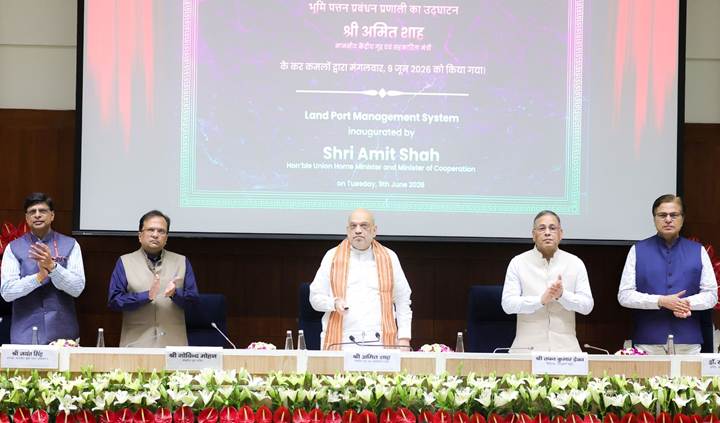
Maritime News, New Delhi: India’s land ports are undergoing a major transformation from traditional border checkpoints into digitally connected trade and logistics gateways, with the launch of the Land Port Management System (LPMS), branded as VINIMAY, by Union Home Minister Amit Shah.
The platform marks one of the most significant digital upgrades undertaken across India’s land border infrastructure and comes at a time when cross-border trade through land ports has expanded dramatically from approximately ₹5,000 crore in 2014 to ₹83,000 crore today, representing a 16-fold increase.
While the initiative is being positioned as part of India’s Smart Border strategy, its implications extend well beyond security. Industry observers believe VINIMAY has the potential to reshape cargo movement, trade facilitation and logistics efficiency across India’s international land borders.
Land Ports Emerging as Strategic Trade Gateways
For decades, discussions around border infrastructure have largely centred on security.
However, India’s land ports are increasingly becoming important economic gateways connecting the country with neighbouring markets in Bangladesh, Nepal, Bhutan, Myanmar and Pakistan.
Government data shows that trade volumes handled through land ports have expanded rapidly over the past decade, reflecting growing regional commerce and stronger economic integration.
Today, 15 land ports are operational across India, while another 11 are expected to be developed over the next two to three years.
The expansion signals a recognition that border infrastructure is no longer merely a security asset but a critical component of national logistics and trade policy.
Digital Platform Promises Faster Cargo Movement
At the heart of the reform is the VINIMAY platform, which introduces an integrated digital ecosystem for managing cargo, vehicles and passenger movement through land ports.
According to the government, the system eliminates nearly 90% of existing paperwork while introducing a Single Electronic Window for processing and approvals.
Officials estimate that truck waiting times could decline by 40% to 60%, while gate processing times may reduce by 22% to 35%.
For transport operators, exporters, importers and customs brokers, these improvements could translate into faster cargo clearance, lower logistics costs and improved supply-chain predictability.
In an economy where logistics efficiency is increasingly linked to competitiveness, even small reductions in border delays can have significant economic benefits.
Bringing Multiple Agencies onto a Single Platform
One of the most significant features of VINIMAY is its ability to integrate multiple government systems and agencies involved in border trade.
The platform enables real-time data sharing among ICEGATE, the Motor Vehicle System, Central Board of Indirect Taxes and Customs (CBIC), Border Security Force (BSF), Directorate General of Foreign Trade (DGFT), UIDAI and the Unified Logistics Interface Platform (ULIP).
The integration is expected to reduce duplication, improve transparency and strengthen coordination among agencies operating at border crossings.
For logistics operators, the move represents a step towards a more predictable and digitally enabled cargo clearance environment.
Why the Logistics Sector Should Pay Attention
The launch is particularly relevant for India’s logistics sector.
As the country pursues the goals of the National Logistics Policy and PM Gati Shakti, reducing delays at critical cargo nodes has become a priority.
Land ports increasingly handle agricultural products, manufactured goods, consumer products, industrial raw materials and cross-border containerised cargo.
More efficient border processing can help reduce transit times, lower inventory costs and improve the competitiveness of Indian exports.
For exporters operating near border regions, faster clearance and better coordination could significantly improve market access.
The Missing Piece: Physical Infrastructure Must Match Digital Ambitions
While the digital transformation has been widely welcomed, industry stakeholders caution that technology alone cannot solve all border trade challenges.
The success of VINIMAY will ultimately depend on whether physical infrastructure develops at the same pace as digital systems.
Many land ports continue to face challenges related to:
- Cargo handling capacity
- Truck parking infrastructure
- Warehousing facilities
- Customs inspection areas
- Multimodal connectivity
- Last-mile road access
Without corresponding investments in physical infrastructure, some of the efficiency gains promised by digitalisation could be difficult to fully realise.
Can Land Ports Become Multimodal Logistics Hubs?
Another question emerging from the initiative is whether India’s land ports can evolve beyond their traditional role as border checkpoints.
Globally, successful border trade zones increasingly integrate:
- Rail freight networks
- Inland container depots
- Logistics parks
- Warehousing clusters
- Export processing facilities
- Digital cargo platforms
Industry experts argue that India’s next challenge will be integrating land ports more closely with the broader logistics ecosystem, including rail corridors, inland logistics hubs and maritime gateways.
Such integration could create seamless cargo movement between land borders, industrial centres and seaports.
A New Chapter for Border Trade
The launch of VINIMAY reflects a broader shift in how India views border infrastructure.
Land ports are no longer being treated solely as security installations but as strategic economic assets that support trade, logistics, regional connectivity and border-area development.
The growth of land port trade from ₹5,000 crore to ₹83,000 crore over the past decade demonstrates the scale of this transformation.
The digital platform is therefore not merely an IT upgrade. It is part of a larger effort to prepare India’s border infrastructure for the next phase of trade growth.
Whether VINIMAY ultimately succeeds will depend on how effectively digital systems, physical infrastructure and multimodal logistics networks evolve together.
If implemented successfully, the platform could become a model for smart border management while strengthening India’s position as a more efficient and competitive trading nation.